Skip to content
You can now search across every topic, entity and event.What's new
European Energy Markets
31JUL

France chairs G7 Digital Ministerial on 29 May

3 min read
09:44UTC

France announced the G7 Digital Ministerial for Friday 29 May 2026 at Bercy in Paris under the French G7 presidency, chaired by Anne Le Hénanff with priorities on AI security, AI diffusion, minors online and digital resilience.

EconomicDeveloping
Key takeaway

The Bercy communique is the first international read of Brussels' two-speed AI enforcement calendar.

France announced that the G7 Digital Ministerial will convene on Friday 29 May 2026 at the Bercy finance ministry complex in Paris under the French G7 presidency 1. The chair is Anne Le Hénanff, France's digital affairs minister. France published the agenda priorities as AI security, AI diffusion, minors online and digital resilience.

The ministerial lands two days after the European Commission is scheduled to adopt the Tech Sovereignty Package . The communique's treatment of CAIDA and the AI Omnibus enforcement split will be the first signal of whether G7 partners endorse, contest or hedge around Brussels' two-speed enforcement calendar. Japan, the United Kingdom and the other G7 capitals operate domestic AI regulatory frameworks that do not split enforcement between domestic and foreign providers in the way the 7 May Omnibus deal does; whether the Bercy text acknowledges that asymmetry is a watchable detail.

Le Hénanff is the same official who opened Sovereign Tech Europe on 23 April and who launched the French Observatory for Digital Sovereignty on 26 January 2026. The conference's forward markers and the legislative calendar have converged on a single week. The Bercy programme runs in parallel to the United States Section 301 investigation, where the 24 July final determination sits inside the window between CAIDA adoption (27 May) and GPAI enforcement (2 August 2026); the G7 communique may signal whether the trade and regulatory tracks coordinate or diverge through that window.


Deep Analysis

In plain English

The G7 is a group of seven wealthy democracies (France, Germany, Italy, Japan, Canada, the US, and the UK, plus the EU). Each year, one country chairs the group and sets the agenda for meetings, including a Digital Ministerial on technology policy. France is chairing in 2026 and has scheduled a digital meeting in Paris on 29 May, two days after the EU plans to pass its Tech Sovereignty Package. France's minister for AI, Anne Le Hénanff, will chair the session. The timing is deliberate: France wants the G7 to endorse EU-style AI governance norms before the US and UK push back formally on the new cloud and AI laws.

What could happen next?
  • Consequence

    A G7 communique endorsing 'trusted cloud infrastructure' language will be cited by member-state procurement authorities as international validation of CAIDA-style national-security carve-outs for public cloud contracts.

    Immediate · 0.65
  • Risk

    US pushback on CAIDA's cloud restrictions at the ministerial, if made public, would arrive simultaneously with the USTR Section 301 determination (ID:3073), creating a dual-track diplomatic and trade-law confrontation in a single week.

    Immediate · 0.55
  • Precedent

    The Bercy ministerial's treatment of AI diffusion will establish whether G7 agreement on AI distribution norms — covering open versus closed models — is achievable before the GPAI enforcement date in August 2026.

    Short term · 0.6
First Reported In

Update #5 · Brussels' 27 May package, two days before G7

Ministère de l'Économie, des Finances et de la Souveraineté industrielle et numérique· 17 May 2026
Read original
Causes and effects
This Event
France chairs G7 Digital Ministerial on 29 May
The ministerial lands two days after Brussels adopts the Tech Sovereignty Package, making the communique the first test of G7 partner reaction.
Different Perspectives
Spain's LNG terminal operators
Spain's 9,145 GWh terminal inventory is the largest single stock in the EU LNG network, an option value that can reroute cargoes wherever the winter strip pays best rather than a cavern gas obligation tied to a fixed date. That flexibility matters more as Germany's cavern shortfall pushes more of the winter security question onto import infrastructure.
European Commission
European Commission
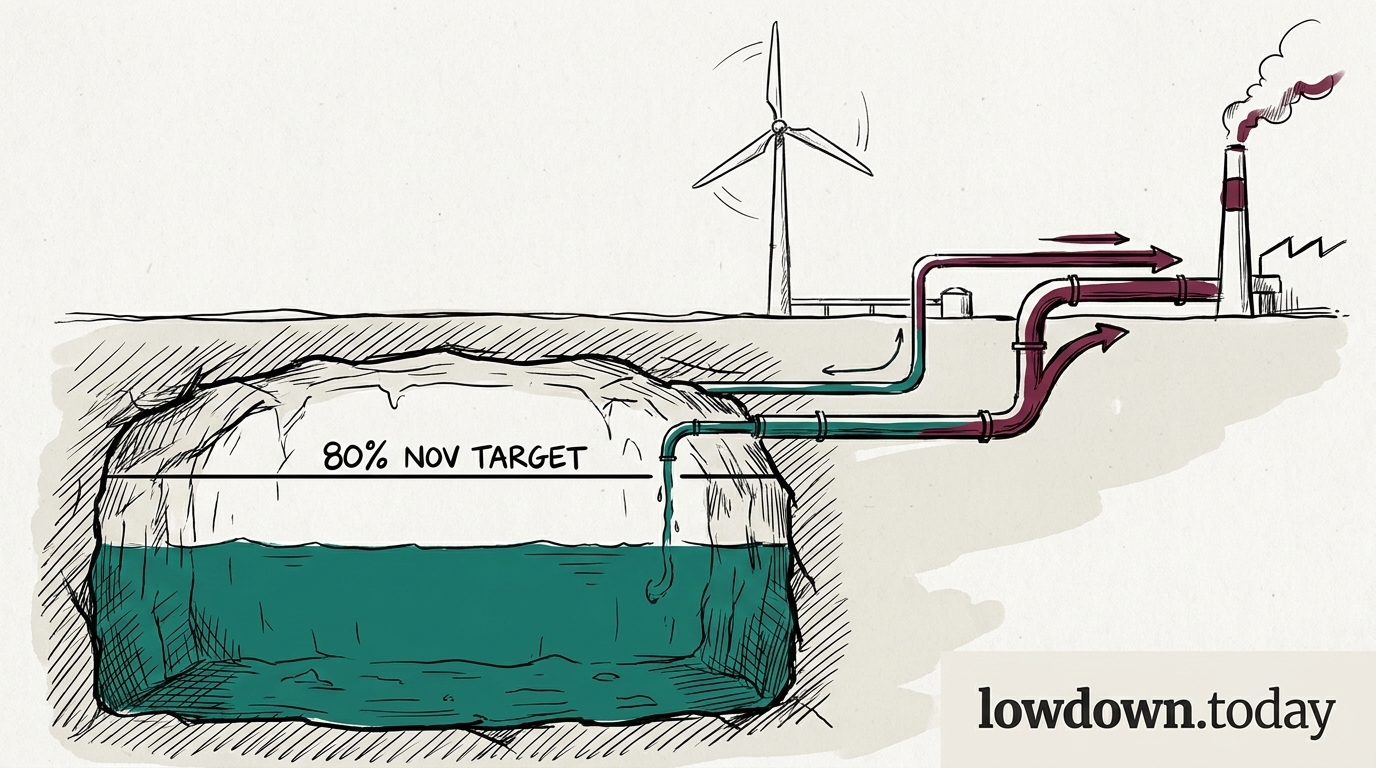
Brussels holds the bloc to 90% on a flexible window while Germany, holding roughly a quarter of EU storage capacity, tracks toward missing its own lower 80% figure by 21 points. A national shortfall this size in the anchor market matters more to bloc security than the flexible timetable alone can absorb.
French power exporters and CRE
French day-ahead rose in step with Germany but by less, reopening a EUR 7-17 premium that makes northward export flows commercially attractive again after the EUR 43.09 discount evaporated in days. CRE separately authorised RTE and Enedis to buy flexibility locally, betting the coming winter's binding constraint is grid congestion rather than a shortage of firm capacity.
TTF trading desk
TTF trading desk
A visible national shortfall like Germany's 21-point gap is a directional signal, not noise, for a desk holding the summer-winter spread. TTF's flat EUR 58-60 range through this week's German price swings says the market has not yet chosen to reprice refill risk into the front of the curve.
German cavern and CCGT operators
German caverns kept buying prompt gas at TTF near EUR 58-60 through the inversion; the wind collapse to 2.4 GW then flipped the spark spread to plus EUR 29 and put turbines back in the same queue. Every day turbines win that bid, injection at a third of the 877 GWh/day pace needed falls further behind.
Slovakia
Slovakia
Slovakia says it dropped its hold-out on the 21st sanctions package only after Ursula von der Leyen personally signed written gas-price and supply guarantees. The Council of the European Union's own 17,238-character release on the package names neither Slovakia nor any guarantee, leaving Bratislava's account unconfirmed by the institutional record.



