Skip to content
You can now search across every topic, entity and event.What's new
European Energy Markets
31JUL

Brussels fines Apple, Meta, and X €820m

3 min read
09:44UTC

The European Commission imposed its largest batch of platform fines under the DMA and DSA, totalling €820m across three US tech companies.

EconomicDeveloping
Key takeaway

The EU's first major DMA and DSA fines total €820m and confirm Brussels will use financial enforcement.

The European Commission fined Apple €500m for preventing developers from communicating freely with consumers, and Meta €200m for its pay-or-consent advertising model, under the Digital Markets Act 1. Separately, X (formerly Twitter) received a €120m fine under the Digital Services Act for deceptive verification practices, opaque advertising, and blocking researcher data access 2. The cumulative total: €820m.

The Apple fine targeted the company's App Store anti-steering rules, which prevented app developers from telling users about cheaper purchasing options outside the App Store. Meta's fine addressed a consent mechanism that forced European users to either pay for an ad-free experience or accept personalised tracking. Both cases concerned practices the companies had argued were compliant with the DMA's requirements.

The fines are large but survivable for companies of this scale. Apple's annual revenue exceeds $380bn. The enforcement significance is procedural: these are the first substantial DMA penalties, and they confirm that The Commission will use financial sanctions rather than relying on compliance deadlines and dialogue. The potential fine exposure across all designated gatekeepers exceeds €100bn if The Commission calculates penalties at the maximum 10% of global turnover. That ceiling gives Brussels considerable leverage in ongoing and future investigations.


Deep Analysis

In plain English

The European Union has two major laws that regulate large technology companies: the Digital Markets Act (DMA) targets the biggest digital platforms; the tech 'gatekeepers'; and requires them to give users and businesses more choice and fairness. The Digital Services Act (DSA) targets harmful or deceptive content and practices on platforms. In early 2026, the European Commission fined Apple €500 million under the DMA for preventing app developers from telling their customers about better deals available outside Apple's own App Store. Apple controls the iPhone's entire app distribution system, and the EC found that Apple was using that control to charge developers up to 30% commission while blocking them from directing customers elsewhere. Meta received a €200 million fine for its 'pay or consent' advertising model; which forced users to either pay a subscription fee or agree to targeted advertising. X (formerly Twitter) was fined €120 million for its blue checkmark verification system, which critics said misled users about who was trustworthy, and for blocking researchers from accessing public data.

Deep Analysis
Root Causes

The DMA's gatekeeper designation framework creates a structural asymmetry: the six designated gatekeepers (Alphabet, Amazon, Apple, ByteDance, Meta, Microsoft) are all US or Chinese companies. No European company meets the thresholds ($75bn market capitalisation, 10,000 active business users, 45m active end users in the EU).

This is not a design flaw; it reflects the actual distribution of digital market power; but it means DMA enforcement will exclusively target non-European entities indefinitely, creating the trade friction the US Section 301 investigation is designed to address.

X's €120m DSA fine is structurally different: it targets deceptive practices (the blue checkmark verification system that previously distinguished public figures from ordinary accounts) and researcher data access. The DSA applies a broader set of platforms, including Twitter/X, YouTube, and other large online platforms with more than 45m EU users. The €120m figure reflects DSA's lower fine ceiling relative to DMA.

What could happen next?
  • Consequence

    The Apple fine scale signals DMA enforcement has crossed the threshold where gatekeeper compliance is more economically rational than continued litigation, likely accelerating Apple's implementation of DMA interoperability requirements.

    Short term · 0.75
  • Risk

    The US Section 301 investigation framing DMA enforcement as 'economic warfare' raises the risk of tariff or trade retaliation that pressures the Commission to moderate enforcement intensity.

    Medium term · 0.6
  • Opportunity

    DMA cloud interoperability mandates, if upheld after gatekeeper legal challenges, create structural switching cost reductions that benefit European cloud providers disproportionately.

    Long term · 0.65
First Reported In

Update #1 · Europe's chip ambitions meet reality

CNBC· 13 Apr 2026
Read original
Different Perspectives
Spain's LNG terminal operators
Spain's 9,145 GWh terminal inventory is the largest single stock in the EU LNG network, an option value that can reroute cargoes wherever the winter strip pays best rather than a cavern gas obligation tied to a fixed date. That flexibility matters more as Germany's cavern shortfall pushes more of the winter security question onto import infrastructure.
European Commission
European Commission
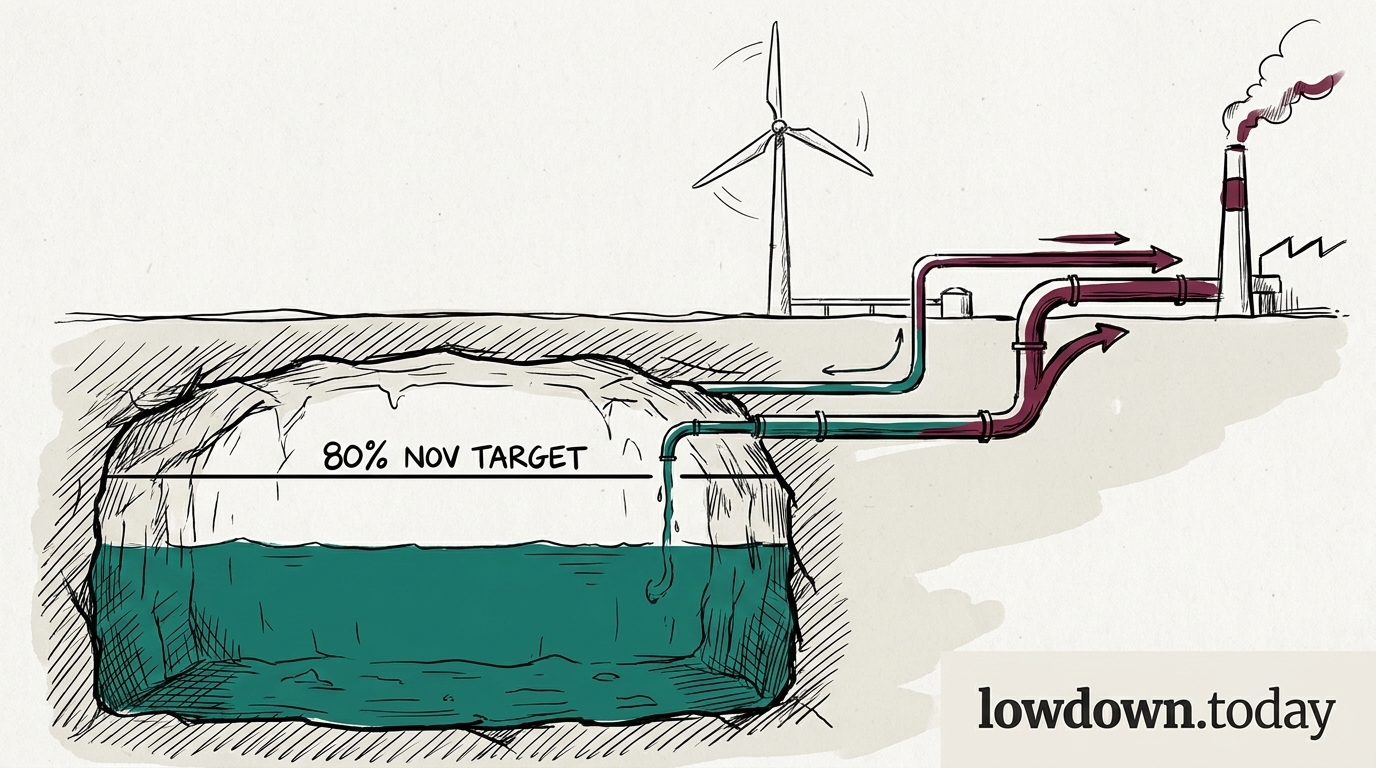
Brussels holds the bloc to 90% on a flexible window while Germany, holding roughly a quarter of EU storage capacity, tracks toward missing its own lower 80% figure by 21 points. A national shortfall this size in the anchor market matters more to bloc security than the flexible timetable alone can absorb.
French power exporters and CRE
French day-ahead rose in step with Germany but by less, reopening a EUR 7-17 premium that makes northward export flows commercially attractive again after the EUR 43.09 discount evaporated in days. CRE separately authorised RTE and Enedis to buy flexibility locally, betting the coming winter's binding constraint is grid congestion rather than a shortage of firm capacity.
TTF trading desk
TTF trading desk
A visible national shortfall like Germany's 21-point gap is a directional signal, not noise, for a desk holding the summer-winter spread. TTF's flat EUR 58-60 range through this week's German price swings says the market has not yet chosen to reprice refill risk into the front of the curve.
German cavern and CCGT operators
German caverns kept buying prompt gas at TTF near EUR 58-60 through the inversion; the wind collapse to 2.4 GW then flipped the spark spread to plus EUR 29 and put turbines back in the same queue. Every day turbines win that bid, injection at a third of the 877 GWh/day pace needed falls further behind.
Slovakia
Slovakia
Slovakia says it dropped its hold-out on the 21st sanctions package only after Ursula von der Leyen personally signed written gas-price and supply guarantees. The Council of the European Union's own 17,238-character release on the package names neither Slovakia nor any guarantee, leaving Bratislava's account unconfirmed by the institutional record.



