Skip to content
You can now search across every topic, entity and event.What's new
European Energy Markets
31JUL

Abu Dhabi Round 2 deadlocks on borders

3 min read
09:44UTC

Negotiators agreed on how to monitor a ceasefire. They cannot agree on where to draw one.

EconomicDeveloping
Key takeaway

Abu Dhabi replicates Minsk II's fatal architecture: monitoring mechanics agreed, territorial status unresolved.

Abu Dhabi Round 2, held in February 2026, achieved progress on ceasefire monitoring mechanics — the procedural framework for how a truce would be observed and verified 1. It deadlocked on the question that has defeated every negotiation since the war's first year: who controls Donetsk, Luhansk, Zaporizhzhia, and Kherson.

Three sticking points remain. Russia demands formal cession of the four oblasts — territory it partially occupies but does not fully control. Ukraine refuses any cession. On security guarantees, Zelenskyy stated the US guarantee text is "essentially ready," but the guarantor structure — who commits, to what, and with what enforcement — is unresolved 2. On monitoring, negotiators reached near-consensus on mechanics but cannot agree on who deploys the monitors, a question that encodes deeper disagreements about whose authority any future peacekeeping presence would represent.

The pattern extends across four years. Istanbul's March 2022 communiqué — proposing Ukrainian neutrality for security guarantees from permanent Security Council members — collapsed after the Bucha killings and both sides' belief they could gain more by fighting. Jeddah in August 2023 drew dozens of states but excluded Russia. Bürgenstock in June 2024 produced a communiqué Moscow dismissed. Abu Dhabi benefits from direct bilateral engagement and Gulf-state mediation, but confronts the same structural impasse: neither side's minimum territorial position is compatible with the other's.

Samuel Charap of the RAND Corporation has argued that ceasefire mechanics can be designed independently of final territorial status, allowing a freeze at current lines without formal cession. That approach would require both belligerents to accept an indefinite pause at present positions — a concession neither has signalled willingness to make. Bloomberg reported on 28 February that Russia is now weighing a full suspension of talks unless Ukraine pre-commits to ceding all four oblasts 3, which would render the monitoring progress moot before it can be tested.


Deep Analysis

In plain English

The Abu Dhabi talks are making progress on administrative details of a ceasefire — who watches the frontline, how violations are reported — but completely stuck on the fundamental question of whose land it is. This mirrors the Minsk agreements of 2014–15, which also agreed on monitoring mechanics while leaving territory unresolved. Those agreements lasted eight years on paper before collapsing. The deeper structural problem: no organisation exists that both Russia and Ukraine would trust to actually monitor a ceasefire. The UN requires Russia's approval in the Security Council — a veto Russia would use. The EU is regarded as biased by Moscow. The OSCE was effectively expelled from Russian-controlled areas and cannot return. Agreeing on monitoring procedures without agreeing on who conducts them is an agreement that cannot be implemented.

Deep Analysis
Synthesis

The three sticking points carry a hidden hierarchy not visible in the body's co-equal listing. Territory is the declared impasse; security guarantees are the US-managed deliverable; but monitoring deployment is the structural impossibility — no institution exists that both parties would accept. A territorial agreement could be reached and still fail at the monitoring stage. Treating the three points as parallel obstacles obscures that monitoring is the binding constraint which territorial agreement cannot automatically resolve.

Root Causes

The monitoring deployment deadlock reflects an institutional gap that predates Abu Dhabi and is not resolvable through negotiation alone. The OSCE SMM was systematically obstructed in Russian-controlled areas throughout its operational period and has since been expelled. UN peacekeeping requires Security Council authorisation — subject to Russian veto. An EU monitoring force is politically unacceptable to Moscow. This is a structural failure in European security architecture, not a solvable negotiating point that better wording can bridge.

Escalation

Progress on monitoring mechanics without territorial agreement creates a strategic incentive for both sides to improve their battlefield position before any ceasefire locks in current lines. Ukraine's February gains increase Kyiv's incentive to fight for more ground; Russia's economic pressure increases Moscow's incentive to freeze current holdings quickly. Both incentives point toward continued or intensified combat in the near term, regardless of the diplomatic process running in parallel.

What could happen next?
  • Risk

    Without a credible monitoring institution, any ceasefire agreed at Abu Dhabi risks replicating Minsk II's pattern of nominal compliance masking continuous violation.

    Medium term · Assessed
  • Consequence

    Territorial deadlock freezes the utility of the EU's €90bn reconstruction loan, as lenders cannot commit to contested-oblast infrastructure without border clarity.

    Short term · Assessed
  • Opportunity

    A formalised US security guarantee, even without territorial settlement, could unlock private reconstruction capital by providing a risk floor that current ambiguity forecloses.

    Short term · Suggested
  • Risk

    The monitoring deployment gap — no credible neutral institution exists — could become the technical mechanism by which a territorial agreement fails to translate into a durable ceasefire.

    Medium term · Assessed
First Reported In

Update #1 · Ukraine best month as Russia triples drones

Bloomberg· 3 Mar 2026
Read original
Different Perspectives
Spain's LNG terminal operators
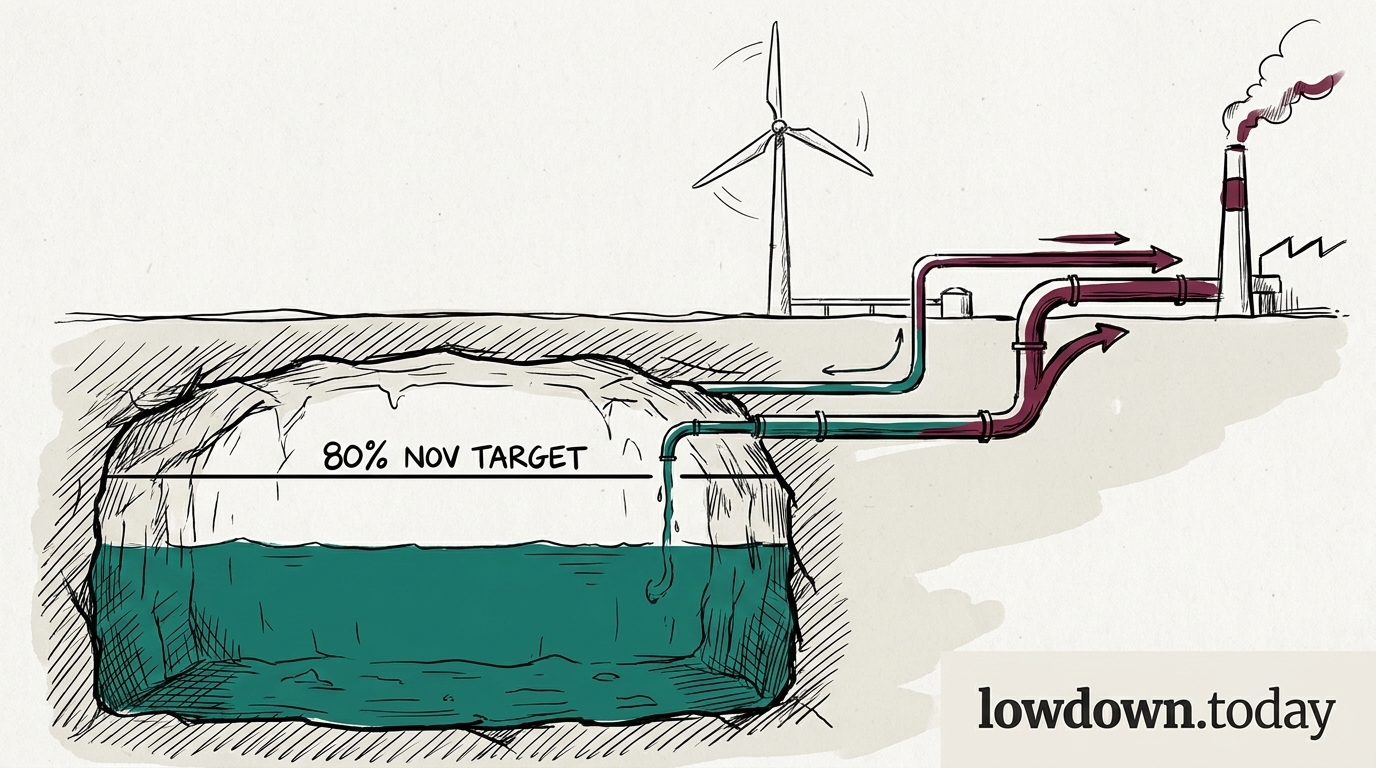
Spain's 9,145 GWh terminal inventory is the largest single stock in the EU LNG network, an option value that can reroute cargoes wherever the winter strip pays best rather than a cavern gas obligation tied to a fixed date. That flexibility matters more as Germany's cavern shortfall pushes more of the winter security question onto import infrastructure.
European Commission
European Commission
Brussels holds the bloc to 90% on a flexible window while Germany, holding roughly a quarter of EU storage capacity, tracks toward missing its own lower 80% figure by 21 points. A national shortfall this size in the anchor market matters more to bloc security than the flexible timetable alone can absorb.
French power exporters and CRE
French day-ahead rose in step with Germany but by less, reopening a EUR 7-17 premium that makes northward export flows commercially attractive again after the EUR 43.09 discount evaporated in days. CRE separately authorised RTE and Enedis to buy flexibility locally, betting the coming winter's binding constraint is grid congestion rather than a shortage of firm capacity.
TTF trading desk
TTF trading desk
A visible national shortfall like Germany's 21-point gap is a directional signal, not noise, for a desk holding the summer-winter spread. TTF's flat EUR 58-60 range through this week's German price swings says the market has not yet chosen to reprice refill risk into the front of the curve.
German cavern and CCGT operators
German caverns kept buying prompt gas at TTF near EUR 58-60 through the inversion; the wind collapse to 2.4 GW then flipped the spark spread to plus EUR 29 and put turbines back in the same queue. Every day turbines win that bid, injection at a third of the 877 GWh/day pace needed falls further behind.
Slovakia
Slovakia
Slovakia says it dropped its hold-out on the 21st sanctions package only after Ursula von der Leyen personally signed written gas-price and supply guarantees. The Council of the European Union's own 17,238-character release on the package names neither Slovakia nor any guarantee, leaving Bratislava's account unconfirmed by the institutional record.



