Skip to content
You can now search across every topic, entity and event.What's new
European Energy Markets
31JUL

Abu Dhabi Gas Facility Ablaze After Intercept Debris Strike

3 min read
09:44UTC

Debris from an intercepted projectile set Abu Dhabi's Habshan gas facility alight on 3 April. Cumulative UAE intercepts have now reached 457 ballistic missiles and 2,038 UAVs, with 19 ballistic missiles and 26 UAVs intercepted in two days alone.

EconomicDeveloping
Key takeaway

Habshan's fire from intercept debris shows UAE defences cannot fully prevent secondary damage even when missiles are stopped.

Abu Dhabi's Habshan gas processing facility caught fire on 3 April from debris of an intercepted projectile, according to UAE WAM. The strike was intercepted; the fire was not. The distinction between a direct hit and intercept debris has become operationally significant as the attack tempo increases.

The UAE Ministry of Defence's cumulative intercept totals now stand at 457 ballistic missiles, 2,038 UAVs, and 19 cruise missiles, up from 438 ballistic missiles and 2,012 UAVs as recently as Day 34 . Nineteen ballistic missiles and 26 UAVs were intercepted in two days alone. CENTCOM has described Iranian strike capability as 'dramatically curtailed.' The intercept data does not support that characterisation.

Habshan processes gas from the Rub al-Khali basin and feeds downstream UAE energy infrastructure. A fire at the facility, even from debris rather than a direct hit, affects processing capacity. The ADNOC bypass pipeline running from Abu Dhabi to Fujairah reached 71% utilisation as of Day 34 , meaning available redundancy is already constrained.

A Bangladeshi farm worker was killed by UAE air defence shrapnel in Fujairah on 1 April . The Habshan fire follows the same lethal-debris pattern. The UAE's missile defence system is performing its function; the secondary effects of that function are accumulating across the country's civilian and energy infrastructure.


Deep Analysis

In plain English

Iran is charging ships $1 for every barrel of oil they carry through the Strait of Hormuz, and it is now a law rather than just a wartime demand. Ships that refuse can go around Africa, adding weeks and significant cost to the journey. Some countries have already negotiated exemptions; everyone else pays.

Deep Analysis
Root Causes

The toll emerged from the IRGC's need to fund ongoing operations while Iran's oil export revenues are under maximum pressure sanctions. At $1/barrel with 16 transits, daily revenue is modest, but codification in law signals this is designed to outlast the conflict as a permanent Iranian revenue stream.

The stablecoin and yuan denomination reflects Iran's broader strategy of decoupling from dollar-denominated financial infrastructure, which has been in development since the reimposition of JCPOA sanctions in 2018.

Escalation

Stabilising in a narrow sense — codification reduces the unpredictability of the toll system by setting a clear price. But the legal permanence is escalatory in terms of the long-term structural conflict: the US cannot accept Iranian toll authority over an international strait without a formal legal and diplomatic challenge.

What could happen next?
  • Precedent

    Codifying the toll in Iranian law creates a permanent legal basis that will survive any ceasefire, requiring a specific diplomatic instrument to reverse.

    Long term · High
  • Risk

    OFAC action against the specific stablecoins used for toll collection would create a financial enforcement confrontation with stablecoin issuers operating in US-adjacent jurisdictions.

    Short term · Medium
  • Consequence

    Asian LNG importers face permanent Hormuz premium pricing regardless of conflict resolution; the structural cost is now baked into the market.

    Medium term · High
First Reported In

Update #57 · Bridge strike kills eight; Army chief fired

UAE WAM / Ministry of Defence· 3 Apr 2026
Read original
Causes and effects
This Event
Abu Dhabi Gas Facility Ablaze After Intercept Debris Strike
Habshan is a critical node in the UAE's gas processing infrastructure. The fire from intercept debris, not a direct strike, shows that a successful air defence system can still generate significant secondary damage on the ground.
Different Perspectives
Spain's LNG terminal operators
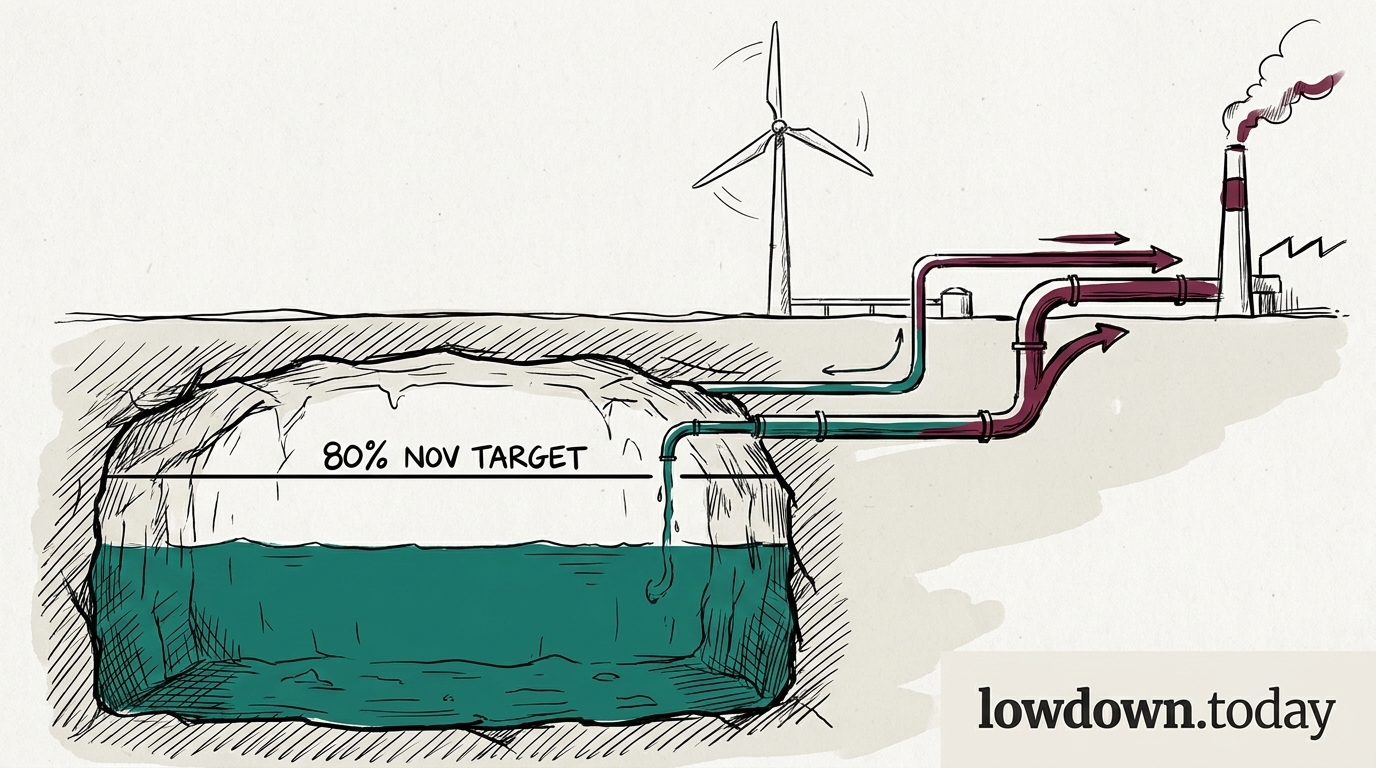
Spain's 9,145 GWh terminal inventory is the largest single stock in the EU LNG network, an option value that can reroute cargoes wherever the winter strip pays best rather than a cavern gas obligation tied to a fixed date. That flexibility matters more as Germany's cavern shortfall pushes more of the winter security question onto import infrastructure.
European Commission
European Commission
Brussels holds the bloc to 90% on a flexible window while Germany, holding roughly a quarter of EU storage capacity, tracks toward missing its own lower 80% figure by 21 points. A national shortfall this size in the anchor market matters more to bloc security than the flexible timetable alone can absorb.
French power exporters and CRE
French day-ahead rose in step with Germany but by less, reopening a EUR 7-17 premium that makes northward export flows commercially attractive again after the EUR 43.09 discount evaporated in days. CRE separately authorised RTE and Enedis to buy flexibility locally, betting the coming winter's binding constraint is grid congestion rather than a shortage of firm capacity.
TTF trading desk
TTF trading desk
A visible national shortfall like Germany's 21-point gap is a directional signal, not noise, for a desk holding the summer-winter spread. TTF's flat EUR 58-60 range through this week's German price swings says the market has not yet chosen to reprice refill risk into the front of the curve.
German cavern and CCGT operators
German caverns kept buying prompt gas at TTF near EUR 58-60 through the inversion; the wind collapse to 2.4 GW then flipped the spark spread to plus EUR 29 and put turbines back in the same queue. Every day turbines win that bid, injection at a third of the 877 GWh/day pace needed falls further behind.
Slovakia
Slovakia
Slovakia says it dropped its hold-out on the 21st sanctions package only after Ursula von der Leyen personally signed written gas-price and supply guarantees. The Council of the European Union's own 17,238-character release on the package names neither Slovakia nor any guarantee, leaving Bratislava's account unconfirmed by the institutional record.



