Skip to content
Welcome, thoughtbot's Giant Robots listeners!Start here
European Energy Markets
23JUL

ASML says it cannot meet 2027-28 demand

3 min read
19:31UTC

ASML sold 113 lithography systems in the third quarter on record sales of €11.66bn, and its chief executive warned that planned supply will fall short in 2027 and 2028.

EconomicDeveloping
Key takeaway

ASML's lithography output is sold out through 2028, and allocation rests with ASML and licensing states.

ASML, the Dutch company that alone makes the machines that print the most advanced chips, reported record third-quarter net sales of €11.66bn on 14 October⁠1. It sold 113 new lithography (chip-printing) systems, up from 86 in the second quarter, and narrowed full-year guidance to €44-45bn from the €43-45bn range it set in July.

Chief executive Christophe Fouquet said ASML now expects "that our supply as currently planned for both 2027 and 2028 will not fully meet the demand of our customers"⁠2. The company plans about 30% more capacity in 2027 for its standard extreme ultraviolet (EUV) machines, which the most advanced chips need, and its older deep ultraviolet (DUV) immersion machines. For 2028 it is studying capacity beyond that increase, and some customers want to book for 2029 and 2030. The squeeze arrives a month after ASML and Intel Foundry moved the next-generation High-NA EUV tools into volume production.

China took 23% of system sales in the quarter, up from 14%, according to the South China Morning Post, which put ASML's system sales to China up 109% on the quarter as memory makers stockpiled⁠3. ASML's own release mentions export controls only in its standard risk factors.

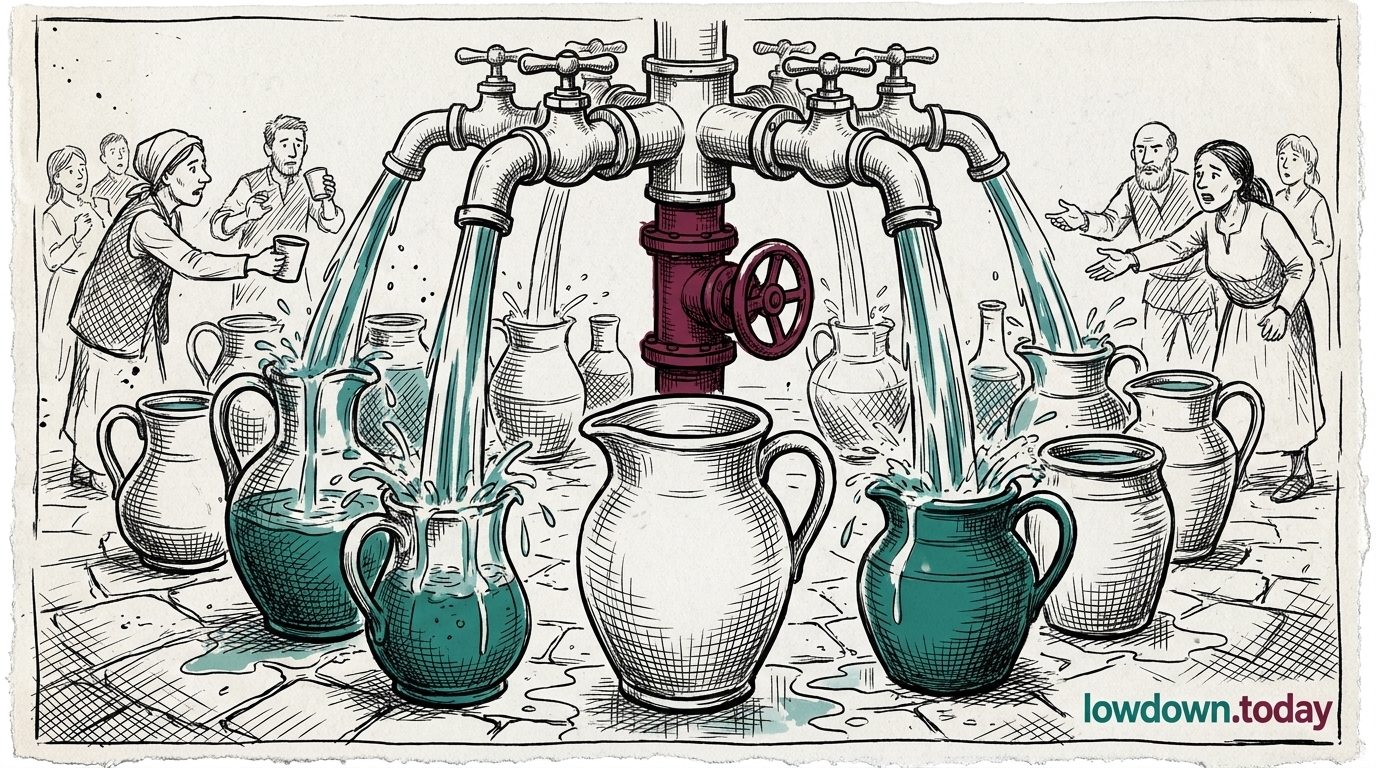
With output booked out two years ahead, the choice of which customers get the 2027 tools, and in which countries, rests with ASML under Dutch and US export licensing. No EU institution has a hand in that allocation.


Deep Analysis

In plain English

ASML is a Dutch company. It is the only firm in the world that makes the machines used to print the most advanced computer chips, using a kind of light called extreme ultraviolet (EUV). Every large chipmaker, from Taiwan to the US to China, buys from it. ASML has now said it will not be able to build enough machines to meet orders in 2027 and 2028. That matters because chips sit inside phones, cars and AI systems. If the machines are scarce, the factories that make chips cannot grow as fast as buyers want.

Deep Analysis
Root Causes

ASML's capacity cannot rise quickly because each EUV machine depends on a narrow chain of sub-suppliers, from optics to light sources, that took decades to build. A 30% step in one year is close to the limit of what that chain can absorb.

Demand is being pulled forward by two forces at once: AI data-centre chips need the newest nodes, and Chinese buyers are ordering older DUV tools before any further controls bite.

The guidance range narrowed rather than rose because supply, not orders, now sets ASML's revenue ceiling.

What could happen next?
  • Consequence

    New European fabs that have not yet booked ASML tools may face delays to 2028 or later.

    Medium term · Suggested
  • Risk

    A higher China share could renew US pressure on The Hague to widen servicing and sales limits.

    Short term · Suggested
  • Opportunity

    ASML's sub-suppliers in the Netherlands and Germany stand to gain from the planned 2027 capacity increase.

    Medium term · Assessed
First Reported In

Update #17 · EU questions AI labs over loss of control

ASML· 22 Oct 2026
Read original →
Causes and effects
This Event
ASML says it cannot meet 2027-28 demand
Europe's only chokepoint supplier in chipmaking is booked out two years ahead, and the allocation of its machines sits outside any EU institution's control.
Different Perspectives
Cross-border power traders
The France-Germany day-ahead spread flipped from a EUR 17.20 German premium on 1 August to a EUR 4.15 French premium on 3 August, the same day French curtailment peaked. They cannot yet attribute the flip to curtailment alone, since a like-for-like overnight comparison shows French nuclear output rising while wind fell and demand returned on the weekday step.
EDF
EDF
River-cooling limits took 7.6 GW, 12 per cent of its fleet, offline on 3 August, the highest curtailment since the heatwave began, with an easing forecast to 4.3 GW on 4 August and 3 GW after. It manages the cut as a recurring seasonal constraint, expecting it to lift with river temperature, not repair.
Gasunie
Gasunie
TTF, the Dutch hub it operates, drifted to roughly EUR 55 to 58 per MWh across the window, staying inside its recent range through both the German spark reversal and the French curtailment. It reads a flat hub price as evidence that neither event this window carried enough weight to move the fuel leg on its own.
German gas-fired generators
Record German solar of 18,761 MW on 2 August pushed the clean spark spread to minus 18.48 EUR/MWh, a loss-making day, before it returned to plus 16.20 on 3 August. They now price dispatch against post-solar residual load rather than wind alone, since the sign flipped inside 48 hours on unchanged fuel and carbon costs.
European Commission (DG Energy)
Its implementing-measures register logged transposition notices from only Portugal and Slovakia against Wednesday's Article 94 deadline for Directive (EU) 2024/1788, with 25 states silent. It expects the register to fill only gradually, since filing routinely lags legislating and any infringement track against non-notifying states runs on a slower clock than the deadline itself.
Spain's LNG terminal operators
Spain's 9,145 GWh terminal inventory is the largest single stock in the EU LNG network, an option value that can reroute cargoes wherever the winter strip pays best rather than a cavern gas obligation tied to a fixed date. That flexibility matters more as Germany's cavern shortfall pushes more of the winter security question onto import infrastructure.

Written with AI from Lowdown's published reporting. Not individually reviewed by an editor. Editorial standards.
