Skip to content
You can now search across every topic, entity and event.What's new
European Energy Markets
16JUL

TTF closes above EUR 50 on Iran re-rate

4 min read
09:48UTC

TTF settled EUR 50.83/MWh on Monday, its first clean close above EUR 50 since a US-Iran deal headline erased 8.1% on 26 May. The driver was re-priced Gulf LNG risk, not a European supply change.

EconomicDeveloping
Key takeaway

The EUR 50 level Lowdown called a ceiling is now a floor under test, nine days before the ban binds.

Dutch TTF settled EUR 50.83/MWh on Monday 8 June, up 4.82% on the day with an intraday print at EUR 51.2, the first clean close above EUR 50 since a US-Iran deal headline erased 8.1% in a single 26 May session 1. TTF is the Title Transfer Facility, the Dutch virtual hub that sets Europe's benchmark wholesale gas price and the reference leg for LNG arbitrage. The driver was a fresh re-pricing of Iran-Israel risk to Gulf LNG flows, not any change in European physical supply, and that distinction is the whole story for a prompt desk.

The front-month had tracked EUR 48.40 to 49.2 across 4 to 5 June before Monday's surge, so a single session moved the curve enough to reopen Bruegel's EUR 35bn refill-cost scenario from the EUR 26bn base case. TTF first broke EUR 50 on 18 May , then retraced as the diplomatic optimism that capped it returned . The level Lowdown has called a diplomatic ceiling across four updates has now flipped to a contested floor.

The re-rate matters because it lands nine days before a physical Russian pipeline step-down on 17 June, with no legal block confirmed. The curve is rebuilding a geopolitical premium it stripped out a fortnight ago, and it is doing so into a binary supply event rather than away from one. Exogenous risk-on meeting an endogenous supply cliff inside the same fortnight removes the mean-reversion comfort that a diplomatic de-escalation could cap the move.


Deep Analysis

In plain English

European gas is priced at a trading hub called TTF in the Netherlands, and that price affects bills across the continent. On Monday 8 June it crossed EUR 50 per megawatt-hour for the first time in almost two weeks. Traders pushed the price up because of Middle East tension, not a physical shortage. A lot of the gas Europe imports as liquefied natural gas (LNG, super-cooled gas shipped on tankers) travels from Qatar and the UAE through the Strait of Hormuz. Iran and Israel have been in conflict, and traders worry that worsening tension could disrupt those tanker routes. In late May a peace rumour pushed the price back down in one session. Now the price is climbing again, with a separate Russian pipeline supply cut arriving in nine days. Iran risk and Russian pipeline risk landing in the same fortnight keeps buyers bidding above EUR 50.

Deep Analysis
Root Causes

The EUR 50 break on 8 June has three separable causes.

First, the Iran-LNG route risk: the Strait of Hormuz carries Qatari and UAE cargoes that together represent more than 2 bcm/week of supply the European balance counted on post-March. Any credible escalation signal re-prices that dependency.

Second, the absence of a physical backstop: Hammerfest LNG is offline with a 10 July base-case return, and Troll A's compressor outage resolved only on 31 May. Norwegian send-out is no longer the unconstrained buffer it was in early 2025, which means Asia can pull flexible Atlantic cargoes east without a European counter-bid.

Third, the storage inventory deficit: at 22.9 percentage points below the five-year seasonal norm, European buyers are structurally short of comfortable reserve headroom, so geopolitical risk-off bids arrive into a physically thin market. The combination produces oversized moves per unit of news.

What could happen next?
  • Consequence

    Bruegel's EUR 35bn EU refill-cost scenario, rather than the EUR 26bn base case, becomes the operative planning figure if TTF holds above EUR 50 through July.

    Short term · Assessed
  • Risk

    A second diplomatic fade, similar to 26 May, would confirm EUR 50 as a contested rather than firm floor, reinforcing the pattern of headline-driven spikes that do not build into a new clearing level.

    Immediate · Assessed
  • Opportunity

    At EUR 50-plus, the summer-winter strip inversion narrows enough that commercial storage operators near continental LNG entry points face a viable booking window for the first time since January.

    Immediate · Assessed
First Reported In

Update #16 · TTF closes above EUR 50 on Iran risk re-rate

Trading Economics· 8 Jun 2026
Read original
Causes and effects
This Event
TTF closes above EUR 50 on Iran re-rate
The level Lowdown called a six-week diplomatic ceiling has flipped to a contested floor, nine days before the 17 June Russian pipeline step-down.
Different Perspectives
LNG spreads desk
LNG spreads desk
The JKM-TTF arb flipped to a TTF premium of roughly USD 0.6/MMBtu on 15 July, the first time this cycle Europe has outbid Asia, yet no Atlantic cargo has rerouted west. Until a cargo actually moves, the desk reads the Hormuz premium as unconfirmed and the EUR 55 print as vulnerable to a fast reversal.
United States
United States
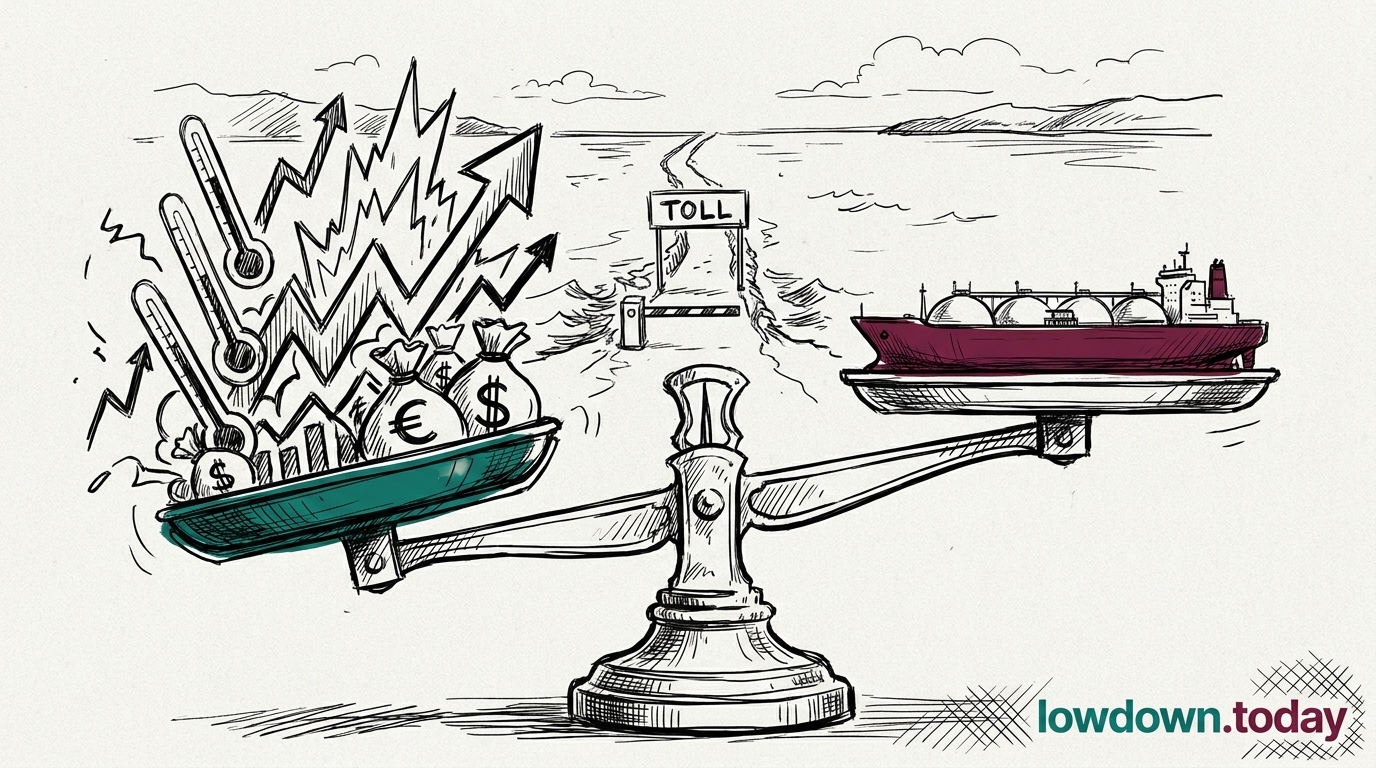
Washington reimposed a blockade on Iranian ports and a 20% Strait of Hormuz cargo toll on 13 July, driving TTF's 9% two-session rally to EUR 54.995/MWh. The posture is again setting Europe's gas benchmark by sentiment rather than by any confirmed change in cargo flows.
EDF
EDF
EDF slipped the Bugey 3, Golfech 2 and Chooz 2 restarts to 19, 22 and 25 July, pushing all three past the 20 July Bugey heat exemption, after river-cooling limits on the Rhone, Garonne and Meuse forced the cuts. The same thermal ceiling has capped the fleet in every major heatwave since 2003, and this cycle is no exception.
German power desk
German power desk
German day-ahead power climbed from EUR 126 to EUR 156/MWh over 14-16 July as the heat dome held, flipping the clean spark spread positive for the first time since 14 July. Gas-for-power demand is now back in competition with mandate storage injection right as the injection margin itself is thinning.
EU carbon and storage regulators
EUA carbon broke EUR 81/tonne on 13 July as the ETS Market Stability Reserve's scheduled withdrawals met fresh fuel-switching demand from France's nuclear curtailment. Brussels' mandatory storage-fill rule kept German and French injection running regardless of the TTF swings, the mechanism working as designed four years after the 2022 shock.
Equinor
Equinor
Equinor returned its Asgard field from maintenance on 11 July, lifting Gassco's exit nominations to 319.8 mcm/day just as TTF round-tripped on Hormuz risk. The restart gave Norway spare pipeline capacity to help Europe absorb the gas rally without drawing down storage, reinforcing its role as the post-2022 swing supplier.
