Skip to content
You can now search across every topic, entity and event.What's new
European Energy Markets
16JUL

EU storage margin narrows to 45 GWh/day

3 min read
09:48UTC

EU gas storage reached 39.1% on 29 May, clearing the 80% trajectory by a daily margin of just 45 GWh, a buffer that the Troll A outage alone exceeds 27 times over.

EconomicDeveloping
Key takeaway

Three national mandates are papering a 45 GWh/day margin that a single Norwegian outage day can erase.

GIE AGSI+ recorded EU aggregate storage at 39.1% on Thursday 29 May, with the seven-day injection pace running at 3,634 GWh/day against a required floor of 3,589 GWh/day to reach 80% by 1 November. The margin is 45 GWh/day, roughly 1.3 mcm/day of gas. At 15.9 percentage points below the five-year seasonal norm of 55%, the fill sits in the lower half of the historical range even against the softer target.

The number needs framing. The Troll A compressor fault removed 34.6 mcm/day from Norwegian send-out on 26 May. The injection doubling to 0.38 pp/day reported on 23-24 May pulled storage from structural deficit to marginal surplus. Three national regulators are doing the work that commercial economics will not: EBN in the Netherlands, CRE in France, and ARERA in Italy hold mandatory injection orders that carry the trajectory . Berlin confirmed on 20 May it will not introduce a summer incentive scheme , leaving Germany as the EU's only major unincentivised storage market after the levy lapsed on 1 January 2026.

The European Commission conceded on the target itself, relaxing the mandatory fill from 90% to 80% under flex provisions. ACER estimates the extra summer fill bill at EUR 10-15 billion. At EUR 47/MWh TTF and an inverted forward strip, commercial injectors face negative carry on every molecule stored; mandate-driven buying is the sole mechanism sustaining the trajectory.


Deep Analysis

In plain English

Think of Europe's gas storage as a giant underground battery that must be 80% full before winter hits in November. Right now it is only 39% full, and the pace of filling is barely above the minimum needed. Three countries' governments are legally ordering their state energy companies to keep buying gas and pumping it underground even though it costs more now than gas is expected to fetch in winter; a money-losing proposition no private company would voluntarily run. The problem is that the gap between the current fill rate and the required rate is paper-thin: a single Norwegian gas platform breaking down for longer than expected could tip the balance from 'on track' to 'behind schedule' within days.

Deep Analysis
Root Causes

Germany's abolition of the storage levy from 1 January 2026 removed the primary EU-wide market incentive mechanism, transferring the injection burden entirely to state-mandated operators in three member states. The inverted summer-winter TTF strip; confirmed by Timera Energy as more than EUR 0.5/MWh and tied to 58 mtpa of new LNG export capacity due online in H2 2026; eliminated the commercial spread incentive for the remainder of the market.

The 15.9 percentage-point deficit versus the five-year seasonal norm reflects two consecutive winters of under-storage, combined with the structural shift away from Russian pipeline gas that removed the cheapest, most flexible baseload supply.

What could happen next?
  • Risk

    Troll A slip past 2 June combined with a June heatwave could snap the 45 GWh/day margin into deficit within seven days, triggering a formal EC regulatory response before the 11 June ACER workshop.

    Immediate · Assessed
  • Consequence

    Germany's absence from mandated injection means the EU's aggregate 80% target conceals a two-speed storage market; Germany is likely to enter winter at 55-60% fill while the EU aggregate reads 78-82%.

    Medium term · Reported
  • Risk

    If one of the three national mandates (EBN, CRE, ARERA) faces political challenge at its annual renewal, the EU injection pace could fall below the floor requirement within weeks, with no commercial backstop.

    Short term · Assessed
First Reported In

Update #13 · Storage on track by 45 GWh; one outage away

Trading Economics / ICE· 29 May 2026
Read original
Different Perspectives
LNG spreads desk
LNG spreads desk
The JKM-TTF arb flipped to a TTF premium of roughly USD 0.6/MMBtu on 15 July, the first time this cycle Europe has outbid Asia, yet no Atlantic cargo has rerouted west. Until a cargo actually moves, the desk reads the Hormuz premium as unconfirmed and the EUR 55 print as vulnerable to a fast reversal.
United States
United States
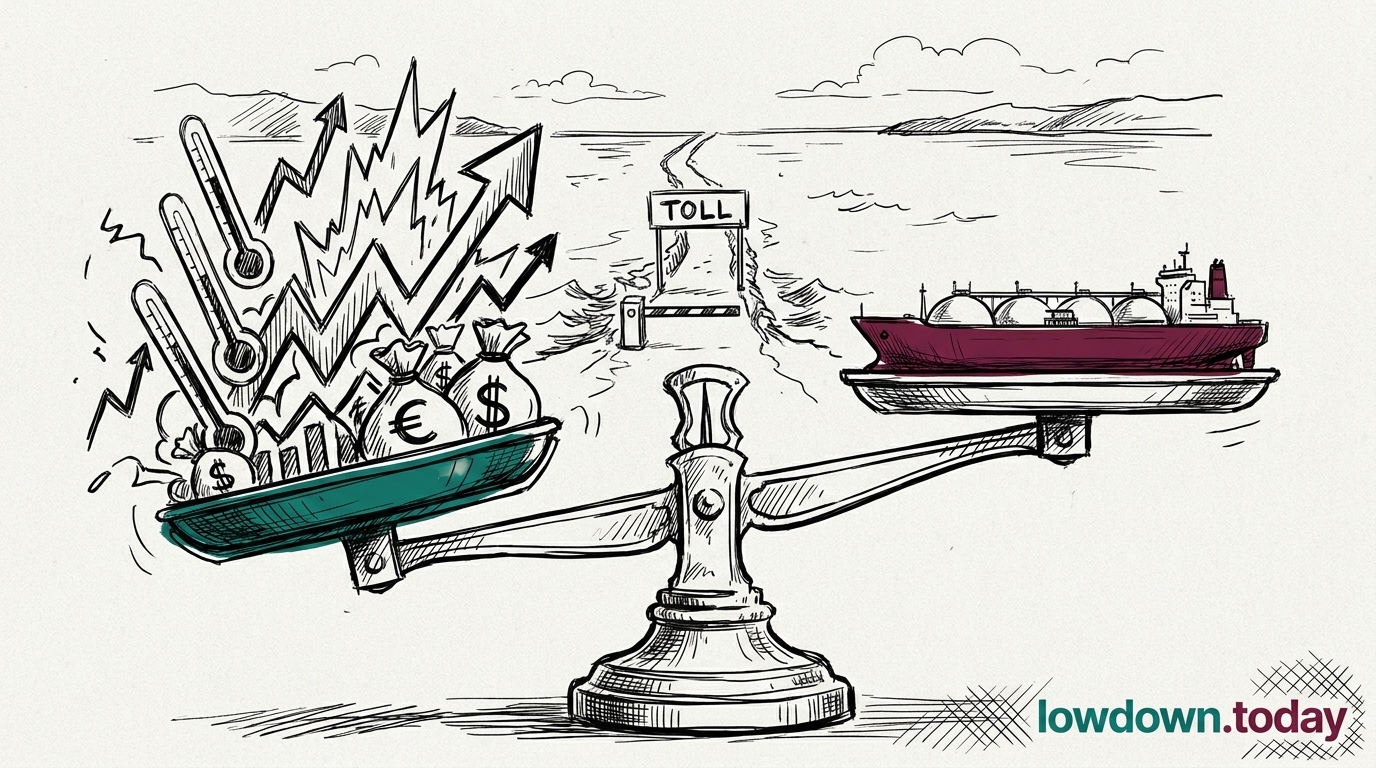
Washington reimposed a blockade on Iranian ports and a 20% Strait of Hormuz cargo toll on 13 July, driving TTF's 9% two-session rally to EUR 54.995/MWh. The posture is again setting Europe's gas benchmark by sentiment rather than by any confirmed change in cargo flows.
EDF
EDF
EDF slipped the Bugey 3, Golfech 2 and Chooz 2 restarts to 19, 22 and 25 July, pushing all three past the 20 July Bugey heat exemption, after river-cooling limits on the Rhone, Garonne and Meuse forced the cuts. The same thermal ceiling has capped the fleet in every major heatwave since 2003, and this cycle is no exception.
German power desk
German power desk
German day-ahead power climbed from EUR 126 to EUR 156/MWh over 14-16 July as the heat dome held, flipping the clean spark spread positive for the first time since 14 July. Gas-for-power demand is now back in competition with mandate storage injection right as the injection margin itself is thinning.
EU carbon and storage regulators
EUA carbon broke EUR 81/tonne on 13 July as the ETS Market Stability Reserve's scheduled withdrawals met fresh fuel-switching demand from France's nuclear curtailment. Brussels' mandatory storage-fill rule kept German and French injection running regardless of the TTF swings, the mechanism working as designed four years after the 2022 shock.
Equinor
Equinor
Equinor returned its Asgard field from maintenance on 11 July, lifting Gassco's exit nominations to 319.8 mcm/day just as TTF round-tripped on Hormuz risk. The restart gave Norway spare pipeline capacity to help Europe absorb the gas rally without drawing down storage, reinforcing its role as the post-2022 swing supplier.
