Skip to content
Briefings are running a touch slower this week while we rebuild the foundations.See roadmap
European Energy Markets
4JUN

Hungary CJEU challenge; Slovakia preparing to join

3 min read
10:45UTC

Hungary filed a CJEU challenge against the EU Russian gas ban on 2 February 2026 arguing the regulation required unanimous Council approval as a sanction rather than trade policy, with Slovakia preparing to join, while the European Commission's TurkStream derogation deadline is 5 August 2026.

EconomicDeveloping
Key takeaway

Hungary's CJEU challenge runs in parallel with the Commission's 5 August TurkStream derogation deadline.

Hungary filed a CJEU challenge against the EU Russian gas ban on 2 February 2026, arguing the regulation required unanimous Council approval as a sanction rather than trade policy 1. Slovakia is preparing a parallel filing to join the Hungarian challenge. No CJEU ruling or preliminary injunction has been issued. The case sits in Luxembourg before the Court of Justice of the European Union, which adjudicates EU institutional and legal questions.

The filing runs in parallel with the TurkStream derogation process. ACER named Hungary and Slovakia among seven national regulatory authorities in its 6 May advisory opinions on TurkStream-entry derogation requests . The European Commission's deadline to rule on those seven requests, including Hungary and Slovakia, is 5 August 2026. The two legal tracks operate on different timelines: the CJEU challenge has no set ruling date; the Commission's TurkStream decision is due by 5 August.

Hungary's EUR 123.23/MWh day-ahead clearing on 12 May, EUR 54 above Spain, is the largest single-market premium in the briefing series. The clearing price compounds the political case for the derogation while the legal challenge runs in parallel. Hungary's reliance on TurkStream-routed Russian gas through the Balkans is the supply-side fact underneath the legal argument; the CJEU filing tests the procedural question, while the Commission's August deadline determines the operational outcome.

For procurement desks the calendar matters more than the legal theory. A Commission ruling against the derogations before 5 August closes the operational route; a ruling in favour preserves the supply line into Q3 and Q4. The CJEU has signalled no intervention date ahead of the Commission deadline. Slovakia's decision to join lifts the political weight of the challenge without changing the timetable.


Deep Analysis

In plain English

Russia sends natural gas to Hungary and Slovakia through a pipeline called TurkStream, which runs under the Black Sea through Turkey and into Central Europe. The European Union passed a law to phase out Russian gas as part of its response to the Ukraine war. Hungary challenged this law in the EU's highest court, the Court of Justice of the European Union (CJEU) in Luxembourg, arguing the law was passed incorrectly. At the same time, Hungary and several other countries asked for an exemption from another related EU gas rule, called the TurkStream derogation. The EU energy regulator ACER published opinions on these requests on 6 May, and the European Commission must make a final decision by 5 August 2026. Slovakia is preparing to join Hungary's court challenge. There is also an important political change in Hungary: a new, more pro-EU government took power in May 2026 after elections in April. It is not yet clear whether the new government will continue the legal challenge that the old government started.

Deep Analysis
Root Causes

Hungary's CJEU challenge rests on a structural dependency, not a legal abstraction. Hungary imported approximately 80% of its gas via TurkStream-routed Russian supply as of 2025, with no LNG regasification terminal and limited interconnection capacity for Norwegian pipeline gas. The ban removes Hungary's dominant supply source without a Commission-approved replacement pathway.

The political context complicates the challenge's future. Hungary's 12 April 2026 election gave Péter Magyar's Tisza party 137 of 199 parliamentary seats; the new government formed around 5 May. Magyar is significantly more pro-EU than Orbán and has expressed support for aligning Hungary with EU energy policy. The CJEU challenge was filed under the Orbán government on 2 February; whether the Magyar government maintains or withdraws it is an open question not yet publicly resolved.

What could happen next?
  • Risk

    If the Commission rules against the TurkStream derogation by 5 August, Hungary faces forced spot procurement at Continental clearing prices from Q3 2026, widening its energy cost disadvantage relative to western EU members.

    Short term · 0.74
  • Consequence

    Hungary's new Tisza government may withdraw or fail to prosecute the CJEU challenge, removing the co-applicant anchor for Slovakia's parallel filing and collapsing the legal challenge without a ruling.

    Short term · 0.6
  • Precedent

    If the CJEU upholds the trade-measure basis for the gas ban (consistent with the 2022 Poland coal ruling), it forecloses the legal avenue for any future member state challenging energy-sector sanctions on unanimous-approval grounds.

    Long term · 0.72
First Reported In

Update #9 · Storage 35% met, 80% trajectory still missed

Xinhua· 12 May 2026
Read original
Different Perspectives
TTF traders / Amsterdam hub desks
TTF broke its 38-session EUR 46-47 band on 2 June to EUR 48.9 on stalled Iran diplomacy and an unconfirmed Troll A restart; Dutch EBN mandates carry storage trajectory while commercial injection books nothing. The 17 June pipeline expiry is the next binary level: Central European hub premium above EUR 2/MWh widens sharply on any physical step-down.
Red Electrica / Spanish grid operators
Spain logged 397 negative-price hours in Q1 2026, eight times the 48 hours of Q1 2025, documenting midday solar surplus now embedding structurally into Continental pricing. Spain is four to six quarters ahead of France and Germany on the solar-penetration curve, making it the clearest forward indicator of where Continental midday clearing is heading.
Equinor
Equinor
Equinor issued no Troll A restart notice through 4 June despite extending the combined outage to 31 May, keeping up to 51 mcm/day of Norwegian supply offline alongside Hammerfest LNG dark since 22 April. The company's silence follows its 2025 Hammerfest pattern, which ran 24 days past target, and each day without a notice sustains the TTF supply premium.
European Commission / GMTF
SWD(2026)147 found EU gas spot and derivatives markets functioning well on 2 June, recommending MiFID-REMIT legislative alignment rather than emergency intervention. The GMTF verdict addressed derivatives-market integrity, not the physical injection mechanism FNB Gas declared broken five days earlier: the Commission's immediate next step is a legislative proposal, not an emergency storage order.
FNB Gas / Bundesnetzagentur
FNB Gas declared the storage-refill mechanism broken on 27 May after zero bookings in January 2026 auctions, and German day-ahead cleared EUR 102.64 on 3 June on a CCGT stack set by TTF near EUR 49 plus EUA near EUR 78. Winter storage fill now depends on state mandates with no commercial self-correction.
EDF / French government
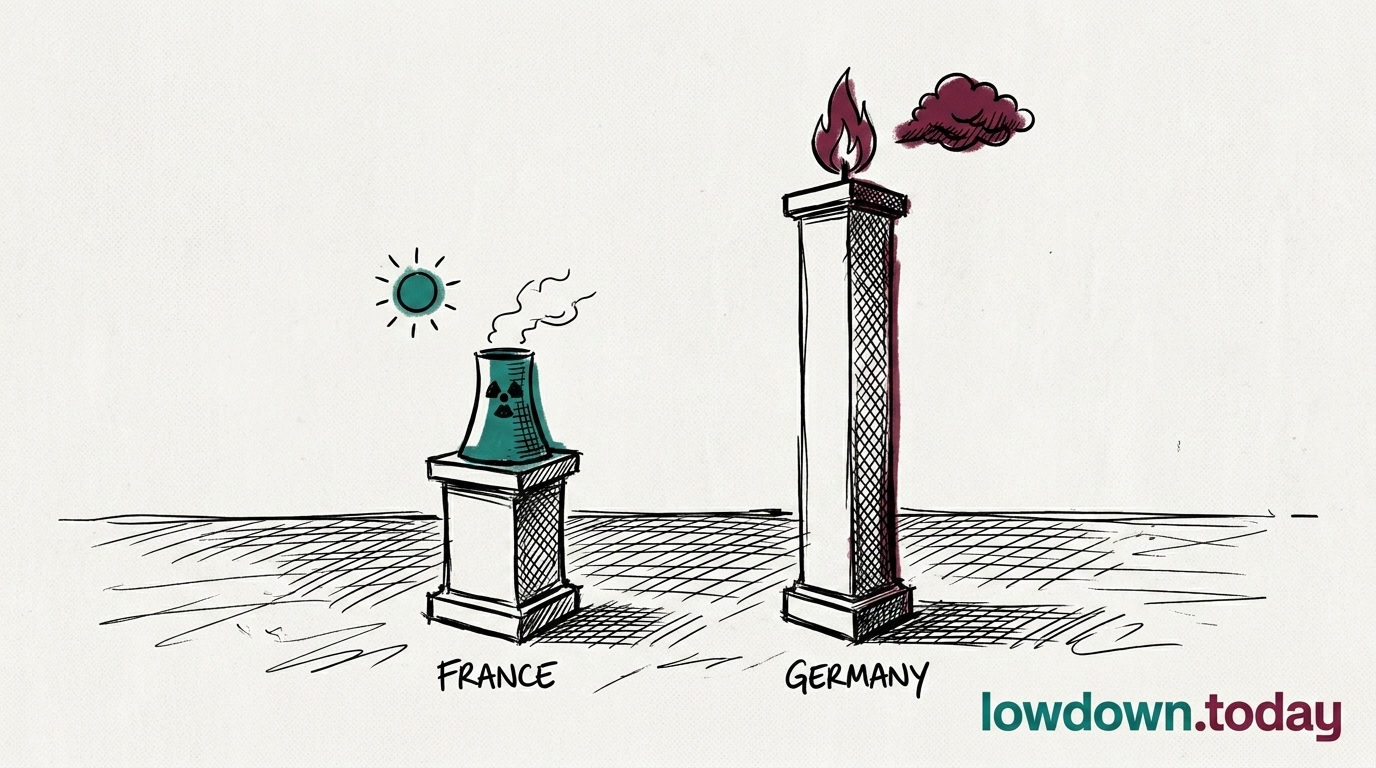
EDF held full-year nuclear guidance at 350-370 TWh after April output of 29.3 TWh, anchoring the surplus that collapsed French day-ahead to EUR 8.96 on 3 June and passed that price to VNU industrials. Flamanville-3's September overhaul removes 1.6 GW at heating-season onset, reversing the nuclear surplus that made VNU pricing competitive.
