Skip to content
Briefings are running a touch slower this week while we rebuild the foundations.See roadmap
European Energy Markets
4JUN

Germany cannot inject at this price

4 min read
10:45UTC

EU storage cleared 37.0% on Friday 22 May at 0.17 pp/day, while German CCGT marginal cost stood at EUR 129/MWh against a EUR 106.35 day-ahead clear; France's 100% mandatory contract fill is the only thing holding the headline.

EconomicDeveloping
Key takeaway

Storage lands below 80% by 1 November unless Germany's clean spark recovers or Berlin reinstates a fill instrument.

Gas Infrastructure Europe's AGSI+ platform recorded EU aggregate gas storage at 37.0% on Friday 22 May, up 0.7 percentage points on the 17 May print of 36.3% and 4.0 pp on the 33.06% reading on Saturday 2 May 1. The seven-day injection pace sits at 0.17 pp/day against the 0.53 pp/day required to reach 80% by 1 November, leaving an 18.0 pp deficit versus the five-year seasonal norm.

Germany's carbon stack, not cargo procurement, drives the deficit. With TTF at EUR 47/MWh and EUA allowances at EUR 75/t, a 0.52 t CO2 per MWh CCGT plant carries roughly EUR 39 of carbon plus EUR 90 of gas, putting marginal cost near EUR 129/MWh against German day-ahead clearing at EUR 106.35/MWh on Thursday 21 May. Clean spark spread inverted, German operators have no commercial trade that lifts summer molecules into caverns at the prevailing near-flat summer-winter strip; the curve does not fund carry. Bruegel's three-scenario refill model priced the bill at EUR 26-44bn across the EUR 45-75 TTF band, with EUR 26bn operative at EUR 45/MWh; that range is now a cost estimate for a landing below 80%, not at it.

Against that, France carries the EU aggregate; storage capacity sits 100% booked under regulated mandatory contracts at zero reserve cost, supplying the EU-aggregate cover that masks the German gap on the headline; 37.0% is materially above the April trough of 28.92% and Berlin's Bundesnetzagentur is still calling supply stable with its early-warning gas stage active since July 2025. The harder read is that Germany abolished its storage levy on 1 January 2026 with no replacement instrument, stripping the cost-recovery mechanism that underwrote injection economics through three winters between TTF prints of EUR 25 and EUR 70/MWh. A second formal cut to the 80% target needs Council unanimity not currently available, leaving silent acceptance of a sub-80% landing as the operative posture into the 11 June joint ACER/EC workshop.


Deep Analysis

In plain English

European countries store gas underground in summer to use in winter. Right now, EU storage tanks are only 37% full, and they are filling at roughly a third of the speed needed to reach the 80% safety target by November. The main reason Germany - Europe's largest storage market - is not injecting more gas is that gas-fired power plants there are losing money at current prices. Gas plus the cost of carbon pollution permits pushes their costs to around EUR 129 per megawatt-hour, but the wholesale electricity price is only EUR 106. No commercial operator will buy gas to inject when the economics run backwards like that.

Deep Analysis
Root Causes

Germany's CCGT marginal cost at EUR 47 TTF and EUR 75/t EUA sits at approximately EUR 129/MWh. At EUR 52/MWh thermal efficiency, a 0.52 t CO2/MWh CCGT pays roughly EUR 39/MWh in carbon plus EUR 90/MWh in gas. German day-ahead cleared EUR 106.35/MWh on 21 May, 23 EUR/MWh below that marginal cost.

No cavern operator can fund summer-molecule carry when the instrument that prices the filled cavern's output - winter day-ahead - fails to cover the cost of acquiring the molecule in summer. The carbon stack is the binding constraint: at EUR 50 TTF and EUR 75/t EUA, CCGT marginal cost stays near EUR 129/MWh regardless of gas procurement strategy.

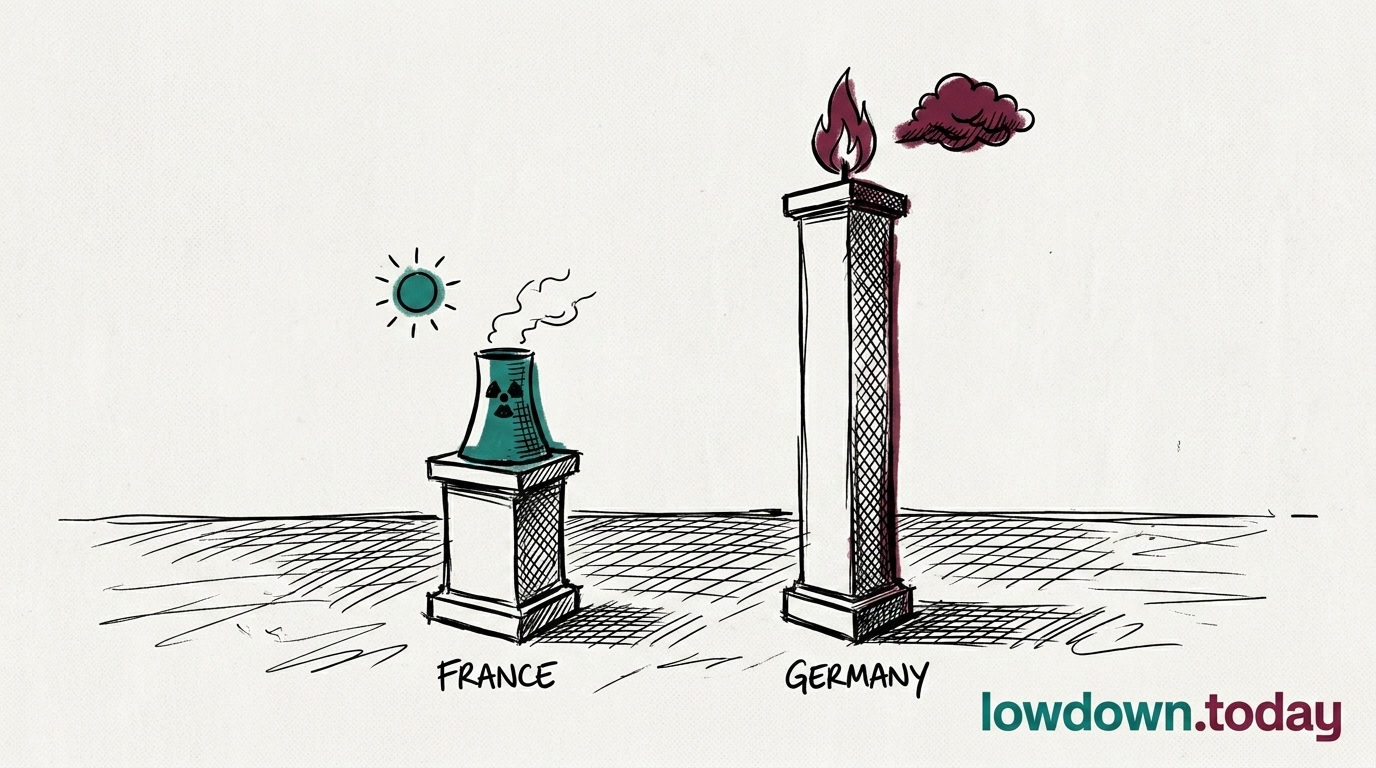
France's 100% mandatory booking covers the EU aggregate headline but does so at zero reserve cost: French operators are required by CRE regulation to hold capacity, not to inject molecules. The aggregate 37.0% therefore masks a two-speed market: France at mandated saturation, Germany at commercial zero. The structural divergence will not close unless Germany either reinstates a fill instrument or the summer-winter strip widens enough to fund carry at EUR 47+ TTF.

What could happen next?
  • Risk

    EU aggregate storage lands at 55-65% on 1 November at the current 0.17 pp/day pace, creating a winter supply gap that TTF cannot price without a 30%+ prompt rally.

    Medium term · Assessed
  • Consequence

    Sub-80% landing makes the Council unanimity needed to formally revise the EU storage regulation politically unavoidable, surfacing the first formal revision of the Gas Storage Regulation since its July 2022 adoption.

    Short term · Suggested
  • Opportunity

    A summer-winter strip widening of EUR 15+/MWh above current levels would unlock commercial injection without a regulatory instrument; any Hormuz reopening signal that breaks TTF below EUR 43 compresses the strip further and eliminates the carry trade for the season.

    Short term · Assessed
First Reported In

Update #11 · Germany cannot inject at this price

euenergy.live· 22 May 2026
Read original
Causes and effects
This Event
Germany cannot inject at this price
The injection deficit is now a market-design problem inside Germany's own electricity stack, not a procurement problem; a sub-80% landing on 1 November is the operative consensus.
Different Perspectives
TTF traders / Amsterdam hub desks
TTF broke its 38-session EUR 46-47 band on 2 June to EUR 48.9 on stalled Iran diplomacy and an unconfirmed Troll A restart; Dutch EBN mandates carry storage trajectory while commercial injection books nothing. The 17 June pipeline expiry is the next binary level: Central European hub premium above EUR 2/MWh widens sharply on any physical step-down.
Red Electrica / Spanish grid operators
Spain logged 397 negative-price hours in Q1 2026, eight times the 48 hours of Q1 2025, documenting midday solar surplus now embedding structurally into Continental pricing. Spain is four to six quarters ahead of France and Germany on the solar-penetration curve, making it the clearest forward indicator of where Continental midday clearing is heading.
Equinor
Equinor
Equinor issued no Troll A restart notice through 4 June despite extending the combined outage to 31 May, keeping up to 51 mcm/day of Norwegian supply offline alongside Hammerfest LNG dark since 22 April. The company's silence follows its 2025 Hammerfest pattern, which ran 24 days past target, and each day without a notice sustains the TTF supply premium.
European Commission / GMTF
SWD(2026)147 found EU gas spot and derivatives markets functioning well on 2 June, recommending MiFID-REMIT legislative alignment rather than emergency intervention. The GMTF verdict addressed derivatives-market integrity, not the physical injection mechanism FNB Gas declared broken five days earlier: the Commission's immediate next step is a legislative proposal, not an emergency storage order.
FNB Gas / Bundesnetzagentur
FNB Gas declared the storage-refill mechanism broken on 27 May after zero bookings in January 2026 auctions, and German day-ahead cleared EUR 102.64 on 3 June on a CCGT stack set by TTF near EUR 49 plus EUA near EUR 78. Winter storage fill now depends on state mandates with no commercial self-correction.
EDF / French government
EDF held full-year nuclear guidance at 350-370 TWh after April output of 29.3 TWh, anchoring the surplus that collapsed French day-ahead to EUR 8.96 on 3 June and passed that price to VNU industrials. Flamanville-3's September overhaul removes 1.6 GW at heating-season onset, reversing the nuclear surplus that made VNU pricing competitive.
