Skip to content
You can now search across every topic, entity and event.What's new
European Energy Markets
4JUN

French reactors curtail on river heat

4 min read
10:45UTC

EDF curtailed Golfech and Nogent on the 28C river limit as France hit 44.3C, and German power cleared EUR 207.84/MWh with Belgium above EUR 1,000. The cheap-France floor cracked on hydrology, three months before the Flamanville overhaul was due to open the same hole.

EconomicDeveloping
Key takeaway

River temperature, not the September Flamanville overhaul, is now the nearest binding constraint on France's export surplus.

Golfech Unit 2 shut at 23:45 on 22 June when cooling water in the Garonne neared the 28°C regulatory limit, and Nogent-sur-Seine ramped a reactor down on the Seine the next day 1. EDF, France's state nuclear utility, may run the reactors; what it cannot do is breach the discharge derogation that caps how much heat they may add to a river already near record temperature. France logged 44.3°C at Pissos on 23 June, its hottest reading since 1947 2. A transformer fault at Ergué-Gabéric then cut power to 68,000 homes in Finistère, peaking at 106,000 customers on 24 June.

German day-ahead cleared EUR 207.84/MWh and a 23 June quarter-hour auction printed EUR 615/MWh 3, while Belgium ran above EUR 1,000/MWh at sunset on 24 June, its highest since the 2022 crisis 4. The German clean spark spread, the margin a gas plant earns after paying for gas and carbon, hit a 2026 high near +EUR 110/MWh. Four sessions earlier it had only just clawed back to +EUR 30 as EDF restored output , recovering from the trough that shut combined-cycle plants on 15 June .

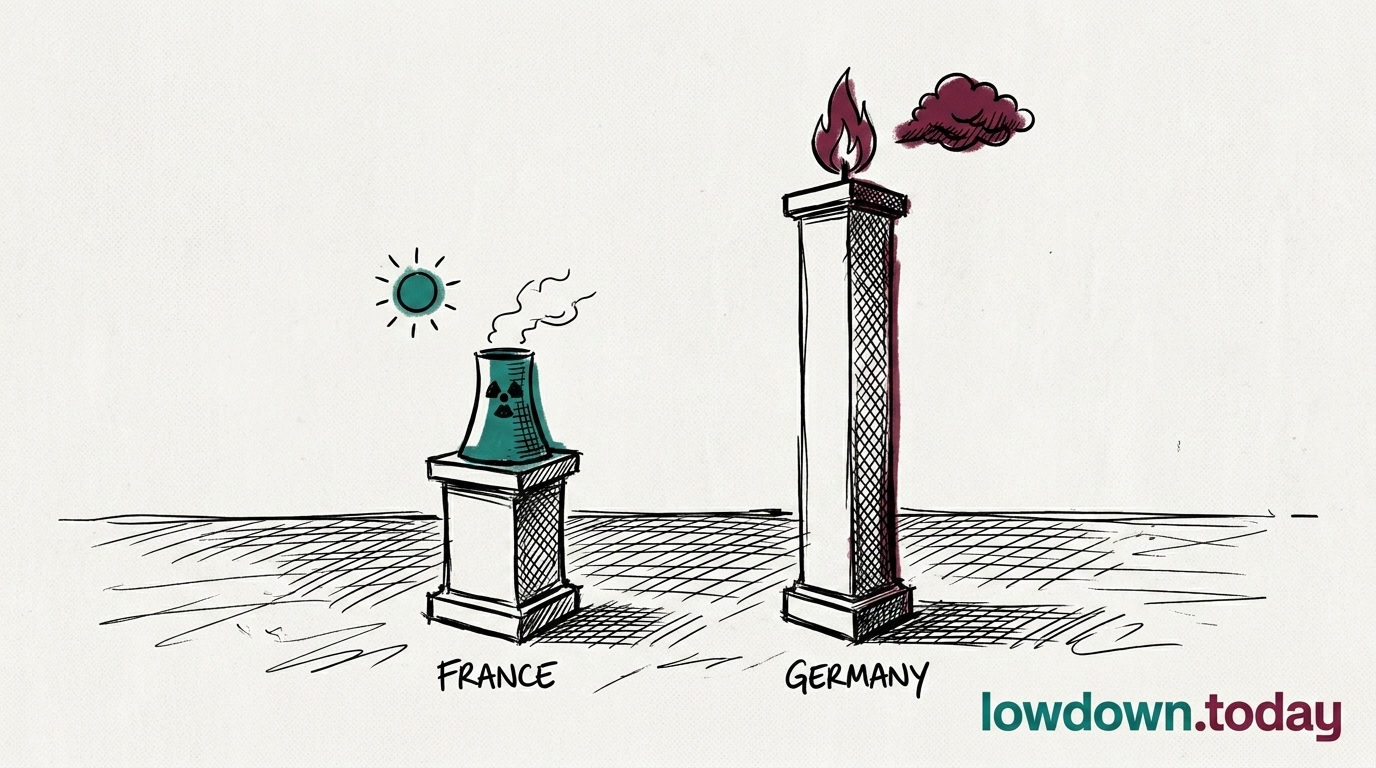
The cheap-France position the desk carried into the week lost both legs at once. French nuclear surplus had held France EUR 17.29 below Germany on 22 June ; river heat pulled the cheap leg's supply while cooling demand bid its price up. This is the mirror image of 3 June, when a heatwave solar surge collapsed French day-ahead toward EUR 9 and blew the spread to a record on cheap France . The mechanism flipped from surplus to curtailment, and the French side ran dear rather than near zero.

Flamanville-3, EDF's newest reactor, was already booked for a one-year overhaul from September that strips roughly 1.6 GW at the start of the heating season. June delivered the same supply hole three months early, on hydrology rather than a planned outage. German day-ahead mean-reverted to EUR 133.54 the following day as the heat broke, but the basis did not: the September overhaul now arrives onto a fleet the market has just watched buckle to weather.


Deep Analysis

In plain English

French nuclear power stations draw water from rivers to cool their reactors. When rivers get too warm in summer, French safety regulators require the plants to cut output to avoid releasing dangerously hot water back into the river. Two reactors near the Garonne river hit the 28-degree limit on 22 June during France's hottest temperatures since 1947. When France loses nuclear output, power grids across Central Europe have to find replacement electricity from gas-fired power stations. At EUR 41/MWh TTF and EUR 80.73/t EUA, running a German gas-fired power station on 25 June cost roughly EUR 98 per megawatt-hour in fuel and carbon costs alone, compared with nuclear's near-zero marginal cost. Germany's day-ahead market hit EUR 207 per megawatt-hour, more than six times the 2025 average, because German gas stations had to serve both German and French demand simultaneously.

Deep Analysis
Root Causes

France's river-temperature regulatory ceiling derives from Directive 2006/44/EC on freshwater fish habitat protection, which caps thermal discharge differentials and sets absolute intake-temperature limits that EDF cannot override commercially. The 28°C ceiling at Golfech's Garonne intake gauge is built into the plant's operating licence; derogations up to 33°C exist but require a three-month application process that is unavailable during unplanned heatwaves.

The 3 June solar episode that collapsed French day-ahead to EUR 8.96/MWh was the inverse mechanism: renewables surplus at Golfech's grid connection drove cheap French clearing. On 22-23 June, the Garonne intake gauge at 28°C triggered ASN-mandated output reduction at Golfech Unit 2, removing approximately 920 MW from the same grid node through a physically unrelated regulatory constraint.

Flamanville-3's September 2026 overhaul timing compounds the structural picture. EDF's outage-scheduling mandate requires 12-month lead times for planned maintenance. With Flamanville-3 locked into a September 2026 slot, EDF cannot stagger the overhaul to avoid coinciding with a fleet that has already demonstrated multi-GW summer curtailment capacity. The portfolio-timing risk sits at the regulatory scheduling level, not at EDF's commercial discretion.

Escalation

The episode confirms the FR-DE spread as a binary weather-conditional instrument during blocking-anticyclone heatwaves, not a structural nuclear-surplus premium. Desks pricing the spread as a slow-moving fundamental position face asymmetric tail risk on unhedged summer strip positions when river gauges are within 1-2°C of the threshold.

What could happen next?
  • Risk

    The FR-DE spread inverted from cheap France to expensive France within eight hours of river temperature breach; desks holding long France against short Germany on structural nuclear surplus thesis were fully inverted before a stop-loss could execute at mid-session prints.

    Immediate · Assessed
  • Risk

    Flamanville-3's September overhaul arriving onto a fleet that has just demonstrated simultaneous multi-GW river-curtailment raises the autumn adequacy picture beyond 1.6 GW nameplate removal; whether EDF can stagger existing outages to compensate is the key Q4 forward positioning question.

    Short term · Reported
  • Precedent

    A blocking anticyclone with no thunderstorm relief corridor is the structural risk scenario for French nuclear adequacy that prior summer incidents (2019, 2022) did not fully realise; the June 2026 episode establishes the scenario as live, not merely modelled, for future summer strip volatility surfaces.

    Medium term · Reported
First Reported In

Update #21 · Heat cracks the French-nuclear floor

France24· 26 Jun 2026
Read original
Causes and effects
This Event
French reactors curtail on river heat
A weather event, not a scheduled outage, removed French nuclear from the supply stack and re-rated every spread anchored to cheap French power.
Different Perspectives
Marine insurers and AIS trackers covering Hormuz
AIS data shows severe curtailment on 20 July, 479 vessels anchored, 36 dark, 123 still broadcasting inside the strait, not the closure the IRGC claims. War-risk premiums move on the unresolved CENTCOM-IRGC contest itself, since underwriters price the dispute as much as the count.
QatarEnergy
QatarEnergy
Ras Laffan has run at minimum output under force majeure into August since 9 July, a constraint already priced before this week's claim. The 17-20 July move is risk premium stacked on that standing loss, not a new physical loss at the plant.
ACER and the European Commission
ACER opened the REMIT reporting consultation on schedule on 16 July, giving firms to 11 September before a quarter to build systems against Regulation 648/2012. Brussels' separate silence on StromVKG state-aid clearance leaves Berlin's own capacity mechanism without legal authorisation.
EDF and French grid operator RTE
France's discount to Germany rests on an ASNR derogation from the 28C river-cooling limit at Bugey that expires today, not on a nuclear recovery; Chooz, Golfech and Bugey restarts run to 25 July. The cheap leg holds only as long as regulators keep waiving the limit each heatwave.
German CCGT operators and grid balancers
German gas plants went off-merit on 20 July as the clean spark spread inverted to minus EUR 15 to minus EUR 21/MWh, sidelining the flexible capacity storage injection needs. Operators are pricing 2027-28 capacity revenue against Bundesnetzagentur's own admission that Brussels has not cleared the 9 GW StromVKG auctions.
LNG spreads desk
LNG spreads desk
The JKM-TTF arb flipped to a TTF premium of roughly USD 0.6/MMBtu on 15 July, the first time this cycle Europe has outbid Asia, yet no Atlantic cargo has rerouted west. Until a cargo actually moves, the desk reads the Hormuz premium as unconfirmed and the EUR 55 print as vulnerable to a fast reversal.
