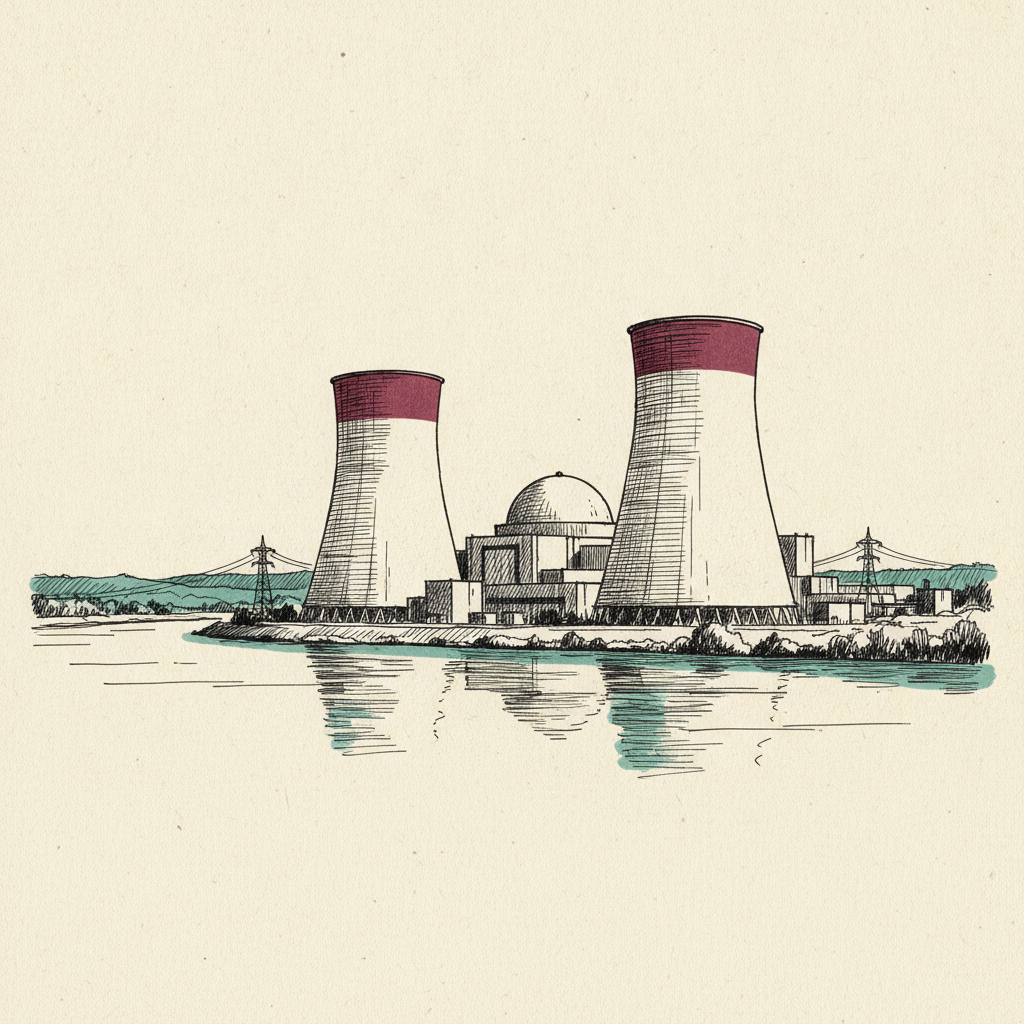
Golfech
French nuclear power station on the Garonne river in Tarn-et-Garonne; its cooling water withdrawals are subject to a 28°C river-temperature regulatory limit enforced during heatwaves.
Golfech went fully offline again on 12 July, alongside Chooz and Bugey, as Garonne cooling water breached the 28°C limit for the second time this summer, briefly flipping French day-ahead power about €7/MWh above Germany's before easing back within a day.
Last refreshed: 23 July 2026 · Appears in 1 active topic
Can France's nuclear floor hold through summer when rivers run hot?
Timeline for Golfech
Mentioned in: River heat cuts 7.6 GW off EDF's fleet
European Energy MarketsFrance cheaper on a waiver ending today
European Energy MarketsStayed offline; restart slipped to 22 July
European Energy Markets: EDF slips three reactor restarts to late JulyFrench heat flips the FR-DE spread
European Energy MarketsMentioned in: EDF adds Chooz to the curtailment list
European Energy MarketsBackground
Golfech is the only nuclear power station in the Occitanie region and the most southerly on the French mainland, sitting on the Garonne in Tarn-et-Garonne. Its two REP 1300 pressurised-water reactors, commissioned in 1991 and 1993, give a combined 2,620 MW of capacity and place it among the twelve two-unit stations in EDF's 1,300 MW class, the most common reactor type in France's fleet.
Because the Garonne is smaller and runs warmer in summer than the Rhône or Loire, which host most of France's other 1,300 MW units, Golfech is more exposed than its sister plants to the 28°C river-discharge ceiling that French environmental regulation imposes on cooling water. When the river nears that limit the plant must cut or halt output regardless of reactor availability, a constraint that has now recurred in successive summers rather than as a one-off.
That hydrology sensitivity matters beyond the plant itself: Golfech sits within EDF's 56-reactor fleet, the backbone of France's role as continental Europe's largest nuclear exporter and the reason French day-ahead power normally clears below Germany's. Each Golfech curtailment removes low-cost supply from a market that watches the plant as a bellwether for how FAR climate-driven river limits can erode that price advantage.
Golfech curtails again on river heat
Golfech first came off cooling-limited duty on 22 June 2026, one of two French reactors curtailed as the Garonne breached the 28°C discharge ceiling during the country's hottest spell since 1947, a limit that applies to Golfech regardless of reactor availability.
The same heat dome forced Golfech fully offline a second time on 12 July, alongside Chooz and Bugey; losing all three at once tipped French day-ahead power about €7/MWh above Germany's before the spread unwound within a day. A second full stoppage inside three weeks marks Golfech's river exposure as a recurring summer constraint, not an isolated incident.
Why did Golfech nuclear plant shut down in June 2026?
How much electricity does Golfech nuclear power station generate?
What is the 28°C rule for French nuclear plants on rivers?
Where is Golfech nuclear power station?
Did Golfech nuclear plant shut down again in July 2026?
