Skip to content
You can now search across every topic, entity and event.What's new
European Energy Markets
4JUN

FR-DE day-ahead resets to Germany dearer

3 min read
10:45UTC

The France-Germany day-ahead trade flipped back to Germany dearer by EUR 19.31/MWh on 17 June, offsetting a desk that had gone France-dearer two sessions earlier by more than EUR 20.

EconomicDeveloping
Key takeaway

Germany is dearer than France by EUR 19.31/MWh, a second FR-DE reversal in a fortnight driven by its thermal stack.

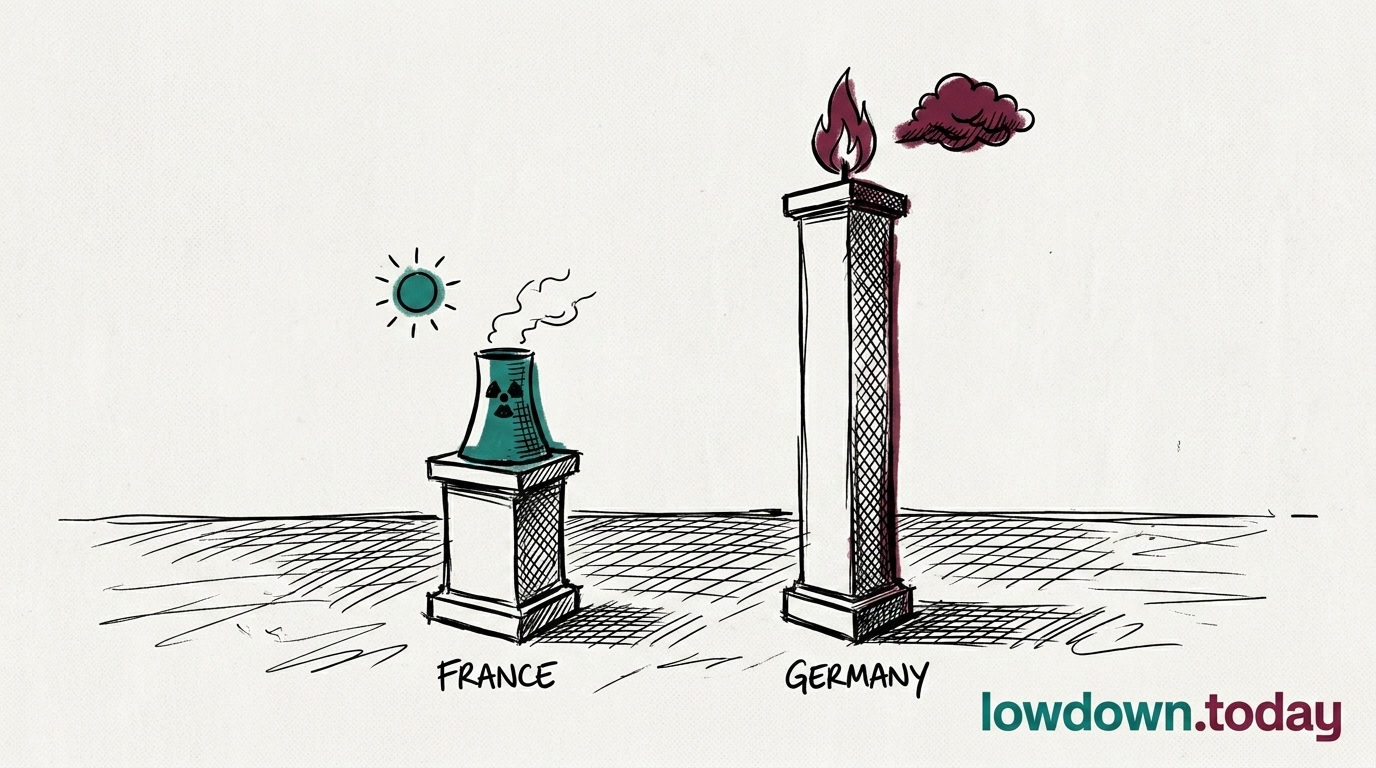
The France-Germany day-ahead power spread flipped back to Germany dearer by EUR 19.31/MWh on 17 June, two days after France had become the dearer leg by EUR 1.6 on 15 June , on euenergy.live data 1. France cleared EUR 98.32/MWh and Germany set the marginal price higher. A desk that put on the France-dearer trade on 15 June was offside by more than EUR 20 two sessions later.

This is the cross-border consequence of the spark-spread move, not a separate German story. The gas-and-carbon stack that flipped German CCGTs back into the money the same session reset Germany's marginal clearing above France. EDF's nuclear fleet ran without a curtailment event on 17 June, holding French clearing down at EUR 98.32 while Germany's thermal generation set the higher print 2.

The EUR 19.31 gap is a fraction of the EUR 96.20 record set on 8 June , but it confirms the market has not settled into a stable equilibrium. A desk long France against short Germany has watched the spread travel close to EUR 116 in nine calendar days, from a EUR 96 French premium to a EUR 19 German one. The signal for a relative-value book is direction instability, not level: the leg that is dearer flips with whichever fleet sets the margin on the day, and that has swung twice in a fortnight.


Deep Analysis

In plain English

France gets most of its electricity from nuclear plants, which produce large amounts of cheap power constantly. Germany burns gas to generate much of its power, and gas costs a great deal more. This means French electricity prices are usually far lower than German ones, a gap traders call the France-Germany spread. In mid-June, traders briefly bet that French nuclear plants would have to slow down because of warm river water used for cooling. That bet pushed French prices above German ones for a day. When no slowdown happened and France's nuclear plants ran normally on 17 June, the old pattern snapped back: France cheap, Germany expensive, with a EUR 19 gap. Desks that put the opposite trade on just two days earlier lost more than EUR 20 per megawatt-hour.

Deep Analysis
Root Causes

The FR-DE spread is structurally determined by the gap between France's nuclear-floor clearing price and Germany's thermal-stack marginal cost. France's EUR 98.32 clearing on 17 June reflects EDF's 350-370 TWh annual output target running at roughly 40 GW of average output, suppressing any price-formation role for French gas or renewables in the day-ahead.

Germany's EUR 117.63 reflects the CCGT stack re-entering the merit order at approximately EUR 102.7/MWh marginal cost, setting the clearing price above all cheaper marginal units.

The 15 June inversion; France dearer by EUR 1.6, was caused by a short-lived repricing of French July forward contracts upward on cooling-water curtailment risk; when no actual curtailment materialised by 17 June, EDF ran without restriction and the cooling-water risk premium drained from the French price.

The structural trade, long Germany day-ahead, short France, paid EUR 96.20 at its extreme on 8 June and will reprice again when Flamanville-3 exits for its September overhaul, mechanically narrowing the nuclear buffer.

What could happen next?
  • Risk

    The September 2026 Flamanville-3 overhaul removes 1.6 GW of French nuclear capacity at heating-season start, mechanically narrowing or reversing the FR-DE premium that funds cross-border electricity exports from France.

  • Consequence

    Any sustained CCGT gas demand in Germany competes with injection for prompt TTF molecules, creating a linkage between the FR-DE spread level and the EU storage refill trajectory.

First Reported In

Update #19 · German spark spread flips +EUR 15 in 48hrs

euenergy.live· 18 Jun 2026
Read original
Different Perspectives
Marine insurers and AIS trackers covering Hormuz
AIS data shows severe curtailment on 20 July, 479 vessels anchored, 36 dark, 123 still broadcasting inside the strait, not the closure the IRGC claims. War-risk premiums move on the unresolved CENTCOM-IRGC contest itself, since underwriters price the dispute as much as the count.
QatarEnergy
QatarEnergy
Ras Laffan has run at minimum output under force majeure into August since 9 July, a constraint already priced before this week's claim. The 17-20 July move is risk premium stacked on that standing loss, not a new physical loss at the plant.
ACER and the European Commission
ACER opened the REMIT reporting consultation on schedule on 16 July, giving firms to 11 September before a quarter to build systems against Regulation 648/2012. Brussels' separate silence on StromVKG state-aid clearance leaves Berlin's own capacity mechanism without legal authorisation.
EDF and French grid operator RTE
France's discount to Germany rests on an ASNR derogation from the 28C river-cooling limit at Bugey that expires today, not on a nuclear recovery; Chooz, Golfech and Bugey restarts run to 25 July. The cheap leg holds only as long as regulators keep waiving the limit each heatwave.
German CCGT operators and grid balancers
German gas plants went off-merit on 20 July as the clean spark spread inverted to minus EUR 15 to minus EUR 21/MWh, sidelining the flexible capacity storage injection needs. Operators are pricing 2027-28 capacity revenue against Bundesnetzagentur's own admission that Brussels has not cleared the 9 GW StromVKG auctions.
LNG spreads desk
LNG spreads desk
The JKM-TTF arb flipped to a TTF premium of roughly USD 0.6/MMBtu on 15 July, the first time this cycle Europe has outbid Asia, yet no Atlantic cargo has rerouted west. Until a cargo actually moves, the desk reads the Hormuz premium as unconfirmed and the EUR 55 print as vulnerable to a fast reversal.
