Skip to content
Briefings are running a touch slower this week while we rebuild the foundations.See roadmap
European Energy Markets
4JUN

Carbon claws back its 11 May cut

4 min read
10:45UTC

EU carbon rose to about EUR 77.46 in late May, the highest since April, reversing most of the 13% cut that followed the Commission's 11 May benchmark revision. The driver is a structural supply squeeze, not sentiment.

EconomicDeveloping
Key takeaway

Carbon's structural rebound raises the cost of the gas-fired generation Europe is leaning on to fill storage.

EUA carbon allowances rose to roughly EUR 77.46 in late May, the highest since April, clawing back most of the ~13% consensus cut that followed the European Commission's 11 May ETS benchmark revision . An EUA, or EU Allowance, is the permit a power generator or industrial emitter buys under the EU Emissions Trading System to cover one tonne of carbon dioxide. The 11 May revision had been read as a structural loosening. The late-May print says otherwise.

Supply tightening, not sentiment, is doing the work. The annual cap falls by around 180 Mt year-on-year, free allocation is shrinking, and the free allowances handed to sectors covered by the Carbon Border Adjustment Mechanism, the EU's levy on carbon-intensive imports, are cut 2.5% in 2026 and 5% in 2027. Fewer allowances chasing the same compliance need lifts the clearing price, and a supply-led move does not unwind the way a sentiment bounce would.

For a gas or power desk, that carbon print feeds straight back into the storage story. A higher EUA lifts German power clearing and compresses clean spark spreads, raising the marginal cost of the gas-fired plant doing the injecting. On 21 May the German carbon stack already set EUR 106 day-ahead clearing , with CCGT running off-merit against that level ; carbon at EUR 77.46 keeps that floor in place. The pressure comes from the supply side, so it does not ease when an Iran headline knocks TTF lower the way a US-Iran deal report did on 26 May .

Deep Analysis

In plain English

The EU runs a carbon market where energy companies and factories must hold a permit, called an EU Allowance or EUA, for every tonne of CO2 they emit. The EU caps how many permits exist in total, and that cap shrinks every year. When permits get scarcer, prices rise. In mid-May, the European Commission released a routine update changing how many free permits companies receive based on how efficiently they produce. Markets misread this as a relaxation of the overall cap and sold off EUAs by about 13%. By late May, EUAs recovered to EUR 77.46 as traders recognised the cap itself had not changed. At EUR 77.46, gas power plants pay roughly EUR 38-40 extra per megawatt-hour of electricity they generate, in carbon permit costs alone. That cost goes directly into electricity bills for industries and, eventually, households.

Deep Analysis
Root Causes

The EU ETS Market Stability Reserve operates as an automatic stabiliser. When the TNAC exceeds 833 Mt, 24% of the surplus is transferred to the MSR annually; when TNAC falls below 400 Mt, allowances are released back. Through 2023 and 2024, MSR withdrawals cumulatively removed over 740 Mt from circulation, narrowing the TNAC buffer that had kept prices suppressed through the post-2008 overhang.

The CBAM mechanism (Carbon Border Adjustment Mechanism) tightens free allocation from the supply side on a schedule: sectors that export to non-EU markets and previously received free allowances to maintain competitiveness lose 2.5% of that free allocation in 2026 and 5% in 2027, with the phase-down accelerating to full elimination by 2034.

Each percentage point of free-allocation cut reduces the supply of EUAs that industry receives without paying, increasing the volume that must be purchased on the secondary market.

The 11 May European Commission benchmark revision that initially knocked EUAs 13% was a one-off administrative event. It adjusted the reference values for calculating how many free allowances sectors receive per unit of output, not the cap itself.

The cap trajectory is set in EU ETS Directive 2003/87/EC as amended; it cannot be changed by a benchmark revision. The sell-off reflected market confusion between a free-allocation adjustment and a cap relaxation. Recovery to EUR 77.46 represents the market correcting that confusion.

What could happen next?
  • Consequence

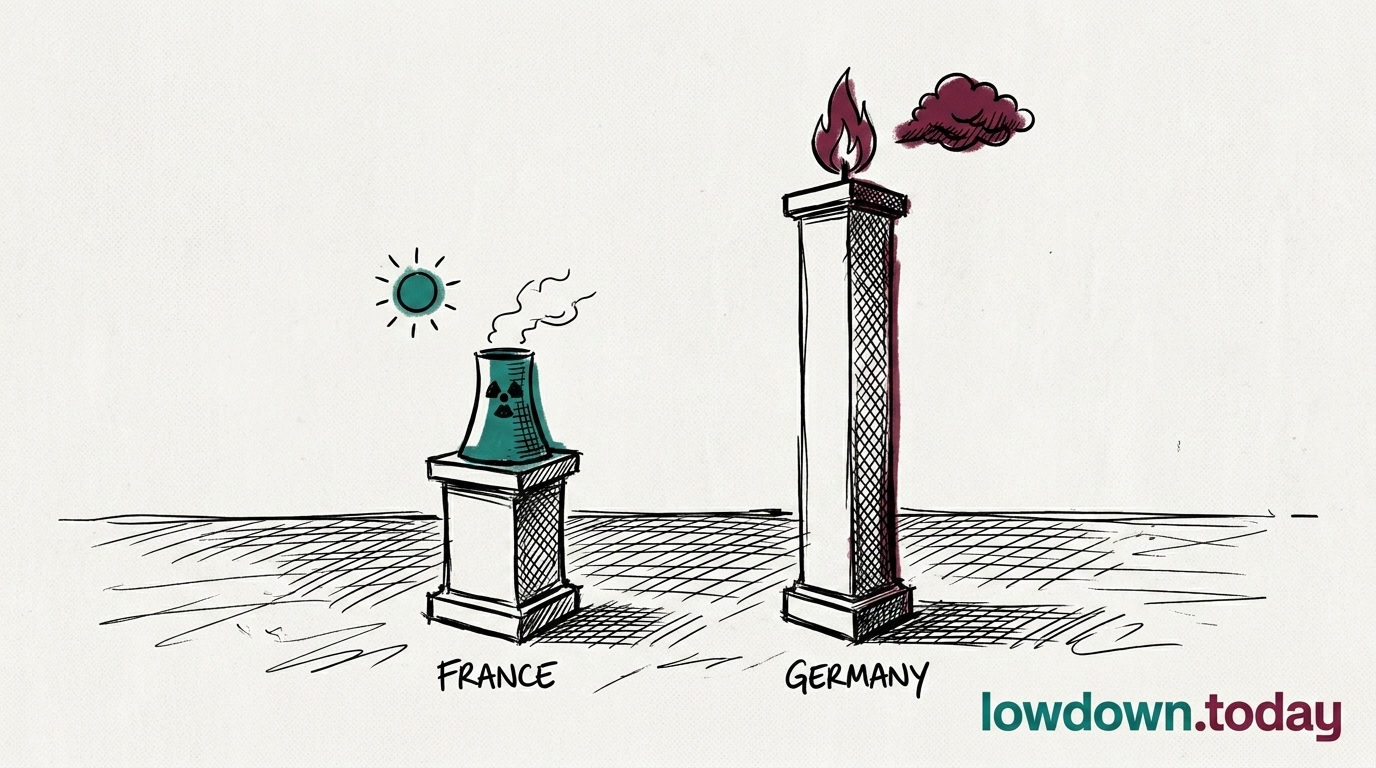
    At EUR 77.46, EUAs set the German CCGT marginal cost approximately EUR 38-40/MWh above a zero-carbon-cost generator, keeping the France-Germany day-ahead spread structurally wide until EDF's September overhaul narrows the French nuclear buffer.

    Short term · Assessed
  • Risk

    CBAM free-allocation phase-down (2.5% in 2026, 5% in 2027) raises net compliance cost for European steel, cement and fertiliser producers at a time when BASF and Yara are already curtailing output on energy cost grounds, creating additional industrial relocation pressure.

    Medium term · Assessed
  • Opportunity

    EUA structural tightening supports a directional long in December Cal-26 EUAs; MSR withdrawals running above 300 Mt per year against a cap cut of approximately 180 Mt tightens net annual supply regardless of short-run demand variation.

    Medium term · Suggested
  • Risk

    A second industrial demand destruction episode (BASF Verbund production freezes, extended Yara curtailments) could suppress verified ETS demand faster than cap cuts tighten supply, repeating the 2022-23 price collapse pattern despite the CBAM phase-down schedule.

    Medium term · Suggested
First Reported In

Update #14 · Germany's TSOs call the refill model dead

Bloomberg· 1 Jun 2026
Read original
Different Perspectives
TTF traders / Amsterdam hub desks
TTF broke its 38-session EUR 46-47 band on 2 June to EUR 48.9 on stalled Iran diplomacy and an unconfirmed Troll A restart; Dutch EBN mandates carry storage trajectory while commercial injection books nothing. The 17 June pipeline expiry is the next binary level: Central European hub premium above EUR 2/MWh widens sharply on any physical step-down.
Red Electrica / Spanish grid operators
Spain logged 397 negative-price hours in Q1 2026, eight times the 48 hours of Q1 2025, documenting midday solar surplus now embedding structurally into Continental pricing. Spain is four to six quarters ahead of France and Germany on the solar-penetration curve, making it the clearest forward indicator of where Continental midday clearing is heading.
Equinor
Equinor
Equinor issued no Troll A restart notice through 4 June despite extending the combined outage to 31 May, keeping up to 51 mcm/day of Norwegian supply offline alongside Hammerfest LNG dark since 22 April. The company's silence follows its 2025 Hammerfest pattern, which ran 24 days past target, and each day without a notice sustains the TTF supply premium.
European Commission / GMTF
SWD(2026)147 found EU gas spot and derivatives markets functioning well on 2 June, recommending MiFID-REMIT legislative alignment rather than emergency intervention. The GMTF verdict addressed derivatives-market integrity, not the physical injection mechanism FNB Gas declared broken five days earlier: the Commission's immediate next step is a legislative proposal, not an emergency storage order.
FNB Gas / Bundesnetzagentur
FNB Gas declared the storage-refill mechanism broken on 27 May after zero bookings in January 2026 auctions, and German day-ahead cleared EUR 102.64 on 3 June on a CCGT stack set by TTF near EUR 49 plus EUA near EUR 78. Winter storage fill now depends on state mandates with no commercial self-correction.
EDF / French government
EDF held full-year nuclear guidance at 350-370 TWh after April output of 29.3 TWh, anchoring the surplus that collapsed French day-ahead to EUR 8.96 on 3 June and passed that price to VNU industrials. Flamanville-3's September overhaul removes 1.6 GW at heating-season onset, reversing the nuclear surplus that made VNU pricing competitive.

