Skip to content
Briefings are running a touch slower this week while we rebuild the foundations.See roadmap
Drones: Industry & Defence
21MAY

LUCAS Enters Combat With Dozens in Stock

2 min read
11:11UTC

The first US-made loitering munition flew its combat mission five weeks ago. The Pentagon still has enough to arm a single platoon.

TechnologyDeveloping
Key takeaway

LUCAS proved affordable mass works in combat but revealed a production shortfall of three orders of magnitude.

SpektreWorks' LUCAS (Low-cost Uncrewed Combat Attack System) became the first US-manufactured loitering munition to see combat on 28 February 2026, deployed during Operation Epic Fury. Pentagon chief technology officer Emil Michael confirmed the inventory stood at "dozens." 1

The drone carries an 18 kg payload over 500 miles with six hours of endurance, at a unit cost of $35,000 to $55,000. That is roughly one hundredth of a Patriot interceptor's price. 2 Built in Phoenix, Arizona, LUCAS was designed as a reverse-engineered answer to Iran's Shahed-136. Michael described the situation bluntly: "not in full-rate production; we shipped what we had." 3

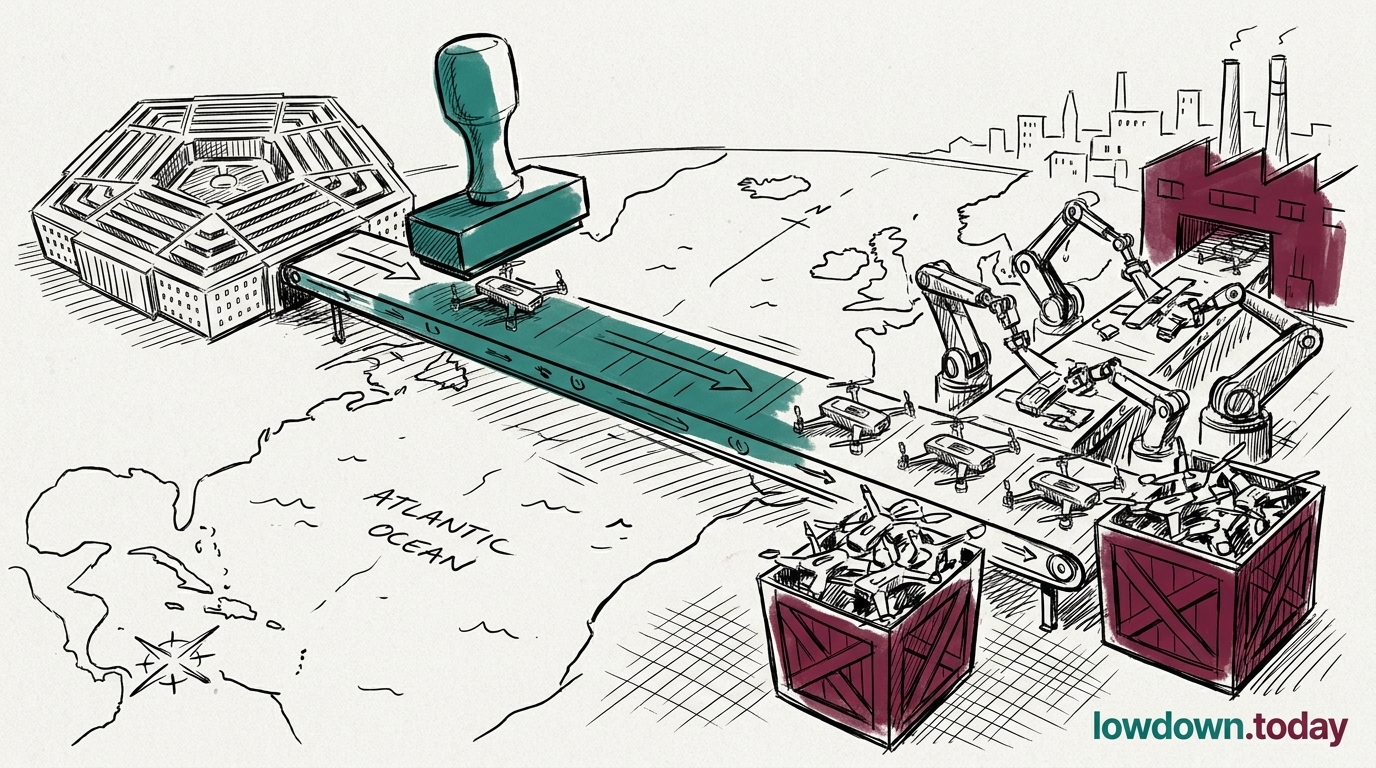
The $30 million initial contract under the Drone Dominance programme was intended to seed production of hundreds. The programme's stated goal remains 300,000 drones by 2027 under a $1.1 billion budget . Five weeks into a conflict that has consumed thousands of interceptors, the US has produced enough attack drones to equip a single squad. The gap between the Gauntlet's procurement ambition and the factory floor is not a future risk. It is an operational fact.

LUCAS validated the central thesis: cheap, expendable drones can substitute for million-dollar munitions. Production scarcity, not capability, is now the binding constraint on the entire programme.

Deep Analysis

In plain English

Imagine the US military revealed its most advanced new weapon, and it turned out there were only enough to fill a single soldier's kit bag. That is roughly the situation with LUCAS. The drone worked in combat for the first time in February 2026. But the Pentagon only has "dozens" of them, against a target of 300,000. Think of it like a car factory that built a prototype, sold it successfully, but never built the assembly line. The prototype proved the design works. Now someone needs to build the factory.

Deep Analysis
Root Causes

US defense procurement law mandates full competition, environmental review, and multi-year contracting cycles that are structurally incompatible with rapid scale-up. SpektreWorks received a $30 million seed contract, not a production order.

LUCAS was designed under an Other Transaction Authority (OTA) pathway intended to accelerate small-company innovation, but OTA does not include provisions for production surge financing or guaranteed offtake that would justify factory investment.

The affordable mass doctrine assumes high volume to achieve unit cost targets below $2,000. Without volume commitments, suppliers cannot invest in the tooling that enables volume, creating a bootstrapping problem.

What could happen next?
  • Pentagon will likely expand multi-year production commitments beyond OTA seed contracts to unlock factory investment.

    6-18 months · Medium
  • SpektreWorks faces a critical choice between raising private capital to build production capacity or seeking a strategic acquirer with existing facilities.

    12 months · Medium
  • The US military will remain dependent on expensive interceptor missiles for peer-adversary drone defence until domestic production reaches meaningful scale.

    2-3 years · High
First Reported In

Update #4 · Factories Under Fire: America's Drone Gap Meets Reality

AeroVironment / Army Recognition· 4 Apr 2026
Read original
Causes and effects
This Event
LUCAS Enters Combat With Dozens in Stock
LUCAS proved affordable mass doctrine works in combat but exposed a production gap between dozens of drones and a 300,000 target.
Different Perspectives
Institutional investors and defence-sector equity markets
Perennial's IDIQ gives revenue-visibility that earlier Schmidt ventures lacked; Northrop's dual award places a heritage prime on the attritable-payload standard-setting layer analysts had reserved for startups. Rheinmetall at €650 per share, up from €500 in January, prices auto-grade drone conversion as margin-accretive; DroneShield's ASIC probe introduces a governance-discount variable proxy advisers will apply at the 29 May AGM.
Korean defence-industrial sector (LIG Nex1, Hanwha Aerospace)
LIG Nex1's $2.2 billion Cheongung-III win and the KUS-FS service introduction together close Seoul's sovereign layered air-defence stack; both firms face multi-year backlog revisions on the Korea Exchange. The unresolved sensor-to-shooter integration risk between Hanwha's LAMD sensors and LIG Nex1's Cheongung-III engagement layer sits publicly unaddressed ahead of the 2029 fielding date.
Ukrainian export regulator (SSEC)
Ukraine's wartime export ban blocks Gulf sales of combat-proven interceptors at $2,100 to $2,500 per unit while Perennial Autonomy, built on Ukrainian combat data, wins a $500 million US IDIQ. Perennial's Merops, credited with 4,000-plus Russian drone kills in Ukraine, can now reach NATO allies via Munich; a direct Ukrainian sale to those same buyers remains legally blocked.
DJI and Autel Robotics
Autel's Ralls Corp filing attacks the classified-evidence foundation of its Covered List designation; DJI's parallel Ninth Circuit case has quantified $1.56 billion in 2026 regulatory losses. Both companies are now betting the D.C. Circuit will extend due-process protections to FCC product certification, a constitutional route that does not require contesting the intelligence allegations directly.
US Pentagon defence-industrial-base policy
JIATF-401's IDIQ names Perennial the benchmark holder while Anduril's $20 billion Lattice vehicle and Northrop's Drone Dominance payload role run in parallel lanes; the DoD bet is that named holders at each tier cut order-to-delivery cycles. The Section 232 clock 54 days overdue signals the administration treats FCC and FAR exclusions as sufficient to manage Chinese market access.
European defence procurement community
Germany's three-tier award demonstrates that EU member states can fund loitering-munition production at scale without single-supplier dependency, and Perennial's Munich line gives procurement offices a domestic-source justification for Merops orders outside US Foreign Military Sales channels. The Bundeswehr's split across Helsing, Stark and Rheinmetall has become the reference architecture other European buyers are mapping their own industrial bases against.
