Skip to content
Briefings are running a touch slower this week while we rebuild the foundations.See roadmap
Drones: Industry & Defence
21MAY

Arsenal-1 adds three more weapons lines

3 min read
11:11UTC

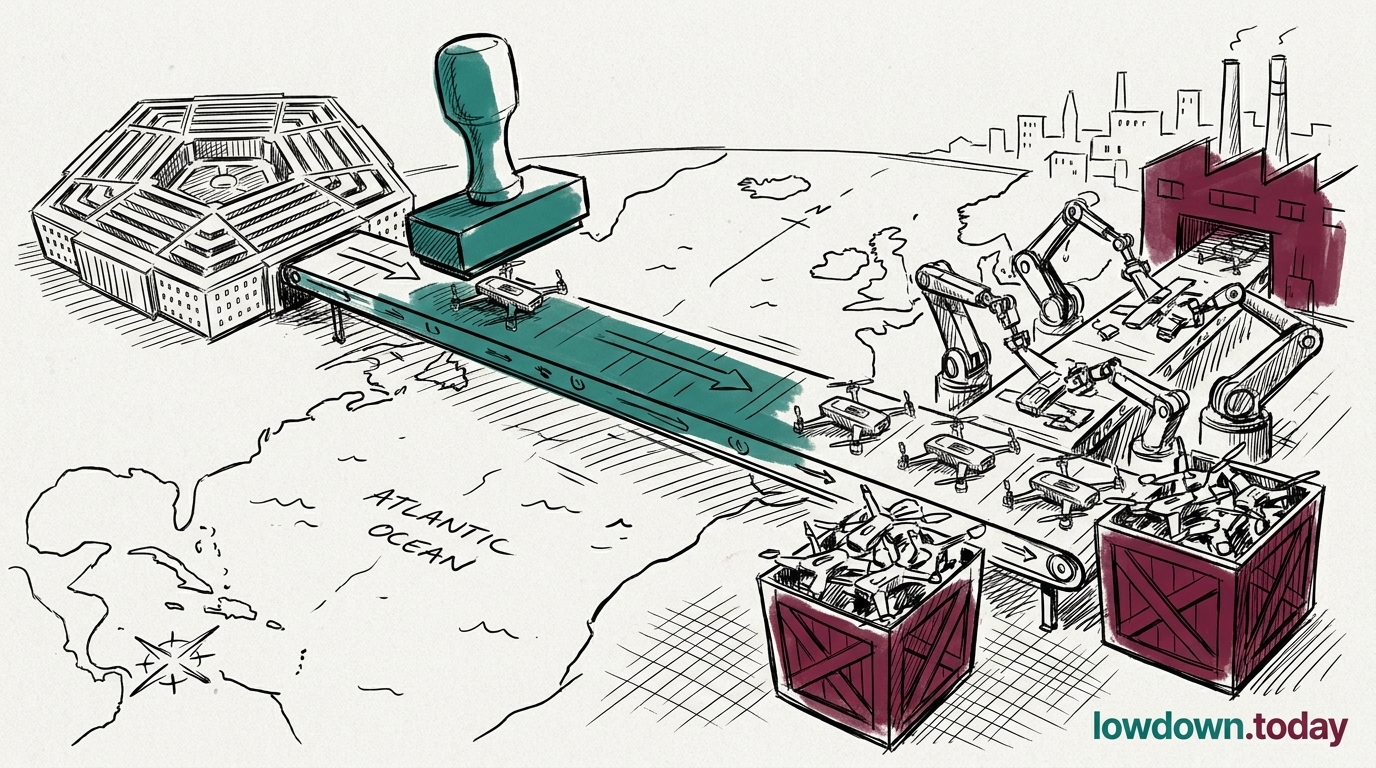
Anduril's Ohio factory will produce four distinct platforms by year-end, but currently operates with 30 workers on a single shift against a target of 250.

TechnologyDeveloping
Key takeaway

Arsenal-1's four-platform ambition rests on an eightfold workforce expansion with no confirmed timeline.

Anduril Industries announced that Arsenal-1 in Columbus, Ohio will produce four weapons systems by end-2026: the YFQ-44A Fury collaborative combat aircraft, Roadrunner interceptor, Barracuda cruise-missile-class munition, and a classified platform. The factory shipped its first Fury in late March , four months ahead of schedule, but currently runs 30 workers across 22 workstations on a single shift.

The strategic logic is defensive as much as offensive. A factory producing four programmes simultaneously is structurally harder to displace than one producing a single airframe. Each additional platform deepens the infrastructure investment that competitors would need to replicate. Combined with the $20 billion Lattice enterprise vehicle and the sole-source Ghost-X contract (see Event 4), Anduril is building reinforcing moats across multiple Pentagon programme offices before rivals reach the production stage.

The workforce gap is the reality check. Growing from 30 to 250 workers requires recruiting and training defence manufacturing talent in rural Ohio, where no obvious pipeline exists. Three full shifts are needed to reach the stated 150 Fury per year capacity; at current single-shift staffing, output is a fraction of that figure. Every month at current levels widens the gap between Anduril's stated capacity and its actual production.

For the Pentagon, Arsenal-1's expansion creates a concentration risk: counter-UAS command, autonomous combat aircraft, and tactical ISR production under one roof and one contractor.

Deep Analysis

In plain English

Anduril is building a factory in Ohio that will produce four different types of military drones and weapons by the end of this year. Think of it as a car factory that is going to build four different car models at the same time, but currently has only 30 workers. To meet their targets, they need to hire and train 220 more workers by December. That is the size of a small school's entire staff, recruited and trained in eight months, for a highly technical job in a part of Ohio that has not done this kind of manufacturing before. The weapons themselves include a small autonomous combat aircraft called the Fury, a drone interceptor called Roadrunner, and a cruise-missile-class weapon called Barracuda. A fourth classified weapon is also being made there.

Deep Analysis
Root Causes

Arsenal-1's four-platform expansion reflects a procurement logic as much as an industrial one. Pentagon programme offices manage budgets by capability category; a manufacturer with products across multiple categories becomes harder to exclude from any single budget cycle. The classified fourth platform is significant precisely because it is unknown: it ensures Arsenal-1 has relationships with at least one programme office whose requirements are not publicly disclosed.

The concentration of four programmes under one roof also reflects the Pentagon's stated preference for 'arsenal ships' or 'arsenal factories' that can surge production across weapon types in response to operational demand. Arsenal-1 is being designed to match a procurement doctrine that itself is still being written.

What could happen next?
  • Risk

    Arsenal-1's stated 150 Fury per year capacity cannot be reached without three-shift operation; at current single-shift staffing, actual output is under 50 aircraft per year, creating a gap between contracted delivery timelines and operational reality.

    Short term · 0.77
  • Consequence

    A four-platform factory under one contractor gives the Pentagon a faster surge option in a wartime emergency but concentrates supply chain risk in a single facility and a single workforce pool.

    Medium term · 0.72
  • Opportunity

    Arsenal-1's classified fourth platform creates a procurement relationship with a programme office whose identity and budget are insulated from public competitive pressure, providing Anduril with revenue diversification that cannot be directly competed.

    Long term · 0.68
First Reported In

Update #5 · Gulf drone war rewrites procurement

Breaking Defense· 13 Apr 2026
Read original
Different Perspectives
Institutional investors and defence-sector equity markets
Perennial's IDIQ gives revenue-visibility that earlier Schmidt ventures lacked; Northrop's dual award places a heritage prime on the attritable-payload standard-setting layer analysts had reserved for startups. Rheinmetall at €650 per share, up from €500 in January, prices auto-grade drone conversion as margin-accretive; DroneShield's ASIC probe introduces a governance-discount variable proxy advisers will apply at the 29 May AGM.
Korean defence-industrial sector (LIG Nex1, Hanwha Aerospace)
LIG Nex1's $2.2 billion Cheongung-III win and the KUS-FS service introduction together close Seoul's sovereign layered air-defence stack; both firms face multi-year backlog revisions on the Korea Exchange. The unresolved sensor-to-shooter integration risk between Hanwha's LAMD sensors and LIG Nex1's Cheongung-III engagement layer sits publicly unaddressed ahead of the 2029 fielding date.
Ukrainian export regulator (SSEC)
Ukraine's wartime export ban blocks Gulf sales of combat-proven interceptors at $2,100 to $2,500 per unit while Perennial Autonomy, built on Ukrainian combat data, wins a $500 million US IDIQ. Perennial's Merops, credited with 4,000-plus Russian drone kills in Ukraine, can now reach NATO allies via Munich; a direct Ukrainian sale to those same buyers remains legally blocked.
DJI and Autel Robotics
Autel's Ralls Corp filing attacks the classified-evidence foundation of its Covered List designation; DJI's parallel Ninth Circuit case has quantified $1.56 billion in 2026 regulatory losses. Both companies are now betting the D.C. Circuit will extend due-process protections to FCC product certification, a constitutional route that does not require contesting the intelligence allegations directly.
US Pentagon defence-industrial-base policy
JIATF-401's IDIQ names Perennial the benchmark holder while Anduril's $20 billion Lattice vehicle and Northrop's Drone Dominance payload role run in parallel lanes; the DoD bet is that named holders at each tier cut order-to-delivery cycles. The Section 232 clock 54 days overdue signals the administration treats FCC and FAR exclusions as sufficient to manage Chinese market access.
European defence procurement community
Germany's three-tier award demonstrates that EU member states can fund loitering-munition production at scale without single-supplier dependency, and Perennial's Munich line gives procurement offices a domestic-source justification for Merops orders outside US Foreign Military Sales channels. The Bundeswehr's split across Helsing, Stark and Rheinmetall has become the reference architecture other European buyers are mapping their own industrial bases against.
