Skip to content
Briefings are running a touch slower this week while we rebuild the foundations.See roadmap
Drones: Industry & Defence
21MAY

Anduril hires for Roadrunner at Arsenal-1

4 min read
11:11UTC

Anduril posted manufacturing engineer, quality engineer and production technician roles for Roadrunner at the Arsenal-1 mega-factory in Pickaway County, Ohio on 22 April.

TechnologyDeveloping
Key takeaway

Roadrunner moves from announcement to production hiring, the second platform on Anduril's four-line Arsenal-1 schedule.

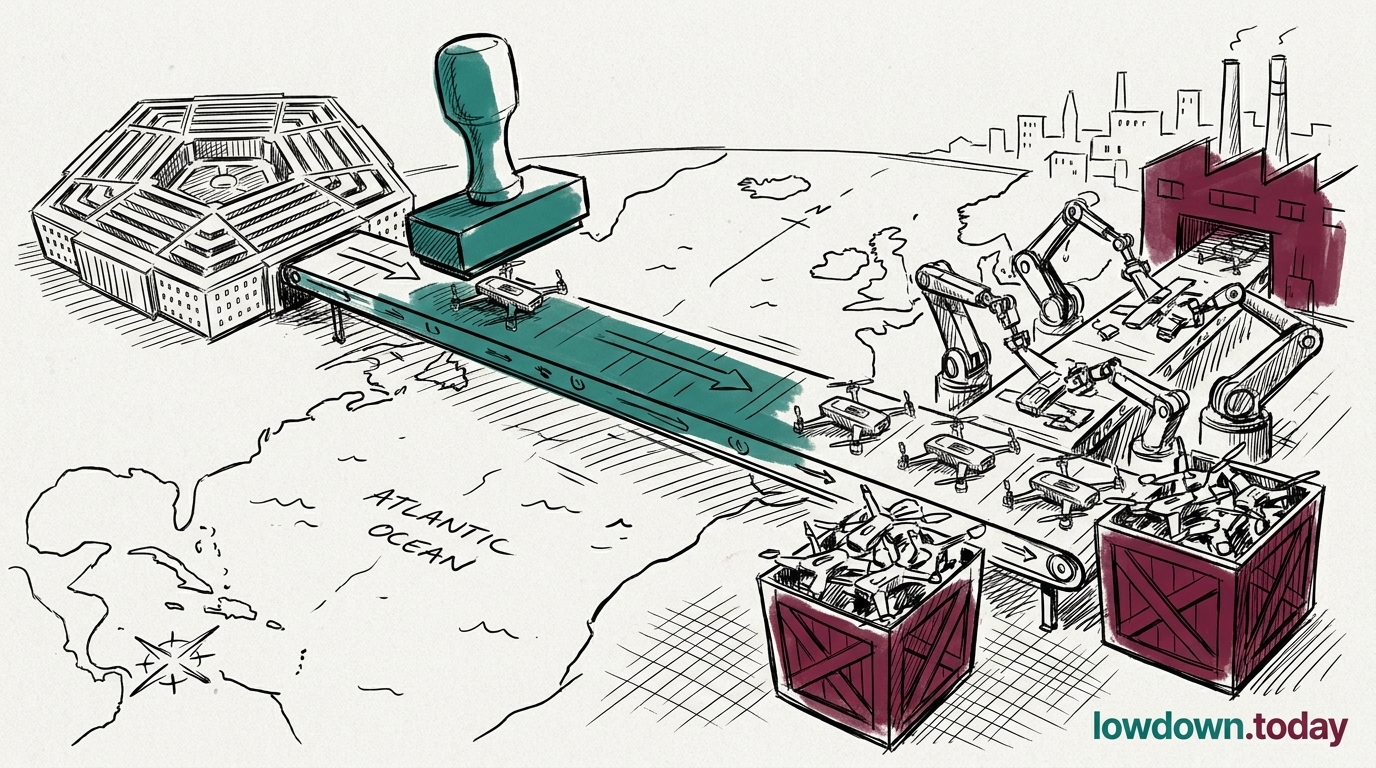
Anduril Industries on Wednesday 22 April posted manufacturing engineer, quality engineer and production technician roles for Roadrunner at the Arsenal-1 factory in Pickaway County, Ohio, telling local press: "When we said we'd begin Roadrunner production at Arsenal-1 by the end of the year, we meant it" 1. Roadrunner is a vertical-takeoff reusable counter-UAS interceptor, designed to launch from a ground container, intercept a hostile drone, and recover for relaunch. Arsenal-1 itself is the five-million-square-foot site Anduril is converting into a four-platform production hub.

Roadrunner is the second of the four platforms Anduril committed to running at Arsenal-1 by end-2026 , after the YFQ-44A Fury collaborative combat aircraft and ahead of Barracuda and one classified airframe. Fury's early delivery from Arsenal-1 is the milestone the hiring wave is sized against. Manufacturing-engineer postings are the leading indicator of a production line: they precede tooling installation by three to six months and first-article output by nine to twelve.

Anduril has now publicly committed to four simultaneous production lines on a single site, a footprint pattern more familiar from Lockheed's Marietta or Boeing's Renton than from a venture-backed defence firm. Whether the four lines all hit serial production by end-2026 will determine whether the Arsenal-1 model becomes the template for autonomous-systems manufacturing or remains a singular bet. The bottleneck is not capital, of which the $3.2 billion Golden Dome OTA pool and the $20 billion Lattice contract supply plenty; it is supervisor headcount, machine tools, and the certification cycle for new welders and machinists. Each Roadrunner posting is a marker on that constraint.

A more cautious view: announcement-to-production gaps in the defence sector routinely run two years longer than the press release suggests. Roadrunner has not yet been integrated into a programme of record; the postings confirm intent, not delivery. The August 2026 production target remains the testable hinge, and the missing fourth platform will tell the reader whether Arsenal-1 is a four-line factory or a three-line factory with marketing.

Deep Analysis

In plain English

Anduril, a defence technology company, opened job listings on 22 April to hire workers for a new production line at its large factory in Ohio. The product is Roadrunner, a drone that launches vertically, intercepts enemy drones, and lands back to fly again. This is the second production line to open at the factory, which Anduril calls Arsenal-1. The first, for a jet-powered combat aircraft called Fury, started ahead of schedule. The company aims to run four separate production lines at the same factory by the end of 2026.

Deep Analysis
Root Causes

Arsenal-1's four-line ambition responds to two Pentagon procurement pressures. First, the DAWG $54.6 billion request requires production at volumes no single-platform factory can supply alone; a multi-platform co-location reduces the DoD's dependence on multiple geographically dispersed suppliers who each face their own labour and tooling constraints.

Second, Anduril's contract portfolio now spans counter-UAS, collaborative combat aircraft and Golden Dome space-based defence simultaneously. Each contract stream creates demand for a different product line; co-locating all four at Arsenal-1 allows shared programme-management overhead and a single interface with the Defense Contract Management Agency inspection team, rather than four separate production audits at four separate sites.

What could happen next?
  • Consequence

    If all four Arsenal-1 lines hit serial production by end-2026, Anduril will have assembled the most diverse autonomous-systems production portfolio in any single facility in US defence history; a structural advantage that will take any competitor at least three years to replicate.

    Short term · 0.67
  • Risk

    Running two mechanically dissimilar production lines on shared floor space creates tooling-conflict risk. Boeing's Renton 737 experience shows that quality failures in this scenario can embed before they become visible in production statistics.

    Medium term · 0.7
  • Opportunity

    Pickaway County, Ohio benefits from an industrial employment base that scales with each new Arsenal-1 line. The county's labour market will become a leading indicator of Anduril's production health; local employment postings are publicly visible before Pentagon contract updates.

    Short term · 0.82
First Reported In

Update #7 · DAWG jumps 24,000% as Anduril sweeps board

Scioto Post· 30 Apr 2026
Read original
Different Perspectives
Institutional investors and defence-sector equity markets
Perennial's IDIQ gives revenue-visibility that earlier Schmidt ventures lacked; Northrop's dual award places a heritage prime on the attritable-payload standard-setting layer analysts had reserved for startups. Rheinmetall at €650 per share, up from €500 in January, prices auto-grade drone conversion as margin-accretive; DroneShield's ASIC probe introduces a governance-discount variable proxy advisers will apply at the 29 May AGM.
Korean defence-industrial sector (LIG Nex1, Hanwha Aerospace)
LIG Nex1's $2.2 billion Cheongung-III win and the KUS-FS service introduction together close Seoul's sovereign layered air-defence stack; both firms face multi-year backlog revisions on the Korea Exchange. The unresolved sensor-to-shooter integration risk between Hanwha's LAMD sensors and LIG Nex1's Cheongung-III engagement layer sits publicly unaddressed ahead of the 2029 fielding date.
Ukrainian export regulator (SSEC)
Ukraine's wartime export ban blocks Gulf sales of combat-proven interceptors at $2,100 to $2,500 per unit while Perennial Autonomy, built on Ukrainian combat data, wins a $500 million US IDIQ. Perennial's Merops, credited with 4,000-plus Russian drone kills in Ukraine, can now reach NATO allies via Munich; a direct Ukrainian sale to those same buyers remains legally blocked.
DJI and Autel Robotics
Autel's Ralls Corp filing attacks the classified-evidence foundation of its Covered List designation; DJI's parallel Ninth Circuit case has quantified $1.56 billion in 2026 regulatory losses. Both companies are now betting the D.C. Circuit will extend due-process protections to FCC product certification, a constitutional route that does not require contesting the intelligence allegations directly.
US Pentagon defence-industrial-base policy
JIATF-401's IDIQ names Perennial the benchmark holder while Anduril's $20 billion Lattice vehicle and Northrop's Drone Dominance payload role run in parallel lanes; the DoD bet is that named holders at each tier cut order-to-delivery cycles. The Section 232 clock 54 days overdue signals the administration treats FCC and FAR exclusions as sufficient to manage Chinese market access.
European defence procurement community
Germany's three-tier award demonstrates that EU member states can fund loitering-munition production at scale without single-supplier dependency, and Perennial's Munich line gives procurement offices a domestic-source justification for Merops orders outside US Foreign Military Sales channels. The Bundeswehr's split across Helsing, Stark and Rheinmetall has become the reference architecture other European buyers are mapping their own industrial bases against.
