Skip to content
Briefings are running a touch slower this week while we rebuild the foundations.See roadmap
Drones: Industry & Defence
21MAY

Anduril joins Golden Dome OTA pool

4 min read
11:11UTC

The US Space Force on 24 April awarded eleven companies, including Anduril, SpaceX, Lockheed and Northrop, a share of a $3.2 billion Other Transaction Authority pool for Golden Dome space-based interceptor prototypes.

TechnologyDeveloping
Key takeaway

OTA pools now distribute the Pentagon's largest autonomous-systems contract decisions, and Anduril spans three procurement domains at once.

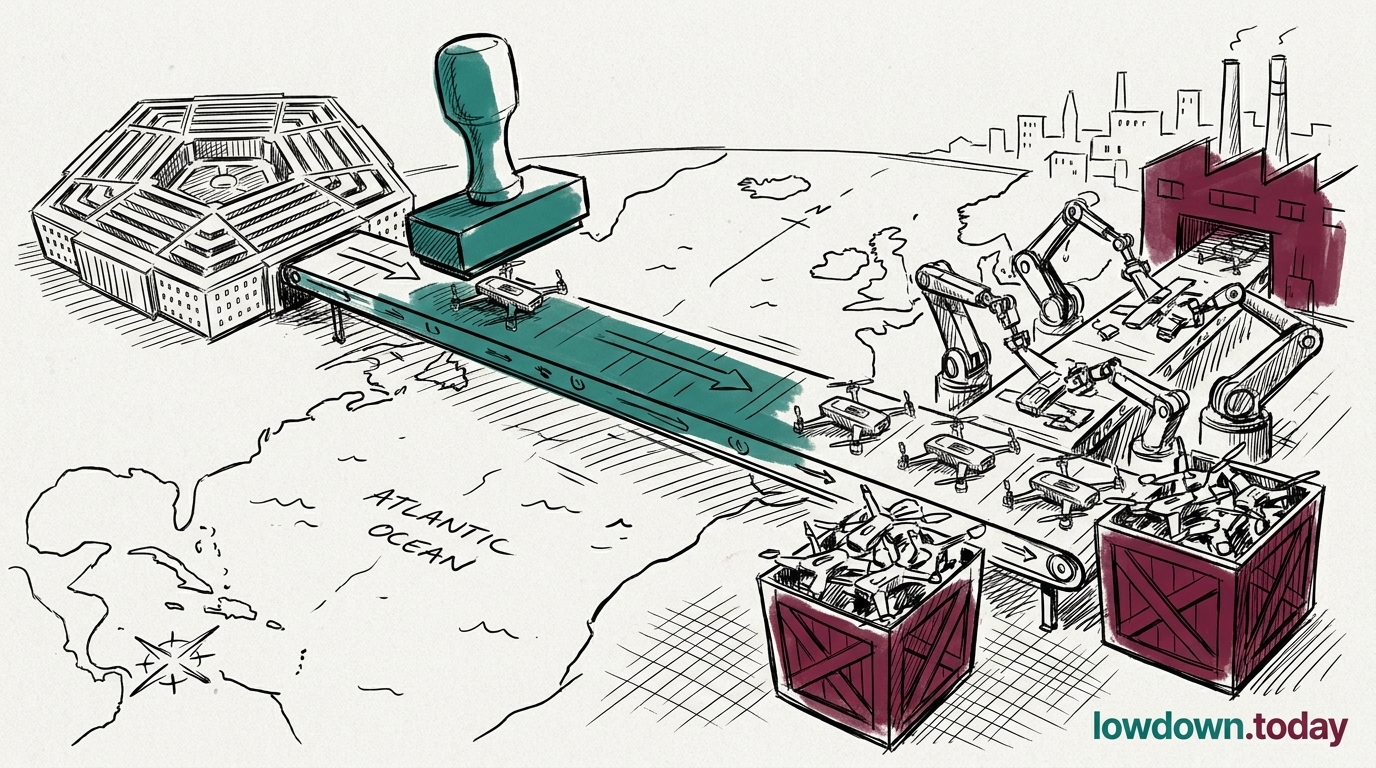
The US Space Force on Friday 24 April awarded a share of a $3.2 billion Other Transaction Authority pool for Golden Dome space-based interceptor prototypes to Anduril Industries, SpaceX, Lockheed Martin, Northrop Grumman, Raytheon Technologies (RTX), Booz Allen Hamilton, General Dynamics, GITAI USA, Quindar Inc., Sci-Tec Inc. and True Anomaly Inc. 1. Other Transaction Authority is a flexible Pentagon contracting vehicle that bypasses Federal Acquisition Regulation competition rules and Section 2304(c) source justifications, allowing the Pentagon to award prototypes to multiple firms in parallel and then convert them to production faster than a FAR-bound competitor.

The award sits on top of Anduril's $20 billion Lattice counter-UAS enterprise contract and the Arsenal-1 Fury production line that delivered its first YFQ-44A Fury collaborative combat aircraft (CCA) airframe four months ahead of schedule . Anduril, founded in 2017, now sits beside Lockheed and Northrop in space-based ballistic missile defence, in CCA, and in counter-UAS at the same time. That breadth was, until this week, the defining shape of a heritage prime: a portfolio that took Lockheed and Northrop three decades to assemble. The Golden Dome pool builds directly on the $10 billion Golden Dome top-up of March and was made possible at this scale by Anduril's four-platform Arsenal-1 expansion .

Used originally for SBIR-tier work, OTA pools at $3.2 billion are now the default vehicle for high-priority Pentagon autonomous-systems procurement. The structural effect is that companies less than a decade old can sit alongside the heritage primes on the same contract pool, which was not possible under FAR competition for high-dollar programmes. Spreading risk across eleven named bidders also signals that the Pentagon is buying breadth rather than crowning a single integrator, and that the OTA architecture itself is now the dominant procurement mechanism for category-defining contracts.

Heritage primes hold the counter-argument. None of the eleven recipients has yet demonstrated an on-orbit interceptor, and Lockheed and Northrop still hold the manufacturing base for solid rocket motors and space-rated avionics that any production winner will need. Whether Anduril's portfolio shape converts into a sustained primacy depends on the May to July congressional markup of the FY2027 request and on which of the eleven names survives the prototype downselection scheduled for FY2028.

Deep Analysis

In plain English

The US Space Force awarded $3.2 billion to twelve companies to develop space-based systems for shooting down ballistic missiles. This is part of Golden Dome, a US programme to build a missile defence shield in orbit. The contract type used; called an OTA pool; is a fast-track procurement vehicle that bypasses the normal competitive bidding rules. It lets the Pentagon fund multiple companies at the same time and pick winners later. Anduril, a nine-year-old company, now sits on the same contract alongside Lockheed Martin and Northrop Grumman, which spent decades building their defence portfolios.

Deep Analysis
Root Causes

OTA pools at scale are the institutional response to two problems the FAR framework failed to solve. First, the FAR source-selection process takes 18 to 24 months from solicitation to award; the Pentagon's autonomous-systems requirements have been updating every six to nine months based on Gulf and Ukraine attrition data. FAR-bound competition cannot keep pace with threat evolution.

Second, the heritage-prime model concentrates risk in single-vendor supply chains that proved brittle under the 300,000-drone Phase II target. Spreading prototype awards across twelve named bidders diversifies supply-chain risk while the market figures out which technical architecture wins. The OTA vehicle is the contracting tool that makes the breadth legally tenable; it allows parallel awards without triggering the FAR's sole-source justification requirements.

What could happen next?
  • Consequence

    The FY2028 prototype downselection will determine which of the twelve awardees receives the production contract. Companies that do not survive the downselection will have invested three years of engineering effort against a losing bid.

    Medium term · 0.78
  • Risk

    No named awardee has yet demonstrated an on-orbit interceptor. If the prototype phase reveals that space-based interception requires manufacturing capability only heritage primes possess, the OTA breadth strategy collapses back to a two-company competition.

    Medium term · 0.65
  • Opportunity

    For GITAI USA, Quindar Inc., Sci-Tec Inc. and True Anomaly Inc., the OTA award provides a programme-of-record reference that was previously inaccessible to firms of their size. Each now has a credible path to larger follow-on work.

    Short term · 0.8
  • Precedent

    A $3.2 billion OTA pool for prototypes establishes that OTA vehicles are now the Pentagon's standard mechanism for programmes at any dollar scale, not just early-stage pilot awards. Allied procurement offices will face pressure to adopt equivalent mechanisms.

    Long term · 0.72
First Reported In

Update #7 · DAWG jumps 24,000% as Anduril sweeps board

Fortune· 30 Apr 2026
Read original
Different Perspectives
Institutional investors and defence-sector equity markets
Perennial's IDIQ gives revenue-visibility that earlier Schmidt ventures lacked; Northrop's dual award places a heritage prime on the attritable-payload standard-setting layer analysts had reserved for startups. Rheinmetall at €650 per share, up from €500 in January, prices auto-grade drone conversion as margin-accretive; DroneShield's ASIC probe introduces a governance-discount variable proxy advisers will apply at the 29 May AGM.
Korean defence-industrial sector (LIG Nex1, Hanwha Aerospace)
LIG Nex1's $2.2 billion Cheongung-III win and the KUS-FS service introduction together close Seoul's sovereign layered air-defence stack; both firms face multi-year backlog revisions on the Korea Exchange. The unresolved sensor-to-shooter integration risk between Hanwha's LAMD sensors and LIG Nex1's Cheongung-III engagement layer sits publicly unaddressed ahead of the 2029 fielding date.
Ukrainian export regulator (SSEC)
Ukraine's wartime export ban blocks Gulf sales of combat-proven interceptors at $2,100 to $2,500 per unit while Perennial Autonomy, built on Ukrainian combat data, wins a $500 million US IDIQ. Perennial's Merops, credited with 4,000-plus Russian drone kills in Ukraine, can now reach NATO allies via Munich; a direct Ukrainian sale to those same buyers remains legally blocked.
DJI and Autel Robotics
Autel's Ralls Corp filing attacks the classified-evidence foundation of its Covered List designation; DJI's parallel Ninth Circuit case has quantified $1.56 billion in 2026 regulatory losses. Both companies are now betting the D.C. Circuit will extend due-process protections to FCC product certification, a constitutional route that does not require contesting the intelligence allegations directly.
US Pentagon defence-industrial-base policy
JIATF-401's IDIQ names Perennial the benchmark holder while Anduril's $20 billion Lattice vehicle and Northrop's Drone Dominance payload role run in parallel lanes; the DoD bet is that named holders at each tier cut order-to-delivery cycles. The Section 232 clock 54 days overdue signals the administration treats FCC and FAR exclusions as sufficient to manage Chinese market access.
European defence procurement community
Germany's three-tier award demonstrates that EU member states can fund loitering-munition production at scale without single-supplier dependency, and Perennial's Munich line gives procurement offices a domestic-source justification for Merops orders outside US Foreign Military Sales channels. The Bundeswehr's split across Helsing, Stark and Rheinmetall has become the reference architecture other European buyers are mapping their own industrial bases against.
