Skip to content
Briefings are running a touch slower this week while we rebuild the foundations.See roadmap
Drones: Industry & Defence
13APR

RTX demos reusable Coyote against swarms

4 min read
13:26UTC

RTX on 21 April reported a Foreign Military Sales case approved for Coyote sales to the UAE and demonstrated a non-kinetic reusable Coyote variant capable of engaging a drone swarm, returning to base, and redeploying.

TechnologyDeveloping
Key takeaway

RTX's reusable Coyote answers the cost-per-engagement problem; effectors crossed 40% of Raytheon segment sales.

RTX reported on Tuesday 21 April that effectors now make up over 40% of Raytheon segment sales, with double-digit growth in Q1, and that a Foreign Military Sales case (US government brokered defence export, FMS) has been approved for Coyote counter-drone sales to the United Arab Emirates 1. Raytheon also demonstrated something the C-UAS field had not seen before: a non-kinetic, reusable Coyote variant that engages a drone swarm, returns to base, recharges, and redeploys for the next salvo. Collins Aerospace, the RTX subsidiary, separately completed a flight test of its mission autonomy software for the Air Force CCA programme.

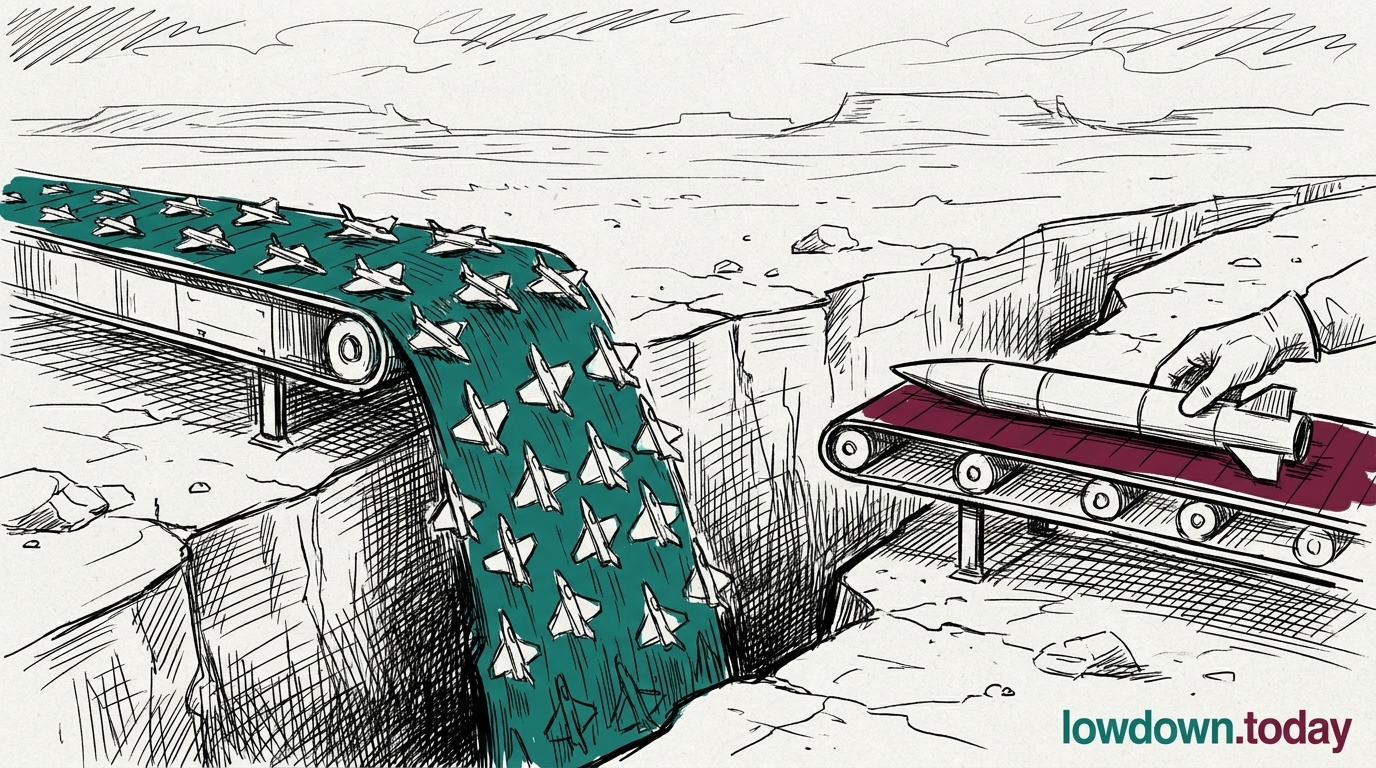
The reusable Coyote is the first declared response to the cost-per-engagement problem that drove the AeroVironment LOCUST X3 delivery to the Rapid Capabilities and Critical Technologies Office (RCCTO) at $5 per engagement and the UK's emergency Skyhammer buy. A kinetic Coyote round costs in the low six figures; a non-kinetic reusable variant collapses that to the cost of recharging and refurbishment per sortie. Whether the unit-economics work depends on how many engagements a single airframe can absorb before refurbishment exceeds the price of a fresh Coyote, which RTX has not yet disclosed.

Collins Aerospace's flight test puts a third autonomy stack into a CCA competition that had appeared to be Shield AI Hivemind versus Anduril's Lattice. Collins brings the full RTX Foreign Military Sales channel into a fight that had been dominated by venture-backed software firms; the Air Force programme office now has three credible bidders rather than two, and the procurement-office logic shifts from sole-source justification to genuine downselection.

Gulf attrition since 28 February has made the UAE the most operationally relevant non-US C-UAS customer, and the Coyote sale converts that demand into a roughly $1.5 billion programme of record over the next decade. The effectors share of Raytheon segment sales crossing 40% is the structural marker: missiles, interceptors and counter-drone rounds are now the majority of the segment's revenue, ahead of radars and command-and-control systems for the first time in RTX's history.

Deep Analysis

In plain English

Raytheon Technologies reported on 21 April that more than 40% of its weapons-division revenue now comes from effectors; missiles and interceptors; rather than radar and command systems. The US approved the sale of Coyote, a counter-drone interceptor, to the United Arab Emirates. Raytheon also showed a new version of Coyote that uses electronic jamming rather than an explosive warhead. After engaging a drone swarm, this version can fly back to base, recharge, and fly again. If the economics hold, one aircraft replaces dozens of expensive single-use missiles over a conflict. Separately, a Raytheon subsidiary flight-tested software that lets unmanned combat aircraft fly cooperatively without human pilots.

Deep Analysis
Root Causes

Effectors crossing 40% of Raytheon segment sales reflects a structural demand shift that Gulf attrition data produced. The UAE's absorption of 55% of loitering-munition strikes since 28 February 2026 generated emergency FMS case demand that Raytheon's existing Coyote production line could not fill from stock.

The UAE FMS approval accelerated a case that would normally take 18 to 24 months through the formal FMS pipeline to roughly half that time; a political decision driven by the UAE's operational losses rather than the standard foreign-partner notification cycle.

What could happen next?
  • Consequence

    Collins Aerospace's CCA autonomy flight test puts a third credible software stack into the Air Force Collaborative Combat Aircraft competition, reducing the probability of a sole-source award to either Shield AI or Anduril and increasing the likelihood of a competitive downselection.

  • Opportunity

    If RTX publishes reusable Coyote refurbishment economics before the FY2027 NDAA markup, it gains a first-mover advantage in the reusable-effector category; a market that does not yet formally exist in Pentagon procurement doctrine.

First Reported In

Update #7 · DAWG jumps 24,000% as Anduril sweeps board

Motley Fool· 30 Apr 2026
Read original
Different Perspectives
Chinese drone manufacturers (DJI, Autel)
Autel's Ralls Corp Fifth Amendment filing and DJI's Ninth Circuit quantification of USD 1.56 billion in 2026 losses are parallel constitutional attacks on a classified-evidence exclusion mechanism; neither company can contest the intelligence allegations directly, so both are betting on due-process doctrine to reopen the FCC authorisation route.
Ukraine (SSEC export regulator)
Baltic states bought Lithuanian Merops and Swedish LVKV 90 stopgaps while Ukraine's cheapest combat-proven interceptors at USD 2,100 to USD 2,500 per unit remain legally blocked under EU conflict-aggravation rules; Perennial Autonomy, built on Ukrainian combat data, can now sell via Munich while direct Ukrainian sales to the same buyers remain prohibited.
Helsing
Helsing
HX-2 combat-proven status, a EUR 1.46 billion German framework, an $18 billion valuation, and the OHB space JV together constitute the first credible European counterweight to Anduril's US stack. The critical test is whether European procurement offices can maintain sovereign AI discipline under operational urgency, or default to the US integration speed that drove the Netherlands Lattice decision.
Anduril Industries
Anduril Industries
A USD 61 billion valuation on USD 2.2 billion revenue prices in the assumption that Lattice becomes the default Western counter-drone software layer. The Netherlands adoption and Project NYX inclusion suggest the architecture bet is converting; the S-1 filing window opens when quarterly growth sustains the 27x multiple.
European Union
European Union
The EUR 115 million AGILE programme was designed before Baltic states began emergency national purchases worth ten times the total EU budget; calling for coordination on 26 May after each country had signed contracts is not a procurement policy, it is a statement of concern with no enforcement teeth.
UK Ministry of Defence
Britain has committed GBP 752 million to Ukraine drones, GBP 115 million to Hormuz, APKWS to Gulf combat, and three concurrent procurement programmes, all driven by the same operational pressure. Project NYX and Corvus together set the British Army's drone architecture through 2036; the autumn down-select will reveal whether Washington or London holds the architectural preference.
