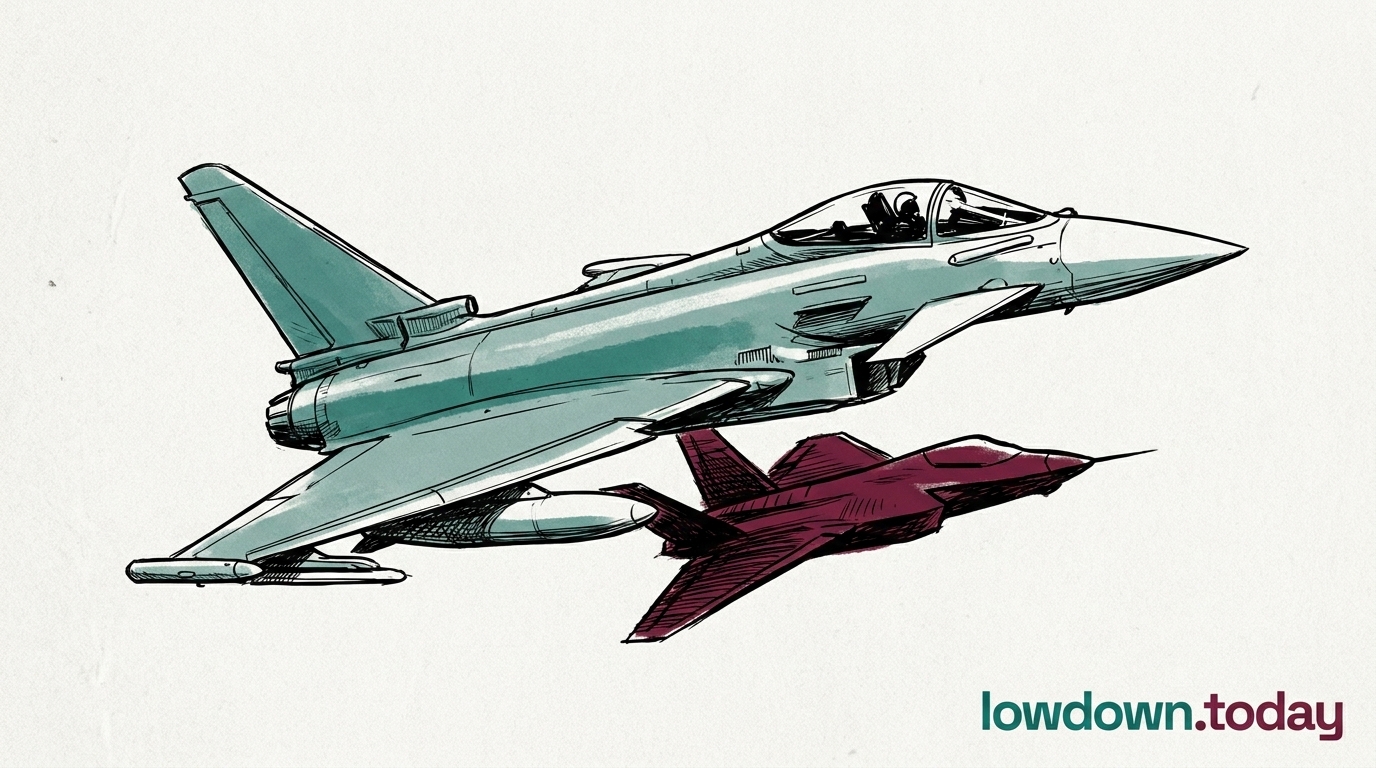
BAE Systems unveiled Brontanax, Britain's first home-built pilotless fighter designed to fly into combat alongside crewed jets, at the Farnborough International Airshow on Wednesday 22 July. It is the country's first sovereign uncrewed Collaborative Combat Aircraft (CCA), a jet that flies and fights under the direction of a piloted aircraft. Built at Warton in Lancashire by more than 500 staff and 75 partner firms, the aircraft is sized like a Hawk trainer and directed from the cockpit of a Typhoon, whose pilot commands it for electronic warfare and precision strike. A prototype is targeted to fly alongside a Typhoon by the end of 2027, with entry into service before the decade closes.1
The unveiling attaches an airframe to money already on the books. Britain's £5 billion Defence Investment Plan names a £300 million StormFighter programme to develop exactly this class of sovereign autonomous combat aircraft, and Brontanax is the first hardware to sit against that line. It slots above the first low-cost air-defence effector awards Britain made this month under LCADE, giving the air force a domestic apex to an autonomy stack it had been assembling contract by contract.
BAE is building the capability two ways at once. Under its FalconWorks advanced-projects arm it builds the CCA in-house, while wholly owned subsidiaries Malloy Aeronautics (heavy-lift logistics drones) and Callen-Lenz (smaller intelligence, surveillance and reconnaissance platforms) supply the tiers around it. One prime now owns logistics, ISR and combat air under a single roof, a vertical span no other British firm holds.2
Washington reached production first. The US Air Force awarded CCA production to Anduril and General Atomics in June while Britain is unveiling a demonstrator two years from first flight. America has combat aircraft on a line; the UK has a prototype, a named programme, and a 2027 clock.




