Skip to content
You can now search across every topic, entity and event.What's new
Data Centres: Boom and Backlash
7JUL

Virginia signs first per-kWh power tax

3 min read
09:27UTC

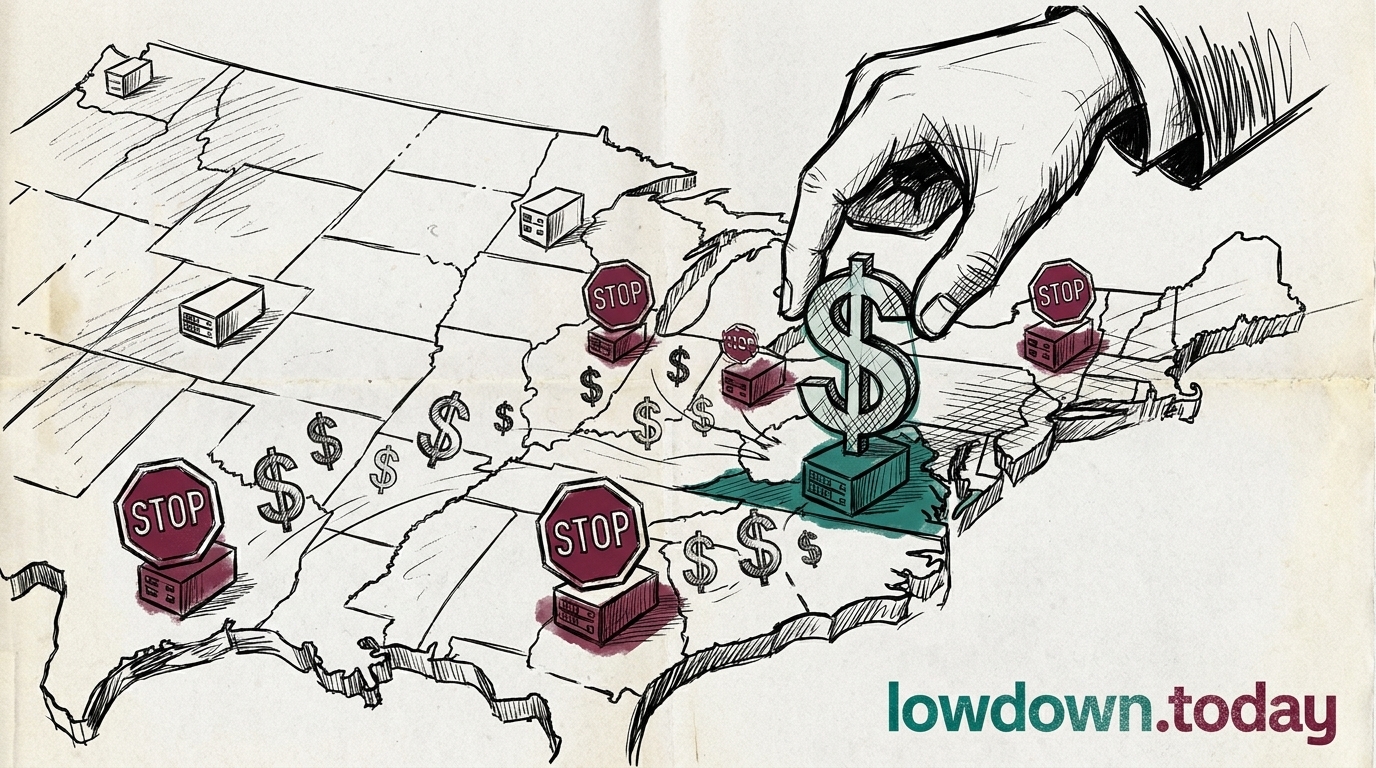
Abigail Spanberger signed Virginia's $0.011-per-kilowatt-hour data-centre tax on 30 June, the first US levy on compute power itself, and the rival backup-generator fee died with it.

IndustryDeveloping
Key takeaway

Virginia now taxes the power a data centre burns, including the power it makes on site.

Virginia Governor Abigail Spanberger signed a $0.011 per kilowatt-hour consumption tax on data-centre electricity into law on 30 June, a day before it took effect on 1 July. 1 It is the first US charge levied on the power a computing campus actually draws, and it reaches every source: utility supply, competitive retail from third-party suppliers in deregulated markets, and behind-the-meter self-generation, the private gas and battery power that never touches the public grid.

The signature settled a months-long fight over method. The state legislature had passed the tax on 22 June , but Senate negotiators were still pushing a rival $35-45 per kilowatt charge on backup generators, the "Lucas fee" , to break a budget deadlock. Signing the consumption model killed that alternative. Virginia's State Corporation Commission, the utility regulator, will collect monthly, with the first payment due in September.

Rob Gramlich of the energy consultancy Grid Strategies puts the effective rate rise near 10%. A 500-megawatt (MW) campus will owe about $48m a year, a full gigawatt campus close to $100m. 2 Operators pass most of that through to their cloud customers. The mechanism matters more than the rate: a per-kilowatt capacity fee taxes installed hardware, which reads in court as a regulatory taking, while a tax on electricity drawn is an ordinary excise. Virginia picked the litigation-proof instrument, and that is what other states will copy or reject.

Deep Analysis

In plain English

Virginia just started charging data centres for every unit of electricity they use, whether that power comes from the grid or from a generator or battery on site. The self-generated power used to escape state tax entirely. A company running a modest server room barely notices the charge. A campus the size of a small town's power plant can end up owing tens of millions of dollars a year. Virginia's utility regulator, the State Corporation Commission, will collect the money monthly starting in September.

Deep Analysis
Root Causes

Virginia's choice of mechanism turns on a legal distinction the fight over the rate obscured. A fee on installed generating capacity risks a Takings Clause challenge because it prices equipment an operator already owns, while a tax on electricity consumed prices an ongoing transaction and reads to courts as an ordinary excise. The Senate's own $35-45 per kilowatt generator fee tested the riskier instrument first and lost.

The tax also closes a gap federal curtailment could not reach. The Department of Energy's 2026 curtailment orders in PJM territory applied only to grid-connected power; Virginia's consumption tax is the first instrument to price behind-the-meter generation, the private gas and battery supply operators built specifically to sit outside federal reach.

What could happen next?
  • Precedent

    Virginia's consumption-tax model becomes the template other high-density states test before drafting comparable legislation.

  • Risk

    The tax's $600m annual cap and 30 June 2028 sunset mean Virginia may need to renegotiate the mechanism again as more campuses come online.

First Reported In

Update #9 · US data-centre backlash becomes law

Tech Times· 7 Jul 2026
Read original
Causes and effects
This Event
Virginia signs first per-kWh power tax
It gives every other state a working template for taxing what a data centre burns rather than what it installs, on the instrument least exposed to a takings lawsuit.
Different Perspectives
Global hyperscale operators
Operators are still filing gigawatt-scale campuses and Meta is proceeding with its $10bn Lebanon, Indiana site despite the county-level bans nearby, betting Q2 capex outruns the patchwork of restrictions. Industry framing casts New York's freeze, Oregon's surcharge and Indiana's bans as taxes and levies that push build-out toward faster-permitting jurisdictions such as India and the Gulf.
EirGrid
EirGrid
EirGrid set a 900 MW instantaneous demand-loss ceiling because a single voltage dip can trip many data centres onto backup power at once, risking imbalance above 1,150 MW. It wrote the limit into a standing procedure rather than waiting for an emergency to force one.
US host communities and ratepayers
Prince William residents backed the 8-0 denial of Dulles South over the Occoquan watershed, drinking water for eight million people, while Oregon's approved tariff cuts residential bills 1.3% by charging large loads 29% more. Their position: consent and cost-attribution belong in law, not left to a developer's or a utility's discretion.
Hassan Allam Digital Infrastructure
Hassan Allam Digital Infrastructure, an Egyptian conglomerate rather than a foreign hyperscaler, reportedly secured a domestic hyperscale licence with a $400m first phase, per single-source reporting still to be verified. It reads as home-grown sovereign compute ambition, building national capacity rather than importing a US or Gulf operator's campus.
Damac Digital
Damac Digital
Damac Digital keeps building toward roughly 6,000 megawatts of hyperscale capacity across 13 countries while Virginia taxes power and New York weighs a freeze. Every dollar or month of delay a US state adds is capacity a Gulf developer can site somewhere with faster permitting and no equivalent levy.
Acequia communities, Santa Fe County
Santa Fe County commissioners voted unanimously on 2 July to freeze any data centre over one megawatt, citing the acequia irrigation commons that has shared scarce water since Spanish colonial rule. They expect the low threshold to draw the same Fifth Amendment challenge RCM Hill brought against Hill County, Texas.

