Skip to content
You can now search across every topic, entity and event.What's new
Autonomous Systems: Land & Sea
11JUL

A £6.68m trial holds the subsea money

2 min read
10:27UTC

The Submarine Delivery Agency awarded M Subs £6.68m on 24 June to trial XV Excalibur, the largest uncrewed underwater vessel the Royal Navy has put in the water.

TechnologyDeveloping
Key takeaway

The only funded submarine-robot work this fortnight is a £6.68m trial, three orders of magnitude below the plan it underpins.

The Submarine Delivery Agency awarded M Subs of Plymouth £6,680,147 on 24 June 2026, running to 1 May 2028, for trials of XV Excalibur, the CETUS-programme extra-large uncrewed underwater vehicle. At 12 metres and 19 tonnes it outsizes the crewless minehunter the Royal Navy sent toward Hormuz in May , and the award was sole-sourced because M Subs is the vehicle's only designer.

Set the two 30 June numbers side by side: a £5bn plan names a Type 93 class, and a £6.68m contract funds the one extra-large underwater vehicle that class currently rests on. The trial runs to 2028, so a Type 93 fielding decision cannot lean on Excalibur data before then, which is why the plan's subsea timeline stays soft.

For the procurement reader this is the useful signal in the fortnight: an actual contract, an actual value, an actual incumbent to displace, against a headline plan that is still nomenclature.

Deep Analysis

In plain English

The navy is paying a Plymouth company nearly seven million pounds to test its biggest robot submarine, a 12-metre, 19-tonne uncrewed vessel, over the next two years. This is the one piece of real, funded work behind the much larger plan to build a whole class of underwater robots, which shows how far the announced ambition runs ahead of the money actually committed.

Deep Analysis
Root Causes

The award is pulled by the AUKUS and Type 93 undersea requirement: Britain needs a home-grown extra-large underwater vehicle to avoid depending wholly on US platforms for seabed and anti-submarine autonomy.

The sole-source route reflects M Subs' position as CETUS's only designer, which concentrates the UK's extra-large underwater vehicle knowledge in one Plymouth SME.

What could happen next?
  • Consequence

    M Subs becomes the reference supplier on the Royal Navy's largest uncrewed underwater vehicle, a position rivals must displace.

  • Meaning

    A trial running to 2028 means a Type 93 fielding decision cannot rest on Excalibur data before then.

First Reported In

Update #5 · Britain names four robot warship classes

The Defense Post· 3 Jul 2026
Read original
Causes and effects
This Event
A £6.68m trial holds the subsea money
This is the funded, dated, contracted reality sitting under the Type 93 banner, and its scale against the £5bn plan is the clearest live measure of announcement versus delivery on this beat.
Different Perspectives
China (military commentary)
Chinese military commentary has called uncrewed maritime equipment 'an excellent force multiplier' that cannot overturn the fundamental logic of naval warfare, the lone voice against the Western consensus that autonomy is the central axis of naval modernisation. Beijing reads the airdrop trial as an incremental logistics fix, not London's claimed doctrinal breakthrough.
Iran (Ministry of Foreign Affairs)
Spokesman Kazem Gharibabadi said clearance of the Hormuz mines is 'Iran's sole responsibility', rejecting the Omani-authorised allied mine-clearance mission as a jurisdictional dispute rather than a technical favour. Tehran has not ratified UNCLOS, the treaty that would otherwise settle transit-passage rights through the strait.
Norway (Kongsberg Discovery)
Kongsberg Discovery's Camilla Kiss said the subsea-protection contract shows the industry 'moving from recognising the need to implementing solutions', selling fused sonar and C-Scope software to an unnamed buyer because fragmented cable, pipeline and platform ownership means no single navy commissions this the way it commissions a warship.
Ukraine (Trinity Robotics)
Trinity Robotics doubled its Konyk One production target to 2,200 units and opened French joint-venture talks, co-founder Oleksii Konik said, because wartime demand outpaces what factories inside a live-fire war zone can safely hold. Ukraine is answering the authority gap other actors face by manufacturing around it.
United Kingdom (Ministry of Defence and Royal Navy)
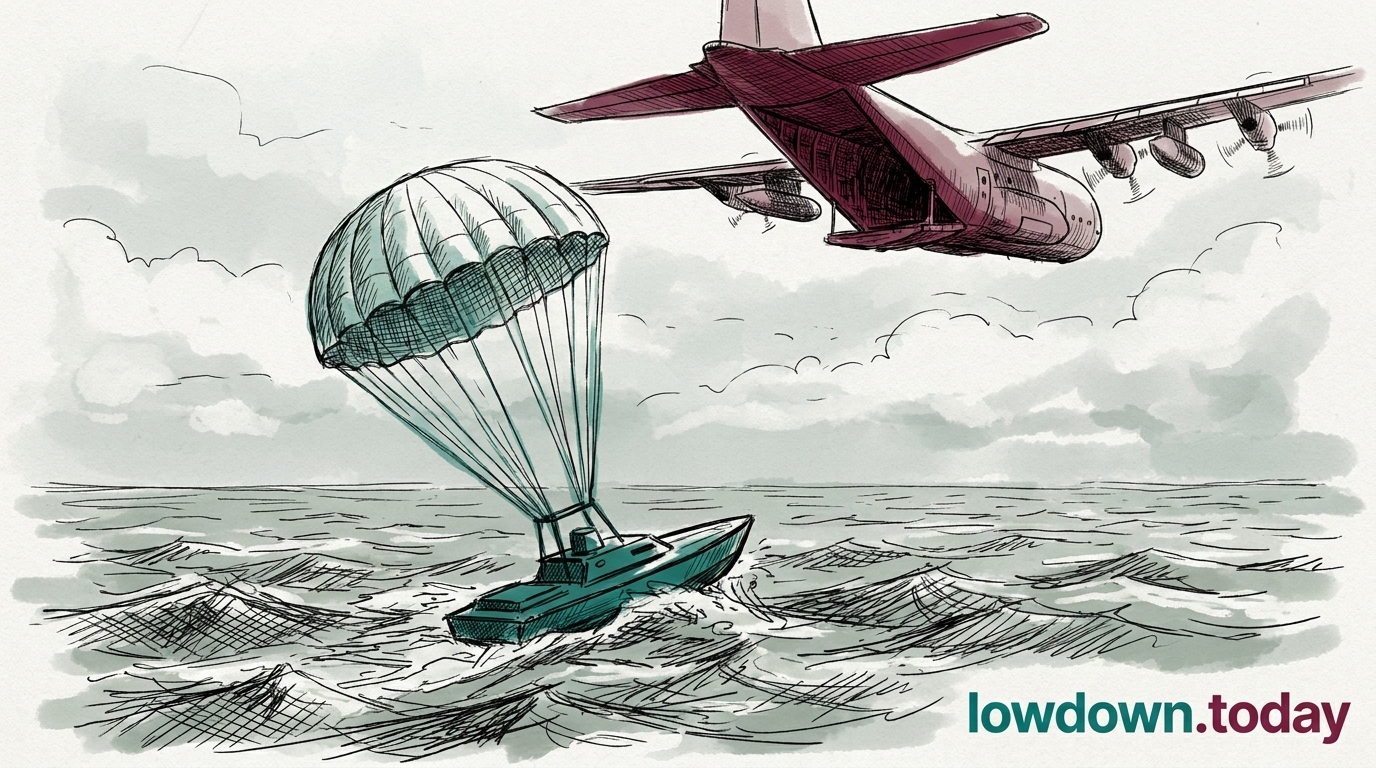
The Royal Navy proved it can airdrop a mine-hunting robot from any A400M into Sea State 4 waters, working round a front line of just six Type 45 destroyers and eight Type 23/26 frigates rather than waiting for more hulls. First Sea Lord Gwyn Jenkins's 'uncrewed wherever possible' doctrine gets a delivery method; it still lacks a named operational deployment.
Nautilus International
Nautilus International pressed the unresolved liability gaps as the MASS Code entered force, noting a master stays legally responsible without saying who answers when ashore. Entry into force changed nothing an operator may legally do, leaving the seafarer-displacement question open.