Skip to content
You can now search across every topic, entity and event.What's new
Autonomous Systems: Land & Sea
12AUG

Undersea robots go core at BALTOPS

3 min read
14:17UTC

The US Navy ran the Iver3 autonomous underwater vehicle off Latvia from 8 June, the first time in 55 years that uncrewed undersea systems were a core part of NATO's Baltic exercise rather than a side trial.

TechnologyDeveloping
Key takeaway

NATO drilled both hunting mines with robots and stopping enemy ones, the usual precursor to a buying wave.

The US Navy operated the Iver3 autonomous underwater vehicle (AUV) off Liepaja, Latvia between 8 and 10 June, the first time in BALTOPS's 55-year history that uncrewed undersea systems ran as a core capability and not an experiment 1. BALTOPS is NATO's annual Baltic Sea exercise; this year it drew 15 nations across 4 to 19 June. The Iver3 mapped the seabed, hunted mines and ran electronic surveillance over a Baltic floor laced with the cables and pipelines that have been cut and dragged repeatedly since 2022.

NATO also drilled the harder half of the problem: stopping a hostile robot. Crews tested counter-AUV measures and ran a multinational detect-to-remediate chain, with Netherlands explosive-ordnance-disposal (EOD) teams and Latvian personnel working behind the vehicle that made each detection 2. The same shift showed up a week earlier, when NATO sent uncrewed systems to watch the Greenland-Iceland-UK (GIUK) gap . In a single fortnight, seabed defence moved from a doctrine paper to a rehearsed core task across two exercises.

For suppliers, the detect-to-remediate chain carries the procurement signal. NATO is no longer shopping for a single clever sensor; it is buying a networked pipeline that runs from detection through to an EOD response. That favours firms able to integrate across the chain over those selling one vehicle, and it turns a rehearsed workflow into a procurement specification others must now build to.

Deep Analysis

In plain English

BALTOPS (Baltic Operations) is a NATO naval exercise held every year since 1971. In 2026, for the first time in that 55-year history, the alliance used an autonomous underwater vehicle (AUV) as a core part of the exercise rather than just a demonstration add-on. The Iver3 is an autonomous underwater vehicle (AUV): a submersible robot that navigates on its own, uses sonar to scan the seabed for objects like mines or sabotaged pipelines, and sends its findings back to a control team. The US Navy deployed the Iver3 AUV off Liepaja, Latvia, where it mapped the seabed and hunted mines. NATO also practised counter-AUV drills, rehearsing how to detect and neutralise enemy underwater robots, and ran a multinational 'detect-to-remediate' chain where the AUV's findings were handed off to Dutch explosive-ordnance disposal (EOD) teams and Latvian personnel for follow-on action.

Deep Analysis
Root Causes

Two structural factors drove the BALTOPS 2026 integration.

The 2023 Balticconnector pipeline rupture and subsequent Nord Stream investigation exposed NATO's persistent surveillance deficit under the Baltic Sea; the IISS documented fewer than six maritime patrol aircraft sorties per day over Baltic seabed infrastructure, insufficient to detect or attribute slow-moving subsea threats. This created a standing unfunded requirement for persistent, low-cost seabed sensing.

The Iver3 AUV's entry into routine US Navy operations, rather than experimental programmes, gave BALTOPS planners a platform with a maintenance and training baseline already established; deploying a fielded system requires a force integration decision rather than an acquisition decision, which shortened the doctrinal adoption path significantly.

Escalation

Doctrinal consolidation, not escalation. Running counter-AUV drills signals NATO acknowledges potential adversary use of similar systems; this is prudent capability mirroring rather than a provocation. The exercise ran within established Baltic frameworks.

What could happen next?
  • Consequence

    Running undersea uncrewed systems as core BALTOPS capability for the first time creates a standing NATO requirement that drives procurement across allied navies; the 15-nation participation means the demand signal reaches defence budgets in multiple European capitals simultaneously.

  • Precedent

    The multinational detect-to-remediate chain run at BALTOPS 2026 establishes a NATO interoperability standard for AUV-to-EOD handoff; future exercises will test compliance with that standard rather than demonstrate the concept.

First Reported In

Update #4 · Allied robot minehunters reach the Gulf

DVIDS / US Department of Defense· 24 Jun 2026
Read original
Causes and effects
This Event
Undersea robots go core at BALTOPS
A standing NATO requirement for seabed protection reads to European yards as the start of a procurement wave for undersea robots.
Different Perspectives
Conservative opposition
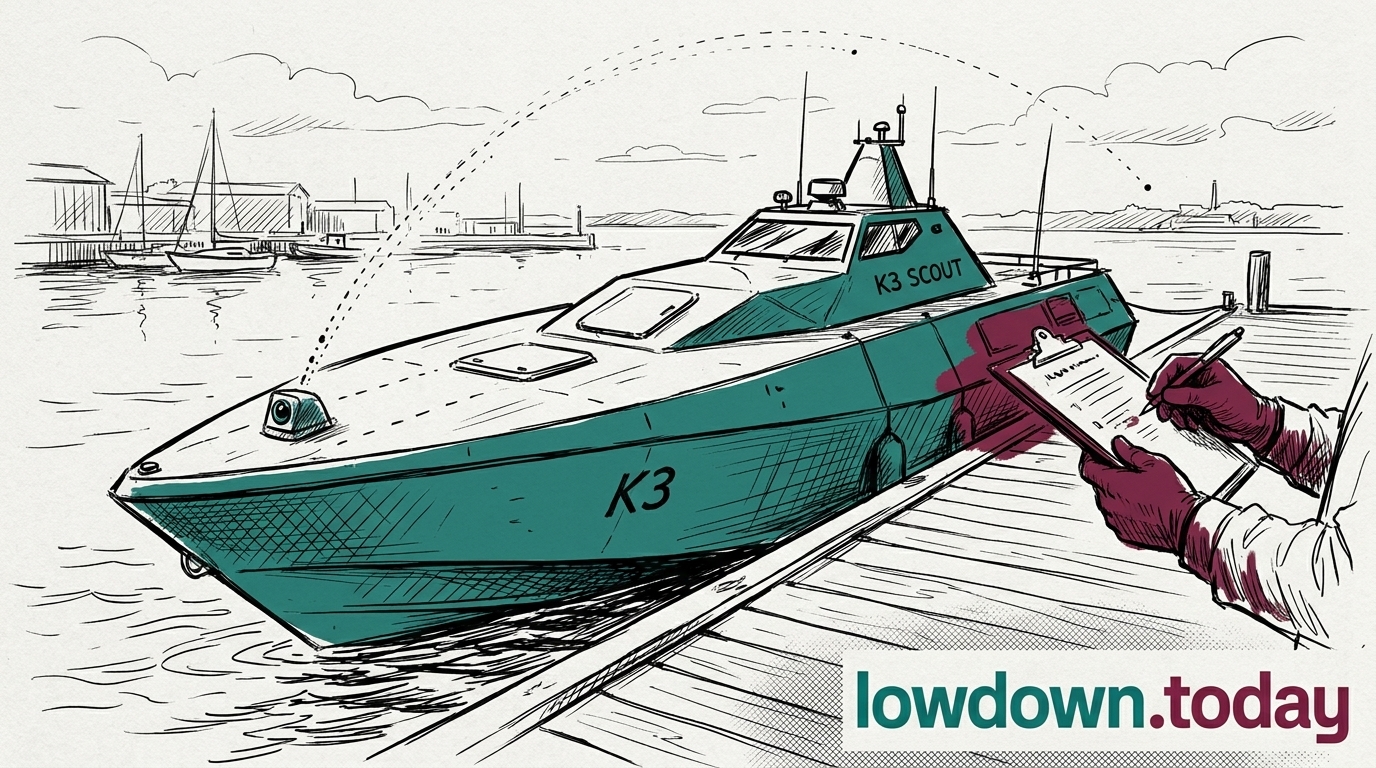
The Conservative opposition called on the Government on 9 August to 'urgently audit' equipment for hidden Chinese components, after the Telegraph's K3 SCOUT report. No named MP has been quoted on the record; the call came at party level, alongside the Ministry of Defence's own 10 August statement that no data had been compromised.
Netherlands Ministry of Defence
The Netherlands Ministry of Defence authorised Dutch Naval Design on 4 August to design 12-metre anti-submarine warfare uncrewed vessels for the Dutch-Belgian frigate programme, and to buy an adapted Compact FLASH dipping sonar from Thales Underwater Systems France. The order commits money and a named supplier while Britain's own certification body remains at the market-engagement stage.
Kraken Technology Group
Kraken Technology Group is a UK maritime-defence company based in Portsmouth that builds the K3 SCOUT, and crossed a $1bn valuation in July on a single-sourced $175m raise. The camera components reached the fleet under a third party's written security assurance, which the Platform Authority, which does not yet exist, was never positioned to check.
Navy Commercial
Navy Commercial
Navy Commercial at Whale Island published two notices on 5 August: 074032-2026, asking industry how to build a Platform Authority to certify uncrewed vessels, and 074351-2026, a GBP10m multi-role USV testbed for the Defence Chief Technology Officer. Responses on the Platform Authority close 19 August, ten days after the cameras were found transmitting to China.
Ministry of Defence
Ministry of Defence
The Ministry of Defence said on 10 August that a routine cyber vulnerability assessment found the camera fault, and a thorough investigation found no evidence that MoD data or systems had been accessed, compromised or transmitted externally. It stripped the cameras of internet connectivity but did not say whether it acted against the supplier.
Thales
Thales
Thales converted its 6 July engaging accord with Exail into a definitive combination agreement on 30-31 July, but the tender offer for Exail's remaining shares now closes by early 2028, later than July's timetable implied. Thales integrates its new undersea prime while still bidding against Kongsberg and DRASS's 2027 target for the AUKUS Pillar II contest.
