Skip to content
You can now search across every topic, entity and event.What's new
Autonomous Systems: Land & Sea
12AUG

Ukraine weighs lifting arms export ban

3 min read
14:17UTC

Ukraine banned weapons exports in 2022 to keep every round for its own survival. Gulf demand and fiscal pressure are now forcing a rethink.

TechnologyDeveloping
Key takeaway

Ukraine is converting battlefield expertise into a durable foreign policy instrument through arms exports.

Ukrainian officials are discussing the creation of a state-regulated arms export market, though no formal lifting of the 2022 export ban has occurred 1. The National Security and Defence Council will determine what weapons can leave the country without weakening Kyiv's own capacity — a question that shifted from hypothetical to urgent when eleven countries formally requested Ukrainian counter-drone help and Gulf States began submitting purchase orders for thousands of interceptor drones.

The ban was a wartime necessity. In early 2022, Ukraine was losing territory daily and scrambling for ammunition from any source. Exporting anything was unthinkable. But Ukraine's defence industrial base has changed since then. The country now MASS-produces interceptor drones, has developed electronic warfare systems tested against platforms no other nation has faced, and fields unmanned naval and aerial systems that Western defence firms would take years to replicate. What began as an offer to share counter-drone expertise escalated within a fortnight to crew deployments across four Gulf States and arms purchase requests from eleven countries 2.

The fiscal argument is concrete. Ukraine's economy has contracted sharply during the war. Western military aid faces political uncertainty in Washington — where congressional appropriations are contested cycle by cycle — and fatigue in European capitals. Arms export revenue, denominated in Gulf currencies and backed by governments with large sovereign wealth funds, would give Kyiv an income stream independent of allied budgets. A country whose technology other nations need for their own defence holds leverage that one dependent entirely on allied goodwill does not.

The corresponding risk is equally concrete. Russian drone volumes now exceed 9,000 per week , and the 13–14 March barrage alone comprised 430 drones and 68 missiles targeting Energy infrastructure. Every interceptor drone exported is one not available over Kyiv, Kharkiv, or Odessa. The Council must identify the threshold: how much can Ukraine export before its own population pays the cost in unintercepted strikes. That calculation requires honest assessment of production capacity, current stockpiles, and the rate at which Russian attacks are intensifying — none of which Kyiv has disclosed publicly.

Deep Analysis

In plain English

Ukraine banned weapons sales abroad in 2022 to keep everything for its own defence. It has since mass-produced cheap, battle-proven anti-drone systems that Gulf states urgently want and cannot source cheaply from Western suppliers. Opening an export market would give Kyiv revenue independent of Western aid packages. It would also build political relationships with Gulf buyers who now have a direct stake in Ukrainian industrial survival — a new form of diplomatic leverage Kyiv did not previously hold.

Deep Analysis
Synthesis

Arms exports would embed Kyiv into the strategic calculations of states that previously had no stake in Ukrainian sovereignty. Gulf buyers with signed contracts acquire an incentive to oppose any peace settlement that leaves Ukraine defenceless or dismantles its defence industry. This expands Kyiv's diplomatic coalition in ways that Western security guarantees alone cannot replicate.

Root Causes

Three structural forces drive the reversal. Ukraine has achieved genuine mass-production capacity for low-cost interceptors. Gulf states face a threat that expensive Western systems cannot affordably address at scale. Ukraine also requires revenue streams not subject to Western parliamentary approval cycles, which have proven politically unreliable.

Escalation

The export discussion signals production confidence. Kyiv would not publicly entertain diverting output unless it assessed domestic stocks as adequate. This is a structural uplift in Ukraine's geopolitical weight, not a tactical adjustment — and it is largely irreversible once contracts are signed.

What could happen next?
  • Precedent

    A wartime arms export framework established by a country under active invasion would be historically novel and structurally difficult to reverse post-conflict.

    Medium term · Assessed
  • Opportunity

    Export revenue could reduce Ukraine's dependence on Western aid conditionality, strengthening Kyiv's hand in ceasefire negotiations where aid leverage is routinely applied.

    Medium term · Suggested
  • Risk

    Production diversion toward export contracts could create domestic air-defence coverage gaps if Russian strike tempo continues to increase.

    Short term · Suggested
  • Consequence

    Gulf states purchasing Ukrainian systems acquire a direct stake in Ukrainian industrial survival, expanding Kyiv's diplomatic coalition well beyond Europe and North America.

    Medium term · Assessed
First Reported In

Update #4 · Ukraine pivots to drone exporter

Kyiv Independent· 15 Mar 2026
Read original
Causes and effects
This Event
Ukraine weighs lifting arms export ban
A state-regulated Ukrainian arms export market would generate revenue, reduce dependence on Western aid, and strengthen Kyiv's negotiating position — but risks weakening domestic air defence while Russian strike volumes are at record levels.
Different Perspectives
Conservative opposition
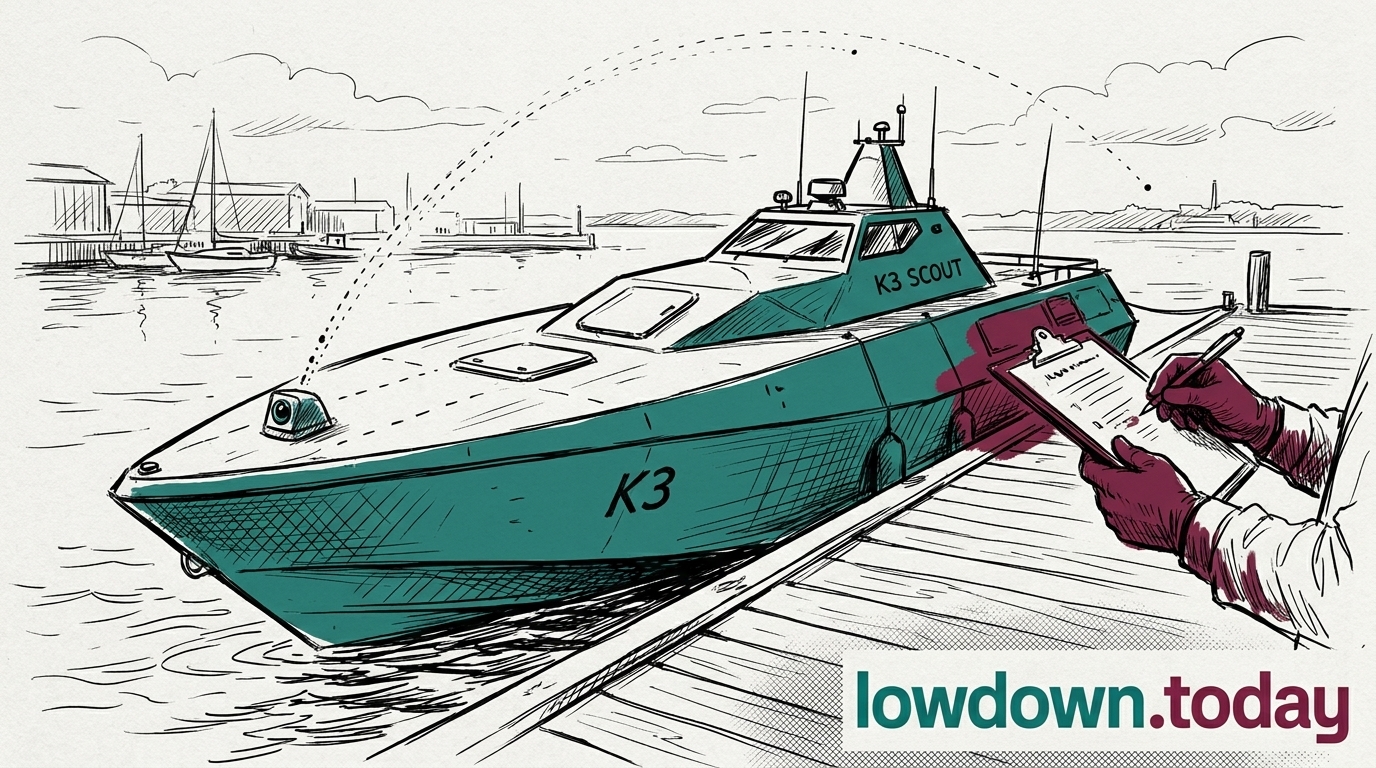
The Conservative opposition called on the Government on 9 August to 'urgently audit' equipment for hidden Chinese components, after the Telegraph's K3 SCOUT report. No named MP has been quoted on the record; the call came at party level, alongside the Ministry of Defence's own 10 August statement that no data had been compromised.
Netherlands Ministry of Defence
The Netherlands Ministry of Defence authorised Dutch Naval Design on 4 August to design 12-metre anti-submarine warfare uncrewed vessels for the Dutch-Belgian frigate programme, and to buy an adapted Compact FLASH dipping sonar from Thales Underwater Systems France. The order commits money and a named supplier while Britain's own certification body remains at the market-engagement stage.
Kraken Technology Group
Kraken Technology Group is a UK maritime-defence company based in Portsmouth that builds the K3 SCOUT, and crossed a $1bn valuation in July on a single-sourced $175m raise. The camera components reached the fleet under a third party's written security assurance, which the Platform Authority, which does not yet exist, was never positioned to check.
Navy Commercial
Navy Commercial
Navy Commercial at Whale Island published two notices on 5 August: 074032-2026, asking industry how to build a Platform Authority to certify uncrewed vessels, and 074351-2026, a GBP10m multi-role USV testbed for the Defence Chief Technology Officer. Responses on the Platform Authority close 19 August, ten days after the cameras were found transmitting to China.
Ministry of Defence
Ministry of Defence
The Ministry of Defence said on 10 August that a routine cyber vulnerability assessment found the camera fault, and a thorough investigation found no evidence that MoD data or systems had been accessed, compromised or transmitted externally. It stripped the cameras of internet connectivity but did not say whether it acted against the supplier.
Thales
Thales
Thales converted its 6 July engaging accord with Exail into a definitive combination agreement on 30-31 July, but the tender offer for Exail's remaining shares now closes by early 2028, later than July's timetable implied. Thales integrates its new undersea prime while still bidding against Kongsberg and DRASS's 2027 target for the AUKUS Pillar II contest.
