Skip to content
You can now search across every topic, entity and event.What's new
Autonomous Systems: Land & Sea
12AUG

Two Ukrainian firms enter Pentagon gauntlet

2 min read
14:17UTC

Two Ukrainian drone makers joined the Pentagon's Drone Dominance Phase 2 field, one partnering Phase 1 leader Skycutter, as Stage 1 opens at Camp Grayling, Michigan.

TechnologyDeveloping

Two Ukrainian drone manufacturers entered the field for the Pentagon Drone Dominance Phase 2 Gauntlet, confirmed on 3 June, with one named as a partner of Phase 1 leader Skycutter 1. Drone Dominance is the Pentagon's $1.1bn programme to buy more than 300,000 one-way attack drones by 2027; the Gauntlet is its competitive proving ground, with Stage 1 at Camp Grayling, Michigan.

Skycutter, the London-based startup, won Phase 1 outright flying a Ukrainian-built Shrike 10 Fibre FPV (first-person-view) drone. The two new Ukrainian entrants extend that combat lineage directly into the US field. They arrive as the programme stops looking startup-only: Northrop Grumman was named a preferred payload provider in May, tasked with arming the FPV fleet .

Northrop's payload role reshapes what a startup win is worth, because whoever defines the common payload shapes every airframe that follows, regardless of who builds it. For the Ukrainian firms, the question is whether competing inside the programme secures a procurement foothold that survives a future ceasefire, or whether the primes integrate them on the primes' terms.

Deep Analysis

In plain English

The Pentagon is running a competition called Drone Dominance to find the best attack drones for the US military. Phase 1 was won by a company called Skycutter, a London startup that used a Ukrainian-built drone platform. In Phase 2, the competition has expanded and now includes two Ukrainian companies directly. Stage 1 of Phase 2 runs 8-20 June at a military training base in Michigan called Camp Grayling. The drones are tested on realistic combat tasks. Whatever performs best at the lowest cost gets large procurement orders. The Ukrainian companies are competing alongside American firms and FPV racing specialists who have adapted their skills from the sport.

Deep Analysis
Root Causes

Two Ukrainian firms entering the Phase 2 field reflects a structural change in how the Pentagon perceives combat-validated foreign entrants. Phase 1's acceptance of Skycutter, a London-based firm using a Ukrainian-built platform, normalised the precedent. The Gauntlet's programme structure, administered by Joint Interagency Task Force 401, does not require US-origin hardware, only performance and security-of-supply assurances.

Skycutter's partnership with one of the Ukrainian entrants accelerates the integration: the Ukrainian firm brings combat-hardened FPV design experience while Skycutter provides the US regulatory familiarity and procurement relationships acquired in Phase 1.

First Reported In

Update #11 · Ukraine starts exporting the factory

The Telegraph· 7 Jun 2026
Read original
Different Perspectives
Conservative opposition
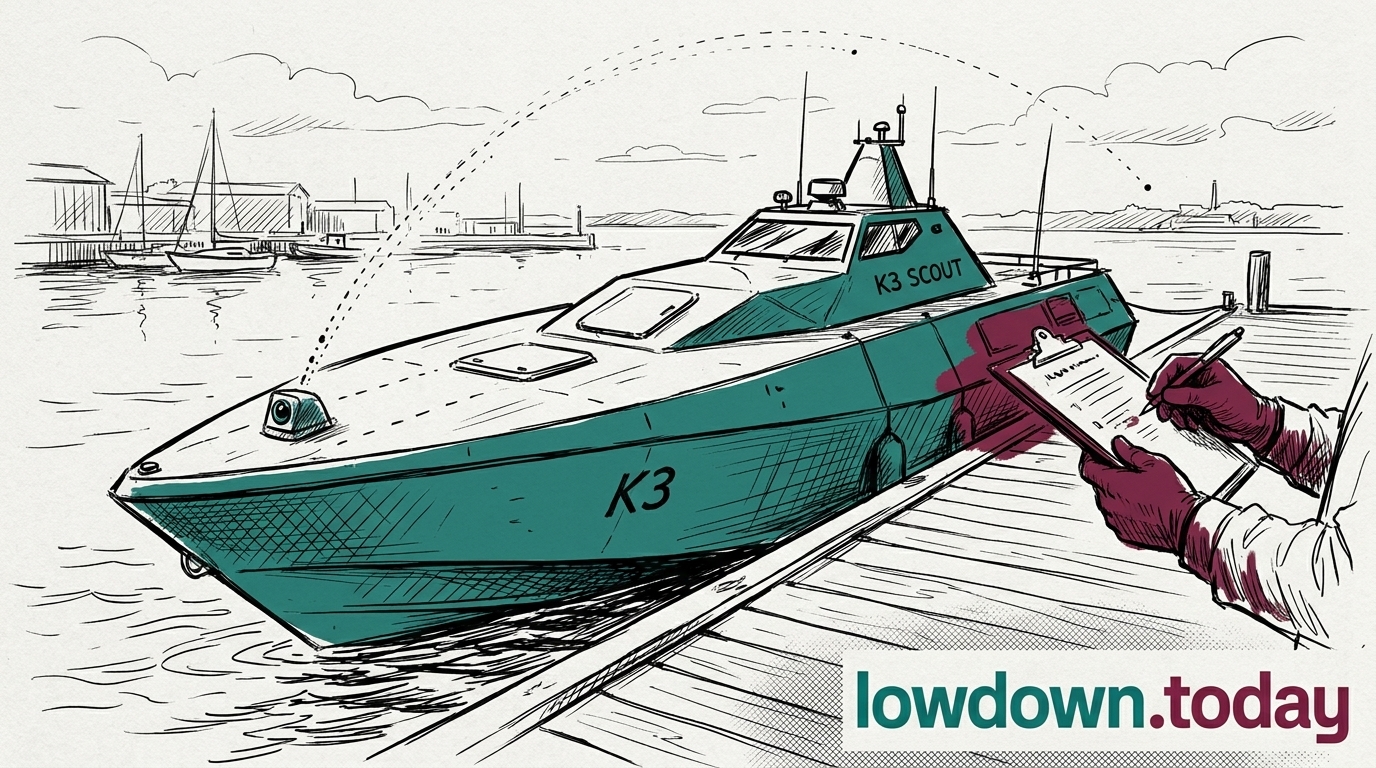
The Conservative opposition called on the Government on 9 August to 'urgently audit' equipment for hidden Chinese components, after the Telegraph's K3 SCOUT report. No named MP has been quoted on the record; the call came at party level, alongside the Ministry of Defence's own 10 August statement that no data had been compromised.
Netherlands Ministry of Defence
The Netherlands Ministry of Defence authorised Dutch Naval Design on 4 August to design 12-metre anti-submarine warfare uncrewed vessels for the Dutch-Belgian frigate programme, and to buy an adapted Compact FLASH dipping sonar from Thales Underwater Systems France. The order commits money and a named supplier while Britain's own certification body remains at the market-engagement stage.
Kraken Technology Group
Kraken Technology Group is a UK maritime-defence company based in Portsmouth that builds the K3 SCOUT, and crossed a $1bn valuation in July on a single-sourced $175m raise. The camera components reached the fleet under a third party's written security assurance, which the Platform Authority, which does not yet exist, was never positioned to check.
Navy Commercial
Navy Commercial
Navy Commercial at Whale Island published two notices on 5 August: 074032-2026, asking industry how to build a Platform Authority to certify uncrewed vessels, and 074351-2026, a GBP10m multi-role USV testbed for the Defence Chief Technology Officer. Responses on the Platform Authority close 19 August, ten days after the cameras were found transmitting to China.
Ministry of Defence
Ministry of Defence
The Ministry of Defence said on 10 August that a routine cyber vulnerability assessment found the camera fault, and a thorough investigation found no evidence that MoD data or systems had been accessed, compromised or transmitted externally. It stripped the cameras of internet connectivity but did not say whether it acted against the supplier.
Thales
Thales
Thales converted its 6 July engaging accord with Exail into a definitive combination agreement on 30-31 July, but the tender offer for Exail's remaining shares now closes by early 2028, later than July's timetable implied. Thales integrates its new undersea prime while still bidding against Kongsberg and DRASS's 2027 target for the AUKUS Pillar II contest.
