Skip to content
You can now search across every topic, entity and event.What's new
Autonomous Systems: Land & Sea
12AUG

Switchblade 400 wins Army LASSO at $1.2bn ceiling

4 min read
14:17UTC

The US Army selected AeroVironment's Switchblade 400 under the Low Altitude Stalking and Strike Ordnance OTA on Monday 4 May. The Army is requesting $110 million in FY2027 procurement with a planned ceiling of approximately $1.2 billion through FY2031.

TechnologyDeveloping
Key takeaway

Anti-tank loitering reach jumped from 10 km to 65 km in one Army selection.

The US Army selected AeroVironment's Switchblade 400 under the Low Altitude Stalking and Strike Ordnance (LASSO) Other Transaction Authority on Monday 4 May 1. The Army is requesting $110 million in LASSO procurement for fiscal year 2027 (FY2027) with a planned ceiling of approximately $1.2 billion through FY2031 2. Annualised, that funds roughly 200 to 400 Switchblade-class munitions a year against the Pentagon's 300,000-drone procurement target. AeroVironment declined to disclose the prototype contract value.

Switchblade 400 has a 65 km range, 35-minute endurance, and an all-up weight of 39 lbs, deployable by a single soldier in under five minutes with day-night electro-optical / infrared (EO/IR) sensors and autonomous target recognition. In practice, that pulls Russian armoured columns inside loitering reach from 6.2 miles to over 40. The 400 sits between the existing Block 2 SB 600 and SB 300 already running under an $1 billion August 2024 contract and a $186 million February 2026 delivery order. AeroVironment now operates SB 300, SB 400, and SB 600 simultaneously inside Army programmes, the broadest US loitering munition coverage on offer.

The Pentagon's Lethality Prize and the Mountain Horse Solutions kinetic win sit alongside this award inside the same Gauntlet II munitions architecture. Anti-tank loitering reach jumping from 10 km to 65 km changes which echelon owns the deep-strike fires problem: brigade rather than divisional artillery.

A $1.2 billion ceiling spread across six fiscal years averages $200 million annually, modest against the $54.6 billion DAWG line and well below the volume the Pentagon's stated 300,000-drone target would imply. The annual run rate places LASSO inside the procurement-frame envelope rather than the production-rate envelope that DAWG would otherwise fund.

Deep Analysis

In plain English

A loitering munition is a drone that can fly to an area, circle while searching for a target, and then dive to destroy it. Think of it as a guided missile that can wait. The Switchblade 400 is an American version that a single soldier can carry and launch, and it can fly 65 km, more than 40 miles, before finding and hitting a target. The US Army has now chosen it as the standard weapon for this role, with up to $1.2 billion available to buy them through 2031. In practical terms, this means American ground troops could attack enemy tanks from a distance that was simply not possible with previous weapons, without needing aircraft or artillery.

Deep Analysis
Root Causes

The 65 km selection over shorter-range alternatives traces to two constraints absent from previous loitering-munition competitions.

First, the brigade-echelon targeting gap. The Army's FY2027 doctrine update identified a specific gap: no organic weapon could engage armoured vehicles beyond the reach of line-of-sight optics but inside the range envelope where Air Force close air support assets face unacceptable crew risk from integrated air defences. The 65 km figure was not chosen arbitrarily: it is the minimum range that closes that gap while staying inside the radio-link budget of man-portable ground-control equipment.

Second, AeroVironment's head start from the Block 2 SB 300 programme. The LASSO solicitation explicitly valued prior-programme investment and fielded-system data from the $1 billion August 2024 contract. AeroVironment enters LASSO with two years of Army range safety, logistics, and maintenance data already on file. Competitors starting from a clean sheet face a 12-18 month head start disadvantage that the OTA vehicle does not fully equalise.

First Reported In

Update #8 · The week defence-AI got priced

AeroVironment· 10 May 2026
Read original
Causes and effects
This Event
Switchblade 400 wins Army LASSO at $1.2bn ceiling
The Switchblade 400 sextuples anti-tank loitering reach from 10 km to 65 km, changing the brigade combat team strike envelope. AeroVironment now operates SB 300, SB 400, and SB 600 simultaneously inside Army programmes, the broadest US loitering munition coverage on offer. The $1.2 billion ceiling spread across six fiscal years averages $200 million annually, modest against the $54.6 billion DAWG line.
Different Perspectives
Conservative opposition
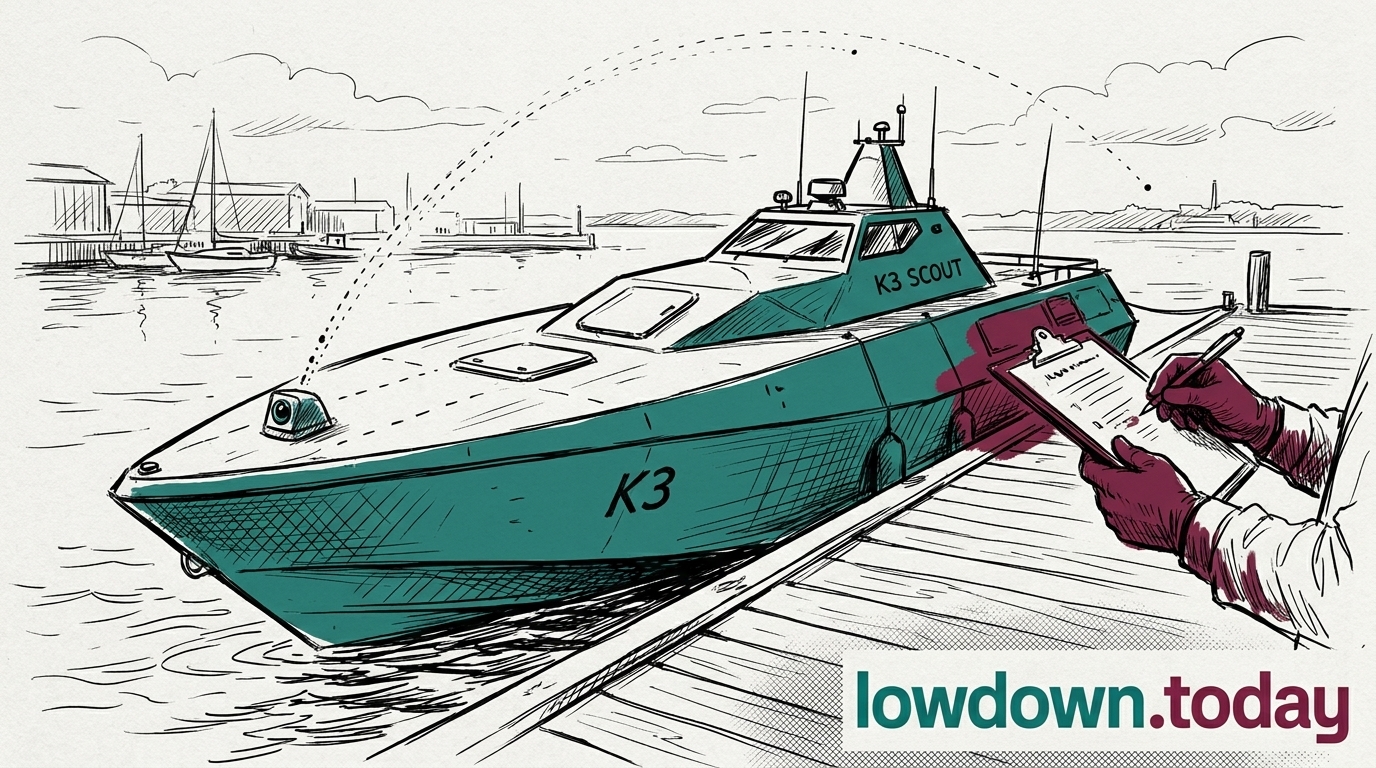
The Conservative opposition called on the Government on 9 August to 'urgently audit' equipment for hidden Chinese components, after the Telegraph's K3 SCOUT report. No named MP has been quoted on the record; the call came at party level, alongside the Ministry of Defence's own 10 August statement that no data had been compromised.
Netherlands Ministry of Defence
The Netherlands Ministry of Defence authorised Dutch Naval Design on 4 August to design 12-metre anti-submarine warfare uncrewed vessels for the Dutch-Belgian frigate programme, and to buy an adapted Compact FLASH dipping sonar from Thales Underwater Systems France. The order commits money and a named supplier while Britain's own certification body remains at the market-engagement stage.
Kraken Technology Group
Kraken Technology Group is a UK maritime-defence company based in Portsmouth that builds the K3 SCOUT, and crossed a $1bn valuation in July on a single-sourced $175m raise. The camera components reached the fleet under a third party's written security assurance, which the Platform Authority, which does not yet exist, was never positioned to check.
Navy Commercial
Navy Commercial
Navy Commercial at Whale Island published two notices on 5 August: 074032-2026, asking industry how to build a Platform Authority to certify uncrewed vessels, and 074351-2026, a GBP10m multi-role USV testbed for the Defence Chief Technology Officer. Responses on the Platform Authority close 19 August, ten days after the cameras were found transmitting to China.
Ministry of Defence
Ministry of Defence
The Ministry of Defence said on 10 August that a routine cyber vulnerability assessment found the camera fault, and a thorough investigation found no evidence that MoD data or systems had been accessed, compromised or transmitted externally. It stripped the cameras of internet connectivity but did not say whether it acted against the supplier.
Thales
Thales
Thales converted its 6 July engaging accord with Exail into a definitive combination agreement on 30-31 July, but the tender offer for Exail's remaining shares now closes by early 2028, later than July's timetable implied. Thales integrates its new undersea prime while still bidding against Kongsberg and DRASS's 2027 target for the AUKUS Pillar II contest.
