Skip to content
You can now search across every topic, entity and event.What's new
Autonomous Systems: Land & Sea
12AUG

Mountain Horse wins first Lethality Prize

2 min read
14:17UTC

Mountain Horse Solutions, a Global Ordnance subsidiary, on 29 April won the Pentagon's inaugural Drone Dominance Lethality Prize Challenge, eight days after the stated 21 April announcement target.

TechnologyDeveloping
Key takeaway

First Lethality Prize winner pulls a munitions house into autonomous-systems integration, validating Gauntlet II's prize architecture.

Mountain Horse Solutions, a Global Ordnance subsidiary, won the Pentagon's first Drone Dominance Lethality Prize Challenge on Wednesday 29 April, eight days after the stated 21 April announcement target. Partners included Gale Force Marine, Argus Industrial, and one further defence-technologies firm. The Lethality Prize sits inside Gauntlet II, the 50,000 to 60,000 drone procurement programme established earlier this year , and winners join its preferred munitions list with an associated R&D follow-on contract.

The prize structure rewards integrated kits rather than single platforms: a winning entry typically pairs an airframe with a munition, a ground-control element, and a sustainment package that meets a stated cost-per-effect ceiling. Mountain Horse's industrial base is concentrated in small-arms munitions and ordnance integration; the win positions Global Ordnance as a credible integrator on autonomous-systems munitions, a category dominated until now by AeroVironment, Anduril and Shield AI. The four-firm partnership signals the prize is functioning as intended: pulling traditional munitions houses into the autonomous-systems supplier base rather than awarding only to venture-backed entrants.

Lethality Prize cadence is meant to function as a forcing mechanism for the Pentagon's broader autonomous-munitions Phase II procurement, which had underperformed across service acquisition offices through 2025. A week of slip on a single prize is small in absolute terms; routine on the procurement-cycle clock the DAWG $54.6 billion request is now sized to fund. Whether the slip recurs across subsequent prize rounds will signal whether the new contracting rhythm holds at scale or reverts to the standard programme-of-record cadence the Lethality Prize was built to bypass.

A sceptical view: Mountain Horse's win is one data point in a programme that needs to award dozens before its production rate is testable. Global Ordnance's role as a credible integrator is asserted by the prize, not yet demonstrated at volume. The Q3 2026 production milestone will be the first chance to read whether the four-firm partnership converts into delivered units, or whether the prize architecture awards faster than the supplier base can scale.

Deep Analysis

In plain English

The Pentagon announced the first winner of its Drone Dominance Lethality Prize on 29 April. The prize goes to companies that develop effective ways to destroy enemy drones and is part of a wider US programme called Gauntlet II, which aims to procure 50,000 armed drones. The winner, Mountain Horse Solutions, is a subsidiary of Global Ordnance and led a partnership of four companies. Winning this prize means Mountain Horse joins the preferred list of suppliers for the Pentagon's drone procurement programme. The announcement came eight days later than the Pentagon's stated target of 21 April, which is being watched as a signal of whether this new faster procurement approach actually moves faster than the old one.

First Reported In

Update #7 · DAWG jumps 24,000% as Anduril sweeps board

Soldier Systems Daily· 30 Apr 2026
Read original
Different Perspectives
Conservative opposition
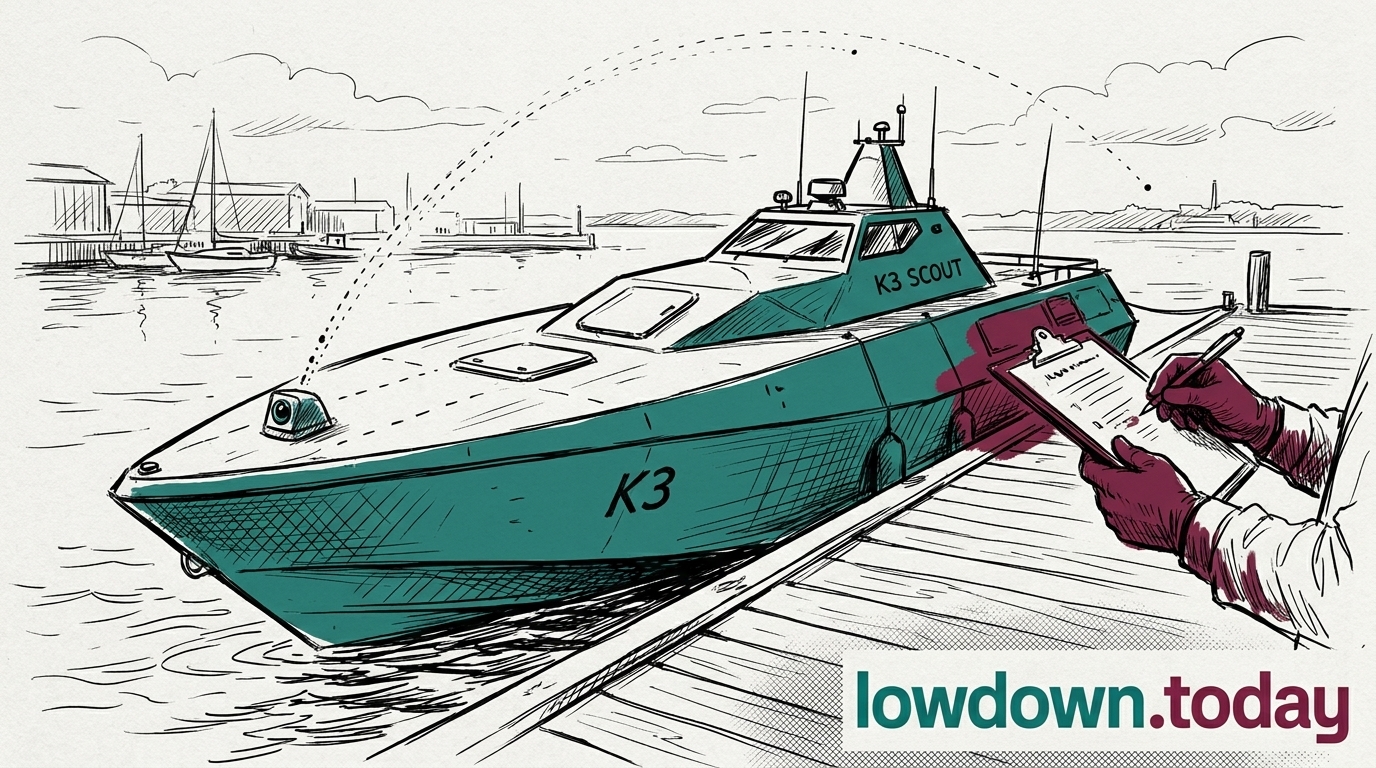
The Conservative opposition called on the Government on 9 August to 'urgently audit' equipment for hidden Chinese components, after the Telegraph's K3 SCOUT report. No named MP has been quoted on the record; the call came at party level, alongside the Ministry of Defence's own 10 August statement that no data had been compromised.
Netherlands Ministry of Defence
The Netherlands Ministry of Defence authorised Dutch Naval Design on 4 August to design 12-metre anti-submarine warfare uncrewed vessels for the Dutch-Belgian frigate programme, and to buy an adapted Compact FLASH dipping sonar from Thales Underwater Systems France. The order commits money and a named supplier while Britain's own certification body remains at the market-engagement stage.
Kraken Technology Group
Kraken Technology Group is a UK maritime-defence company based in Portsmouth that builds the K3 SCOUT, and crossed a $1bn valuation in July on a single-sourced $175m raise. The camera components reached the fleet under a third party's written security assurance, which the Platform Authority, which does not yet exist, was never positioned to check.
Navy Commercial
Navy Commercial
Navy Commercial at Whale Island published two notices on 5 August: 074032-2026, asking industry how to build a Platform Authority to certify uncrewed vessels, and 074351-2026, a GBP10m multi-role USV testbed for the Defence Chief Technology Officer. Responses on the Platform Authority close 19 August, ten days after the cameras were found transmitting to China.
Ministry of Defence
Ministry of Defence
The Ministry of Defence said on 10 August that a routine cyber vulnerability assessment found the camera fault, and a thorough investigation found no evidence that MoD data or systems had been accessed, compromised or transmitted externally. It stripped the cameras of internet connectivity but did not say whether it acted against the supplier.
Thales
Thales
Thales converted its 6 July engaging accord with Exail into a definitive combination agreement on 30-31 July, but the tender offer for Exail's remaining shares now closes by early 2028, later than July's timetable implied. Thales integrates its new undersea prime while still bidding against Kongsberg and DRASS's 2027 target for the AUKUS Pillar II contest.
