Skip to content
You can now search across every topic, entity and event.What's new
Autonomous Systems: Land & Sea
12AUG

First global code for crewless ships

4 min read
14:17UTC

The IMO adopted the first global code for autonomous cargo ships on 22 May in London. It is voluntary until 2032 and keeps a human master legally on the hook from ashore.

TechnologyDeveloping
Key takeaway

Global rules for self-sailing cargo ships now exist, but stay voluntary until 2032 with a human master still liable.

The International Maritime Organization (IMO), the United Nations body that writes shipping safety rules, adopted the first code for Maritime Autonomous Surface Ships (MASS) on 22 May, closing its Maritime Safety Committee (MSC) 111 session in London. 1 A MASS is a cargo vessel that senses, decides and steers with a reduced crew or none aboard. The code enters force on 1 July 2026, applies to cargo ships only, and keeps a human master legally responsible even when that master sits in a control room ashore.

The small print blunts the milestone. The code is non-mandatory until a binding version targeted for 1 January 2032, and the years between open an Experience Building Phase in which flag states collect operational data and decide for themselves what to permit. The Experience Building Phase exists because no regulator yet holds enough crewless-voyage data to write binding rules. The gap is a data-collection device, but it also lets national regimes diverge.

Classification societies already run ahead of it. DNV and Lloyd's Register, the bodies that certify ships as safe and seaworthy, certify autonomous and remotely operated vessels under their own rules today. 2 That inverts the usual order: SOLAS safety rules normally precede the technology, whereas here the IMO is racing to catch up to commercial practice. The risk is a patchwork of national interpretations during the gap, plus a new shoreside regulated entity, the Remote Control Centre, whose liability questions the code defers rather than settles. Nautilus International, the seafarers' union, argues the master should stay aboard while any crew are present, a labour counterweight to the cost case for emptying the bridge.

The same autonomy stack that runs a crewless box ship runs a minehunter and a subsea-cable inspection drone, which is why a shipping safety code matters to a defence procurement reader.

Deep Analysis

In plain English

International rules for shipping are set by a United Nations agency called the IMO, which stands for International Maritime Organization. On 22 May the IMO agreed the first global rules for ships that operate with no crew on the bridge, or with a much smaller crew controlled from an office on land. These rules are currently voluntary: shipping companies can follow them or not. They become compulsory in 2032. The main sticking point is who is legally responsible if a crewless ship crashes or sinks. The new code says a human "master" on shore is still in charge, but seafarers' unions argue that is not safe if that person is managing several ships at once from a screen.

Deep Analysis
Root Causes

The six-year non-mandatory gap reflects a genuine institutional constraint: the IMO operates by consensus among 175 member states with widely different coastguard and port-state control capacity. Flag-of-convenience states account for the majority of global tonnage; several lack the domestic technical regulation needed to enforce a mandatory autonomous vessel standard today.

The deferred timeline also reflects classification society lobbying. DNV and Lloyd's Register have built first-mover advantage through their own autonomous vessel class notations. A fast mandatory standard risks locking in criteria that disadvantage their proprietary frameworks or force immediate retrofits on vessels they have already certified under weaker rules.

What could happen next?
  • Precedent

    The MASS Code's goal-based, deferred-mandatory model sets the template for how the IMO will regulate other emerging maritime technologies, including hydrogen-fuelled vessels and underwater data cables.

    Medium term · Suggested
  • Risk

    Flag-state divergence on remote-master liability during the 2026-2032 voluntary period creates a regulatory arbitrage window: operators may choose flags with the weakest enforcement.

    Short term · Assessed
  • Opportunity

    Classification societies with existing autonomous-vessel class notations, particularly DNV and Lloyd's Register, gain a commercial advantage as the only bodies currently issuing certificates that comply with the MASS Code's technical objectives.

    Immediate · Reported
First Reported In

Update #1 · UK's robot navy sails for Hormuz

International Maritime Organization· 29 May 2026
Read original
Different Perspectives
Conservative opposition
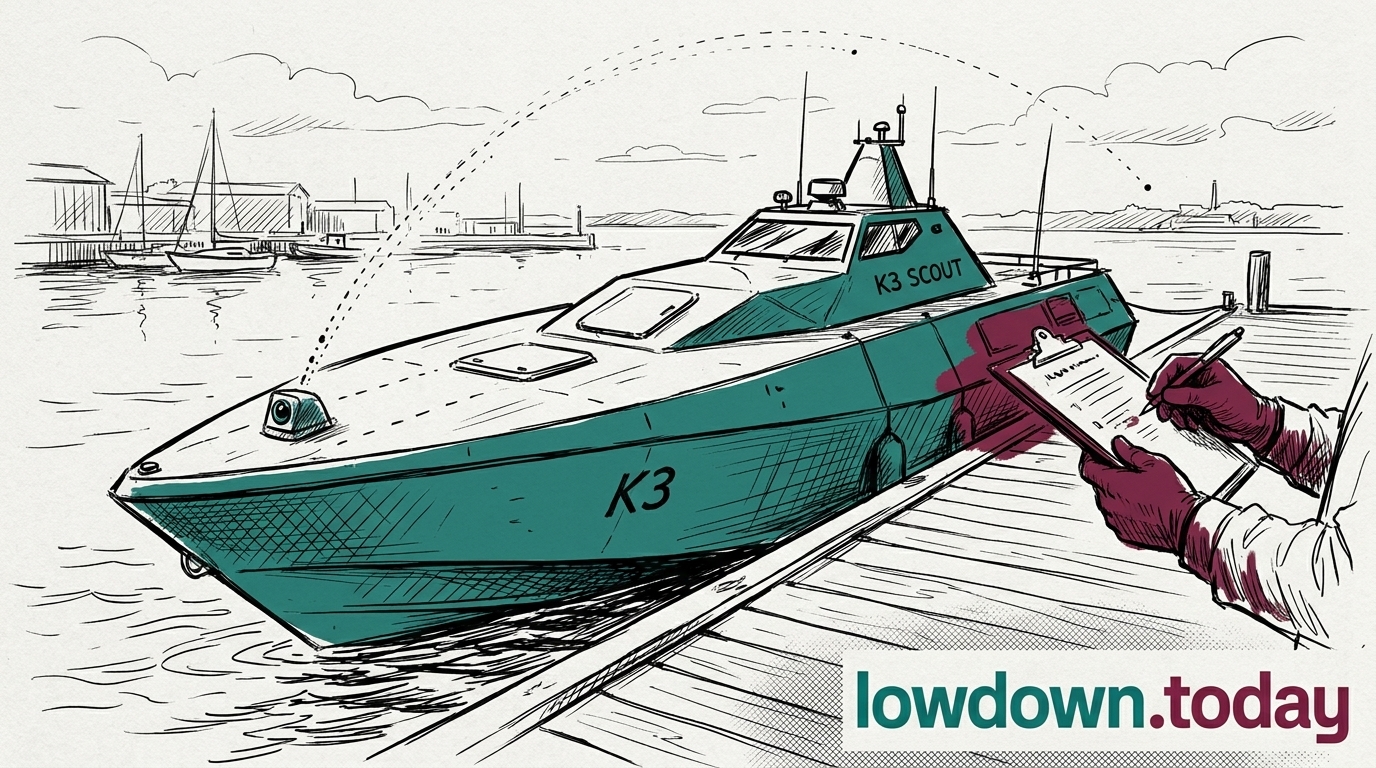
The Conservative opposition called on the Government on 9 August to 'urgently audit' equipment for hidden Chinese components, after the Telegraph's K3 SCOUT report. No named MP has been quoted on the record; the call came at party level, alongside the Ministry of Defence's own 10 August statement that no data had been compromised.
Netherlands Ministry of Defence
The Netherlands Ministry of Defence authorised Dutch Naval Design on 4 August to design 12-metre anti-submarine warfare uncrewed vessels for the Dutch-Belgian frigate programme, and to buy an adapted Compact FLASH dipping sonar from Thales Underwater Systems France. The order commits money and a named supplier while Britain's own certification body remains at the market-engagement stage.
Kraken Technology Group
Kraken Technology Group is a UK maritime-defence company based in Portsmouth that builds the K3 SCOUT, and crossed a $1bn valuation in July on a single-sourced $175m raise. The camera components reached the fleet under a third party's written security assurance, which the Platform Authority, which does not yet exist, was never positioned to check.
Navy Commercial
Navy Commercial
Navy Commercial at Whale Island published two notices on 5 August: 074032-2026, asking industry how to build a Platform Authority to certify uncrewed vessels, and 074351-2026, a GBP10m multi-role USV testbed for the Defence Chief Technology Officer. Responses on the Platform Authority close 19 August, ten days after the cameras were found transmitting to China.
Ministry of Defence
Ministry of Defence
The Ministry of Defence said on 10 August that a routine cyber vulnerability assessment found the camera fault, and a thorough investigation found no evidence that MoD data or systems had been accessed, compromised or transmitted externally. It stripped the cameras of internet connectivity but did not say whether it acted against the supplier.
Thales
Thales
Thales converted its 6 July engaging accord with Exail into a definitive combination agreement on 30-31 July, but the tender offer for Exail's remaining shares now closes by early 2028, later than July's timetable implied. Thales integrates its new undersea prime while still bidding against Kongsberg and DRASS's 2027 target for the AUKUS Pillar II contest.
