Skip to content
You can now search across every topic, entity and event.What's new
Autonomous Systems: Land & Sea
12AUG

A £8.3bn number for the business case

4 min read
14:17UTC

Lloyd's Register, the NPL and the National Shipbuilding Office put the UK maritime-autonomy sector at £600m today and £8.3bn by 2050, the first official measurement of a market the procurement papers will now cite.

TechnologyDeveloping
Key takeaway

Lloyd's Register co-sizing the UK autonomy market at £8.3bn by 2050 turns its assurance role toward advocacy.

Lloyd's Register, the National Physical Laboratory (NPL) and the National Shipbuilding Office (NSO) published the first official measurement of the UK maritime-autonomy sector on 4 June 2026, researched by Stehr Consulting 1. Lloyd's Register is a classification society, the body that certifies a vessel is fit to sail; NPL is the UK's national measurement laboratory; the NSO runs the National Shipbuilding Strategy. The report puts current annual turnover at £600m and roughly 5,000 jobs including the supply chain, projecting £3.7bn of gross value added (GVA) by 2040 and £8.3bn by 2050. A high-growth scenario reaches £26.5bn and 39,200 jobs, across commercial shipping, offshore energy and defence.

NSO chief executive Rod Paterson called it "one of the most significant markets for UK shipbuilding and maritime technology" 2. The £600m base against the £8.3bn central target is a fourteenfold rise, and that multiplier is the figure the sector will drop into procurement papers and shipbuilding-strategy submissions. The high-growth £26.5bn line is the headline number, though it rests on a scenario rather than a measured value, so the durable figures are the £600m turnover and the 5,000 jobs.

Lloyd's Register co-authored a demand-sizing report whose findings sit beside its day job of certifying vessels. Its assurance business depends on independence from commercial pressure, and lending its name to a market-growth case places the body that certifies the hardware on the demand side of the sector it also polices. The report carries the IMO Code's regulatory baseline out of compliance language and into an investment argument, the institutional bridge between a new rulebook and the capital that follows it.

Deep Analysis

In plain English

Lloyd's Register was founded in 1760 to inspect and grade merchant ships; today it sets safety standards and certifies that vessels and offshore structures meet those standards before they are allowed to operate. Think of it as the MOT inspector for large vessels, not an insurance company despite the name. The National Physical Laboratory (NPL) in Teddington is the UK's official measurement standards body: it maintains the UK's definitions of a metre, a kilogram, and so on, and its metrology work feeds into safety certification where precise measurement of sensor accuracy matters. The National Shipbuilding Office (NSO) is the government body responsible for the UK's National Shipbuilding Strategy, published in 2022, which set out how British yards and suppliers could win more of the global ship-building market. Together, these three organisations provide the strongest possible institutional endorsement for the sector's growth projections. The report covers defence, offshore energy, and commercial shipping, spanning the three largest buyers of autonomous maritime systems in the UK rather than making a single-sector case.

Deep Analysis
Root Causes

The simultaneous publication of market-size data and formal trial infrastructure in the same two-week window reflects a deliberate sequencing by UK government departments. The NSO co-authoring the report rather than simply commissioning it ensures the data lands as government-endorsed rather than as industry lobbying, a distinction that matters for both Treasury business-case submissions and parliamentary scrutiny of defence procurement budgets that include autonomous systems.

A second structural cause is the five-year review cycle of the National Shipbuilding Strategy. The 2022 Strategy committed to review in 2027.

A sector baseline published in 2026 provides the quantitative benchmark against which 2027 progress can be measured, creating an accountability mechanism that also functions as a political commitment device: once £8.3bn has been named in a joint government-institution report, future ministers face a higher burden of justification for withdrawing investment.

What could happen next?
  • Opportunity

    UK primes and tier-two suppliers in offshore energy autonomy, including Saab Seaeye, Rovco, and SubSea7's remote-operations division, can use the NSO-endorsed figures as a business-case anchor for investment rounds and government grant applications.

    Immediate · Assessed
  • Risk

    The high-growth £26.5bn scenario's dependence on UK certification standards becoming internationally adopted exposes the projection to competitive displacement if China or South Korea establish a rival global MASS certification standard before 2032.

    Long term · Suggested
  • Consequence

    Lloyd's Register's co-author status commits it institutionally to the sector's growth; future decisions to withhold certification from autonomous vessel designs will face greater political scrutiny than similar decisions in a prior period when LR had no stated commercial interest in sector growth.

    Medium term · Assessed
First Reported In

Update #2 · Britain writes the rules; AUKUS names US robots

Lloyd's Register / NPL / National Shipbuilding Office· 6 Jun 2026
Read original
Causes and effects
This Event
A £8.3bn number for the business case
A classification society co-authoring a growth case moves Lloyd's Register from assuring the market to advocating for it, the figure that will anchor every procurement paper.
Different Perspectives
Conservative opposition
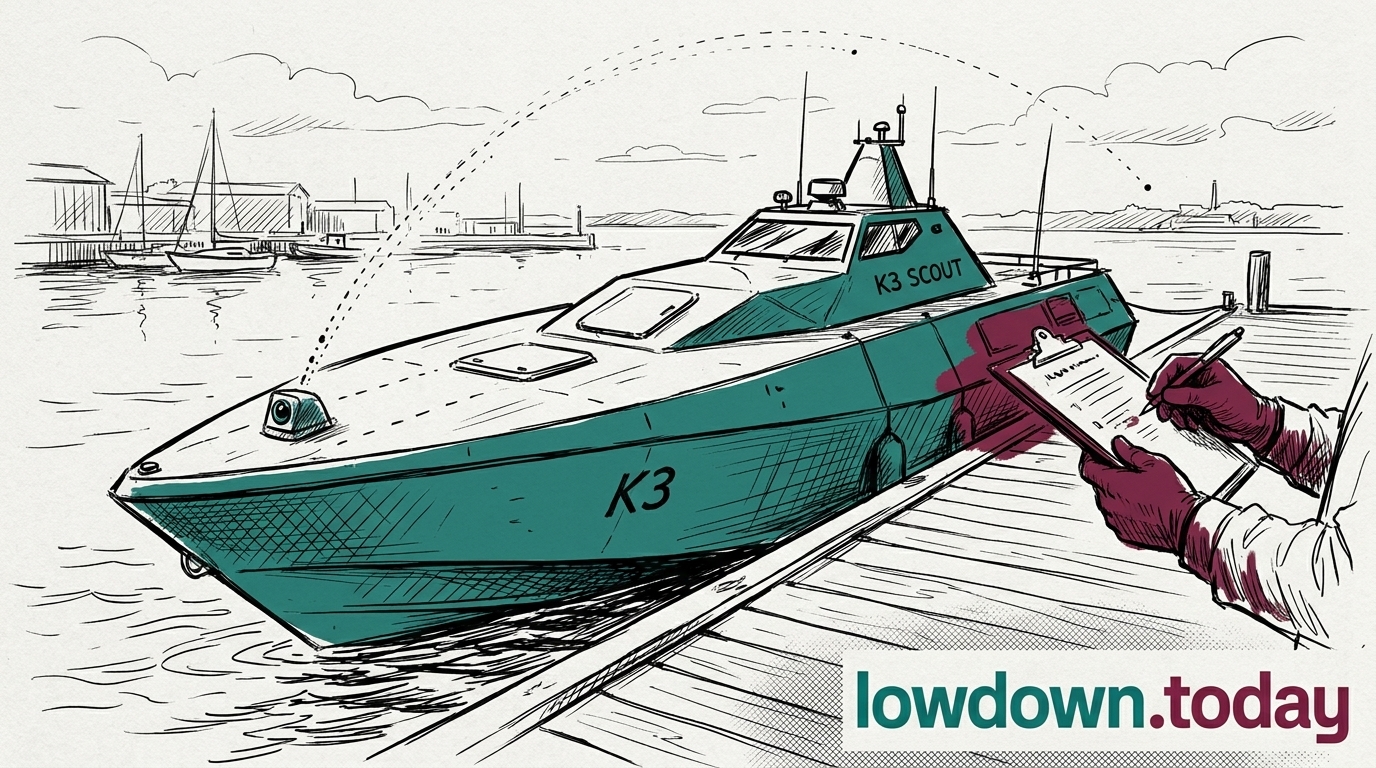
The Conservative opposition called on the Government on 9 August to 'urgently audit' equipment for hidden Chinese components, after the Telegraph's K3 SCOUT report. No named MP has been quoted on the record; the call came at party level, alongside the Ministry of Defence's own 10 August statement that no data had been compromised.
Netherlands Ministry of Defence
The Netherlands Ministry of Defence authorised Dutch Naval Design on 4 August to design 12-metre anti-submarine warfare uncrewed vessels for the Dutch-Belgian frigate programme, and to buy an adapted Compact FLASH dipping sonar from Thales Underwater Systems France. The order commits money and a named supplier while Britain's own certification body remains at the market-engagement stage.
Kraken Technology Group
Kraken Technology Group is a UK maritime-defence company based in Portsmouth that builds the K3 SCOUT, and crossed a $1bn valuation in July on a single-sourced $175m raise. The camera components reached the fleet under a third party's written security assurance, which the Platform Authority, which does not yet exist, was never positioned to check.
Navy Commercial
Navy Commercial
Navy Commercial at Whale Island published two notices on 5 August: 074032-2026, asking industry how to build a Platform Authority to certify uncrewed vessels, and 074351-2026, a GBP10m multi-role USV testbed for the Defence Chief Technology Officer. Responses on the Platform Authority close 19 August, ten days after the cameras were found transmitting to China.
Ministry of Defence
Ministry of Defence
The Ministry of Defence said on 10 August that a routine cyber vulnerability assessment found the camera fault, and a thorough investigation found no evidence that MoD data or systems had been accessed, compromised or transmitted externally. It stripped the cameras of internet connectivity but did not say whether it acted against the supplier.
Thales
Thales
Thales converted its 6 July engaging accord with Exail into a definitive combination agreement on 30-31 July, but the tender offer for Exail's remaining shares now closes by early 2028, later than July's timetable implied. Thales integrates its new undersea prime while still bidding against Kongsberg and DRASS's 2027 target for the AUKUS Pillar II contest.
