Skip to content
Welcome, thoughtbot's Giant Robots listeners!Start here
Autonomous Systems: Land & Sea
12AUG

AeroVironment banks $580.5m in a day

2 min read
14:17UTC

AeroVironment took a $500m Domestic Shield support contract and a same-day $80.5m Titan sensor award from one US counter-drone task force on 6 July, seven weeks after the same body handed a rival an identical $500m ceiling.

TechnologyDeveloping
Key takeaway

One US task force paid AeroVironment $580.5m in a day while keeping a rival prime on an identical ceiling.

AeroVironment secured $580.5 million from a single US counter-drone task force on Monday 6 July, taking a three-year, $500 million Domestic Shield support contract and a same-day $80.5 million Titan Multi-Sensor award. Both came from Joint Interagency Task Force 401 (JIATF-401), the interagency body standing up America's homeland counter-drone architecture. AeroVironment is a Virginia maker of small drones and, increasingly, the sensors and interceptors that shoot other drones down.

Seven weeks earlier the same task force handed Eric Schmidt's Perennial Autonomy an identically sized $500 million ceiling for its Merops interceptor. Two matched $500 million indefinite-delivery, indefinite-quantity (IDIQ) contracts to different primes in under two months, one for interceptors and one for the wider sensor-and-support stack, points to JIATF-401 buying a multi-vendor Domestic Shield rather than crowning one supplier.

An IDIQ sets a spending ceiling, not a guaranteed order, and interceptors and sensors are genuinely different needs, so read narrowly the double award is ordinary contract mechanics. The pattern only sharpens when set beside the week's other awards, where two more procurement systems spread their money the same way.

The timing matters for AeroVironment's balance sheet. The awards land ten days after the company restated an $87.3 million loss, and two days before its Wednesday 8 July Investor Day, where it guided to FY2030 revenue of $3.5 to $4.0 billion, a 15 to 20% organic compound annual growth rate and 18 to 20% adjusted EBITDA margins. A restated loss, then a federal win streak and a 2030 target, reads as investor-confidence repair as much as procurement news.

Deep Analysis

In plain English

AeroVironment is an American company that makes small military drones and counter-drone equipment. In a single day, a US government body called JIATF-401, a task force set up to defend American soil against hostile drones, gave AeroVironment two separate contracts worth $580.5 million combined: one to keep supplying counter-drone equipment over three years, and one for a new sensor system that can detect and track drones. For readers outside the defence industry, the number that matters is how quickly a company can go from a rough quarter to over half a billion dollars in new federal work, showing how fast government drone-defence spending is moving right now.

Deep Analysis
Root Causes

AeroVironment's capacity to absorb two same-day counter-drone awards traces to a narrowing vendor pool rather than unique merit: FCC and Pentagon-level restrictions on Chinese-origin airframes and components have progressively excluded DJI-linked suppliers from federal counter-drone catalogues over the past two years, leaving JIATF-401 with a short list of certified domestic bidders.

AeroVironment's existing programme-of-record status from earlier awards put it first in line for both contracts rather than competing against a full field.

What could happen next?
  • Meaning

    JIATF-401's back-to-back $500m IDIQs to two different vendors within seven weeks signals a shift from single-source to dual-source counter-drone procurement.

  • Risk

    Running parallel identical-value IDIQs to multiple vendors before validating firm end-user demand risks overcommitting task force budget authority ahead of a stable requirement.

First Reported In

Update #15 · Two $500m drone deals, still no winner

AeroVironment· 14 Jul 2026
Read original →
Causes and effects
Different Perspectives
Conservative opposition
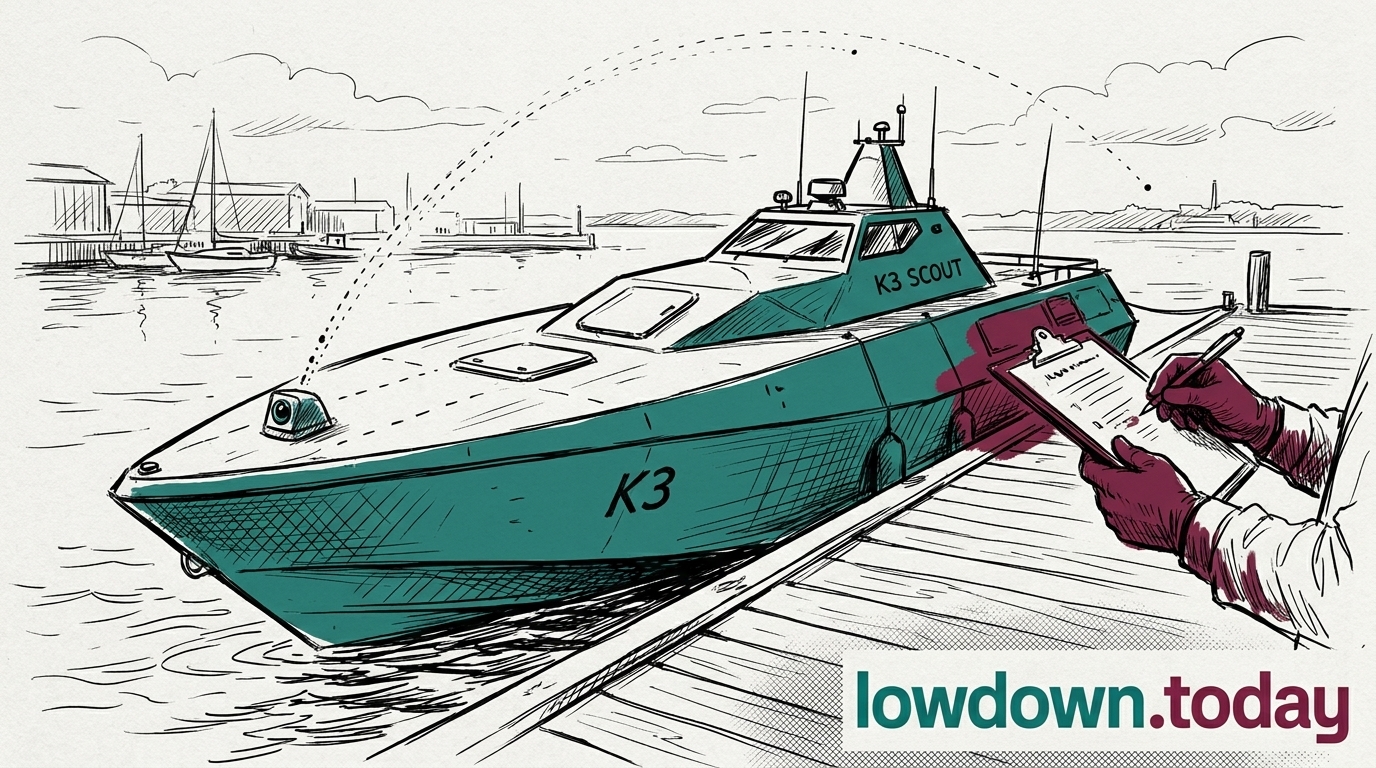
The Conservative opposition called on the Government on 9 August to 'urgently audit' equipment for hidden Chinese components, after the Telegraph's K3 SCOUT report. No named MP has been quoted on the record; the call came at party level, alongside the Ministry of Defence's own 10 August statement that no data had been compromised.
Kraken Technology Group
Kraken Technology Group is a UK maritime-defence company based in Portsmouth that builds the K3 SCOUT, and crossed a $1bn valuation in July on a single-sourced $175m raise. The camera components reached the fleet under a third party's written security assurance, which the Platform Authority, which does not yet exist, was never positioned to check.
Navy Commercial
Navy Commercial
Navy Commercial at Whale Island published two notices on 5 August: 074032-2026, asking industry how to build a Platform Authority to certify uncrewed vessels, and 074351-2026, a GBP10m multi-role USV testbed for the Defence Chief Technology Officer. Responses on the Platform Authority close 19 August, ten days after the cameras were found transmitting to China.
HUMAIN
HUMAIN
HUMAIN and Applied Intuition stated a 2030 target for thousands of autonomous trucks on Saudi logistics corridors. The announcement disclosed no order, fleet baseline or contract value.
Saildrone
Saildrone
Saildrone and Lockheed Martin demonstrated two JAGM launches from a Surveyor-class vessel at RIMPAC. The accepted record identifies no requirement, customer or production configuration behind the demonstration.
Taiwan Legislative Yuan
Taiwan's Legislative Yuan passed the Act at third reading with a small suicide uncrewed boat on the named development list. The NT$240 billion ceiling covers all unmanned domains, and the Act was not promulgated by 4 September.
