Skip to content
Briefings are running a touch slower this week while we rebuild the foundations.See roadmap
Artemis II Moon Mission
11APR

NASA's post-mission press conference disclosed no data

3 min read
13:15UTC

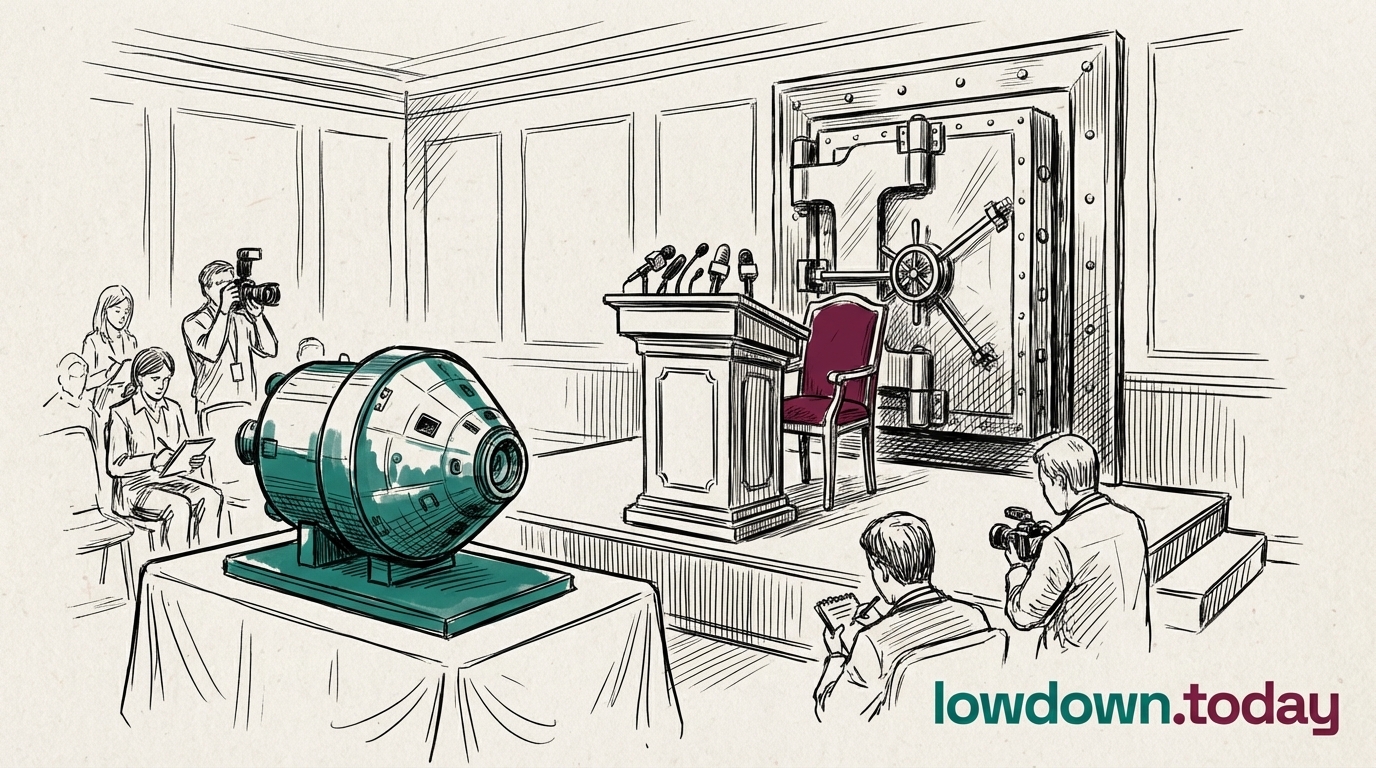
Two hours after splashdown, NASA's accountability window closed without a single technical finding; the official responsible for radiation disclosure did not appear.

ScienceDeveloping
Key takeaway

NASA's press conference was a ceremony. The disclosure did not happen.

Howard Hu, the Orion programme manager, told the 22:30 EDT press conference on 10 April that NASA had "gathered a lot of data" from aircraft and divers and released no technical findings 1. Steve Platts, the NASA chief scientist for human research who signs off crew radiation disclosure, was absent from the podium. Hu had set a public benchmark the day before: char loss "not zero, but not to the magnitude of Artemis I" . The 22:30 EDT window was the moment to confirm or deny that benchmark, and nothing emerged.

Divers photographed the Avcoat heat shield aboard USS John P. Murtha and heat shield experts conducted an on-deck inspection; no findings were released 2. The 2024 Office of the Inspector General readiness audit (IG-24-011) documented a second failure mode: three of four crew module separation bolts melting through from a flawed thermal model. Not one reporter in the public transcript raised the bolt scenario to Hu, Lori Glaze, Amit Kshatriya or Shawn Quinn.

Each individual withholding has a protocol defence: heat shield analysis genuinely takes days; radiation dose data has moved through peer review since Mercury. The aggregate is harder to absolve. The radiation withholding that began at maximum distance from Earth extended through the press conference without interruption, through two solar storms and an M-class flare.

Deep Analysis

In plain English

After a space mission ends, the agency usually holds a press conference to share what they learned. For Artemis II, that window opened at 10:30 pm EDT on 10 April, roughly two hours after splashdown. Three things had been publicly flagged as important questions going in: whether the heat shield survived better or worse than last time, what radiation dose the crew received over nine days including two solar storms, and whether a bolt inspection problem NASA's own auditor had documented in 2024 was present on re-entry. None of those three questions were answered. The official responsible for crew radiation data did not appear. The Orion programme manager said only that the agency had 'gathered a lot of data.' Heat shield experts had already done an initial inspection aboard the recovery ship, but no findings were shared. The window closed without a single technical finding being disclosed.

Deep Analysis
Root Causes

NASA's post-Challenger and post-Columbia institutional reforms centralised communications through public affairs offices rather than programme engineers, reducing the cadence of spontaneous technical disclosure at press events. The radiation data pathway was established as a research solicitation model specifically to allow peer review before public release, a policy Platts had stated pre-launch.

The bolt inspection scenario documented in OIG audit IG-24-011 was not raised by any reporter, reflecting either a press corps that had not read the OIG report or a calculated editorial decision not to ask questions that NASA could not answer in real time. Either case leaves the OIG's documented second failure mode unaddressed in the public record .

The FY2027 budget context is a third structural cause: with NASA science funding under a proposed 47% cut , senior officials at the press conference had political reasons to keep the communication frame positive and milestone-focused.

What could happen next?
  • Risk

    With no Congressional accountability language from the Science Committee chair (Event 9) and no technical findings from NASA, the post-mission disclosure window has effectively closed without a public baseline for the three open technical questions.

    Immediate · 0.85
  • Consequence

    The research solicitation pathway for radiation data means independent scientists cannot check whether the crew's nine-day dose exceeded NASA's published career limits until the solicitation process completes, likely six to eighteen months post-mission.

    Medium term · 0.75
  • Risk

    If KSC's heat shield inspection finds char loss above the Artemis I level, the absence of a pre-announcement baseline from the press conference will make the eventual disclosure appear managed rather than transparent.

    Short term · 0.6
First Reported In

Update #9 · First crewed Moon return since Apollo 17

CBS News· 11 Apr 2026
Read original
Causes and effects
This Event
NASA's post-mission press conference disclosed no data
The scheduled disclosure event produced no actionable data on the four technical items the public was asked to follow across the mission.
Different Perspectives
JAXA
JAXA
JAXA is an Artemis Accords signatory with the Lunar Cruiser rover planned for south-pole surface operations; Chang'e 7's first-arrival timeline compresses the window those surface systems were designed to operate in alongside American crew.
Space Research Institute RAS / Roscosmos
The LILEM instrument on Chang'e 7 gives Russia science-cooperation presence at Shackleton's rim with no independent crewed lunar capability on a public timeline. This is Roscosmos's only confirmed path to south-pole science in the current decade.
CNSA / China Manned Space Agency
Chang'e 7 at Wenchang confirmed a second-half 2026 launch for Shackleton rim, 18 to 24 months before any American crewed arrival. The mission carries a Russian LILEM instrument, giving Roscosmos a south-pole science foothold inside China's programme.
Jeremy Hansen / Canadian Space Agency
Hansen appeared at the 16 April JSC press conference in his only public moment since splashdown. Canada's Canadarm3 remains without a confirmed deployment host after Gateway cancellation, with CSA maintaining institutional silence on the programme's status.
Airbus Defence and Space
Airbus has issued no post-mission ESM performance statement; its press room returned a 404 error on a 14 April check. The only named Airbus engineer quote on the mission appeared in a Nature interview, not a company release.
Daniel Neuenschwander / European Space Agency
ESA's 11 April statement praised ESM translunar injection precision and omitted the pressurisation valve anomaly; the June 2026 Council is the sole stated review forum. ESM-3 is at KSC without a corrected-baseline disclosure to justify its readiness.