Skip to content
Briefings are running a touch slower this week while we rebuild the foundations.See roadmap
AI: Jobs, Power & Money
2MAY

Sanders drafts robot tax on AI layoffs

4 min read
15:17UTC

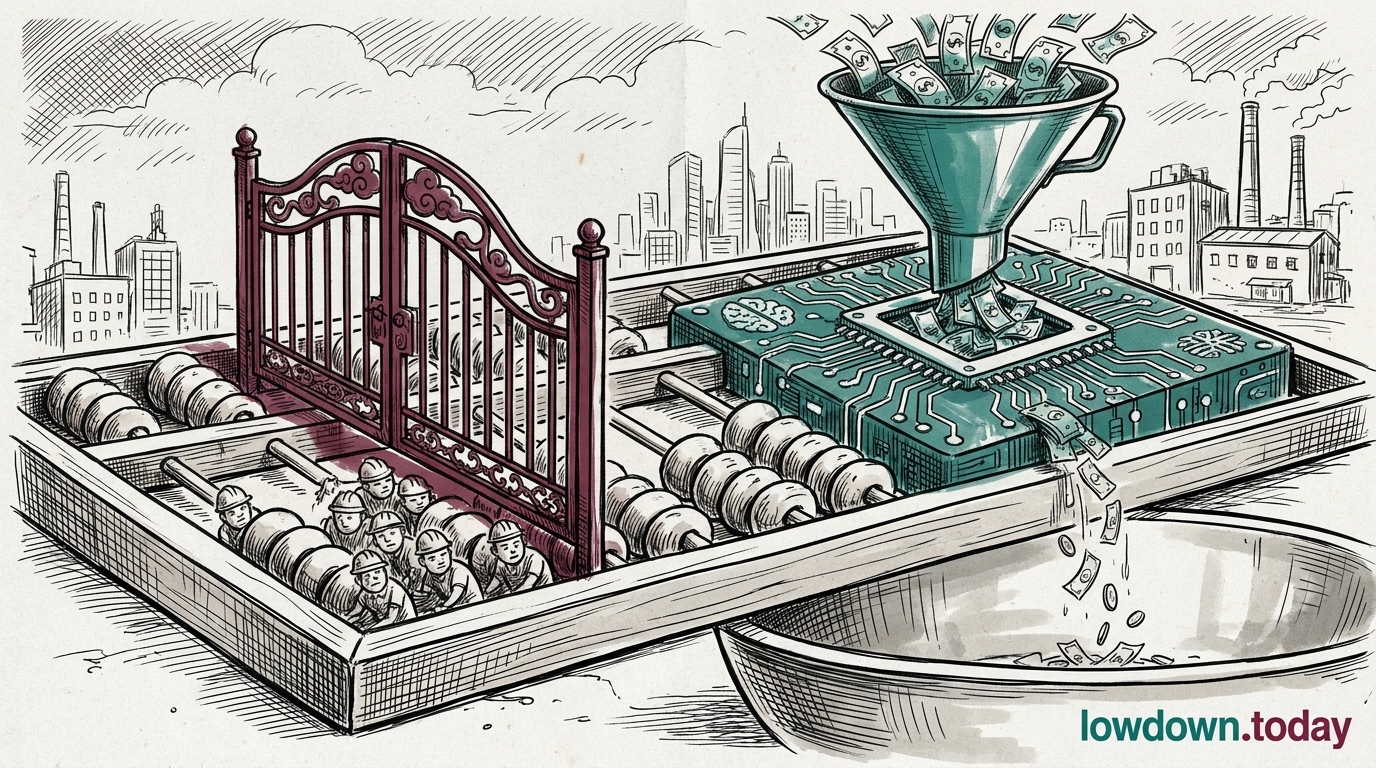
Senator Bernie Sanders is drafting legislation to levy a per-position tax on companies replacing workers with AI — the first concrete US proposal to directly price AI-driven displacement, drawing immediate pushback from the American Enterprise Institute.

EconomicDeveloping
Key takeaway

Sanders' robot tax is the first US legislative proposal to price automation displacement directly.

Senator Bernie Sanders (I-VT) is drafting legislation to impose a per-position levy on corporations that replace workers with AI or automation 1. Revenue would recoup lost payroll taxes and fund worker retraining. His HELP Committee staff report claimed AI could replace more than half of jobs in 15 of 20 major US economic sectors, potentially affecting approximately 100 million positions over a decade 2.

The proposal addresses a fiscal vulnerability The Brookings Institution has quantified: roughly three-quarters of US federal tax revenue comes from labour income . Each position eliminated shrinks that base. The IRS — already operating with 31% fewer revenue agents and 27% fewer IT staff — would collect less from a workforce that is itself smaller. Sanders's mechanism is blunt by design: rather than incentivising retraining or cushioning transitions, it raises the cost of replacement itself, altering the calculus that has driven companies from Block to Atlassian to shed staff in the name of AI.

The American Enterprise Institute published a direct rebuttal, arguing Sanders's staff report "ignores the data on AI and inequality" and that current AI tools function as "skill equalisers" that raise performance at the lower end of the distribution 3. The disagreement is genuine. Harvard Business Review research by Thomas H. Davenport and Laks Srinivasan found only approximately 2% of organisations reported layoffs tied to actual AI implementation — the rest are cutting in anticipation of capability that does not yet exist 4. If AEI is right that AI augments rather than replaces, the tax addresses a problem that will not materialise at the scale Sanders projects. If the HELP Committee's projections hold, the tax may be the only mechanism that preserves fiscal solvency during the transition.

Sanders is not alone in calling for AI taxation. Andrew Yang renewed his proposal to "stop taxing labour and start taxing AI" in March, citing support from Anthropic CEO Dario Amodei, who urged AI companies to "steer customers away from firing workers" . But Sanders has no announced co-sponsors. With the Warner-Rounds study commission offering a less confrontational path, the robot tax is more likely to set the terms of a debate over AI revenue policy than to reach the Senate floor in its current form.

Deep Analysis

In plain English

Sanders wants companies to pay a per-job fee for each position they cut by replacing workers with AI. The revenue would replace payroll taxes those workers would have paid and fund retraining. The logic is similar to a carbon tax: companies currently externalise the social cost of displacement onto workers and the state; this would force them to internalise it. Whether it would slow layoffs or merely generate revenue from them depends on the tax rate — which has not been specified.

Deep Analysis
Synthesis

The per-position framing of the tax is strategically significant and analytically distinct from alternative designs. A per-position levy is directly measurable and attributable at the firm level, creating an enforcement architecture that mirrors carbon pricing: internalise the externality at the point of production. The critical difference is that carbon emissions are physically verifiable; 'replaced positions' are legally ambiguous when automation is partial. This definitional gap is the tax's principal technical vulnerability — and it is not addressed in the HELP Committee framing.

Root Causes

The structural driver behind the tax proposal is the Brookings fiscal vulnerability finding: if 75% of federal revenue depends on labour taxation, AI displacement is a macroeconomic threat to state solvency, not merely a distributional equity concern. Sanders is converting a structural fiscal argument into a populist political instrument — which is analytically accurate even if ideologically motivated.

Escalation

The HELP Committee's 100-million-jobs framing is designed to establish political scale, creating the predicate for a tax whose magnitude would otherwise seem disproportionate to current observable displacement. The escalation dynamic positions Sanders as the activist pressure that makes the Warner-Rounds commission route appear moderate — a deliberate legislative pincer that historically accelerates the centre's willingness to act.

What could happen next?
  • Precedent

    If passed, this would be the first direct per-position automation tax in a G7 economy, creating legislative pressure for equivalent measures in the EU and UK.

    Medium term · Assessed
  • Risk

    Without equivalent levies in competing jurisdictions, a US robot tax may accelerate offshoring of automatable roles rather than preserving them domestically.

    Short term · Assessed
  • Consequence

    Enforcement would fall on an IRS already cut by 31%, creating a structural gap between the tax's legal existence and its practical administration.

    Medium term · Assessed
  • Risk

    The undefined tax rate makes economic impact modelling impossible; a rate too low generates revenue without deterring displacement, while a rate too high may chill legitimate productivity investment.

    Short term · Suggested
First Reported In

Update #2 · 45,000 tech layoffs, half may be reversed

Washington Examiner· 22 Mar 2026
Read original
Different Perspectives
UK financial regulators (BoE FPC / FCA)
The Bank of England's April FPC directive on agentic AI in payments was scoped around one frontier model; AISI confirmed a second model cleared the same 32-step threshold on 1 May. The supervisory architecture is one model behind the capability it was built to contain.
Indian IT sector workers (TCS, Infosys, Wipro)
TCS posted its first annual revenue decline in the modern era, Infosys shed 8,400 workers in a quarter, and Wipro hit its zero-fresher target. Western Big Tech's AI automation is cannibalising the offshored-services model that employs roughly five million Indian IT workers.
Chinese workers (Hangzhou and Beijing plaintiffs)
Workers Zhou and Liu won cases that established a two-court doctrinal chain: AI adoption is the employer's deliberate strategy, placing the cost of displacement on the employer rather than the worker. Any Chinese employee facing AI-driven dismissal now has a citable legal route that American, British, and European counterparts do not.
Chinese government, courts, and domestic employers
The Hangzhou rulings were released on Workers' Day eve alongside the Ministry of Human Resources' recognition of 42 new AI occupations. Domestic firms now face mandatory retraining obligations; the Orgvue estimate of 8-14 months added to displacement timelines will feature in employer compliance briefings throughout 2026.
EU regulators and European Parliament
The second Digital Omnibus trilogue collapsed without agreement on 28 April; the third is scheduled for 13 May with the binding employer AI-literacy obligation still contested. Brussels is arguing over a non-binding encouragement clause while Beijing's courts have already bound employers.
US legislators (Warner, Rounds, Hawley, Sanders)
Warner and Rounds produced the Economy of the Future Commission Act, the most concrete federal vehicle still moving, endorsed by the companies it would notionally regulate. The Sanders-AOC moratorium was killed by Democratic senators; the Hawley-Warner disclosure bill remains in committee with no floor date.
