Skip to content
Briefings are running a touch slower this week while we rebuild the foundations.See roadmap
AI: Jobs, Power & Money
2MAY

Sanders and AOC target AI data centres

1 min read
15:17UTC

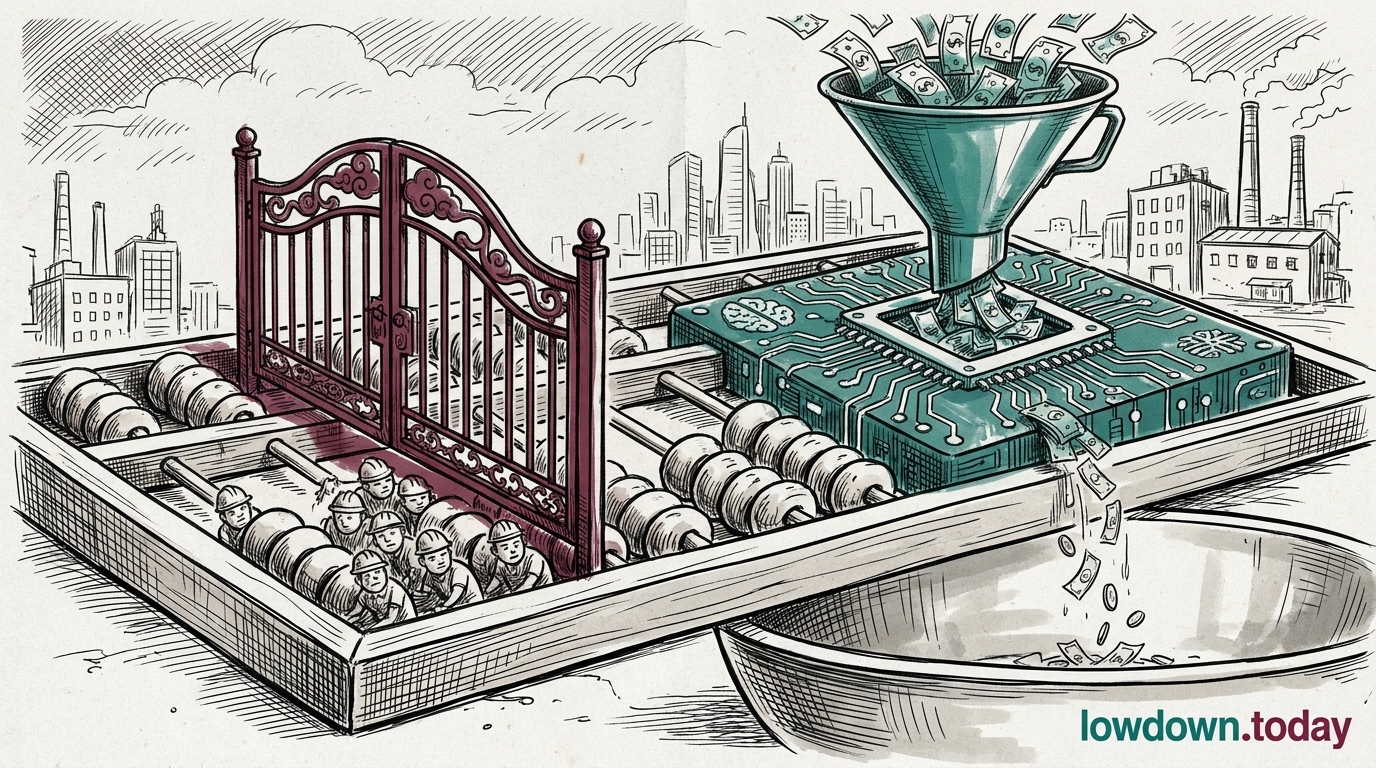
A bill to ban all new AI data centre construction until Congress passes worker protections. It will not pass. It was not designed to.

EconomicAssessed
Key takeaway

The bill will not pass but reframes AI regulation to include energy and infrastructure costs.

Senator Bernie Sanders and Representative Alexandria Ocasio-Cortez introduced the AI Data Centre Moratorium Act on 25 March. 1 The bill would ban all new AI data centre construction until Congress passes legislation addressing worker protection, consumer rights, civil rights, and environmental standards. It cites electricity costs rising nearly 7% last year, double the overall inflation rate, costing the average US household an extra $123 in 2025.

This is separate from Sanders' earlier robot tax proposal . He now operates on two tracks: one targeting AI's economic output through taxation, the other targeting its physical infrastructure through permitting. The moratorium has no path under a Republican-controlled Congress. It is a negotiating position, not legislation designed to pass. Its function is to define the left boundary of the debate and force centrist proposals to account for energy and environmental costs alongside labour displacement.

Deep Analysis

In plain English

Senators Sanders and Ocasio-Cortez have proposed a law that would stop any new AI server farms from being built until Congress passes laws protecting workers, consumers, and the environment. It will almost certainly not pass because Republicans control the Senate. The point is not to become law. It is to make a political argument: AI is already raising your electricity bill by $123 a year, and the companies building it should not be allowed to keep expanding until workers and communities are protected.

Deep Analysis
Root Causes

The moratorium bill reflects a strategic pivot in progressive AI regulation. Having failed to advance the robot tax through a Republican-controlled Senate, Sanders and Ocasio-Cortez are targeting the physical chokepoint: power and permitting. AI data centres require grid capacity, water, and zoning approvals that are already contested at the local level in Virginia, Arizona, and Texas.

The energy cost framing is deliberately populist. Electricity bills rising 7% with AI data centres consuming a growing share of grid capacity is politically legible in a way that labour market statistics are not. The bill is designed to shift the AI debate from abstract displacement risk to concrete household cost.

What could happen next?
  • Consequence

    The bill reframes AI regulation from a labour policy debate to an energy and infrastructure debate, opening a new coalition between labour and environmental advocates.

    Short term · High
  • Risk

    Even without passing, the moratorium bill may prompt hyperscalers to accelerate international data centre builds in EU, Asia, or Latin America to diversify political risk.

    Medium term · Medium
  • Precedent

    Sanders now operates two separate legislative tracks against AI: output taxation (robot tax) and infrastructure permitting (moratorium). Together they define the left boundary of the US AI policy debate.

    Long term · High
First Reported In

Update #3 · The AI jobs data contradicts itself

US News / Roll Call / Axios· 28 Mar 2026
Read original
Different Perspectives
UK financial regulators (BoE FPC / FCA)
The Bank of England's April FPC directive on agentic AI in payments was scoped around one frontier model; AISI confirmed a second model cleared the same 32-step threshold on 1 May. The supervisory architecture is one model behind the capability it was built to contain.
Indian IT sector workers (TCS, Infosys, Wipro)
TCS posted its first annual revenue decline in the modern era, Infosys shed 8,400 workers in a quarter, and Wipro hit its zero-fresher target. Western Big Tech's AI automation is cannibalising the offshored-services model that employs roughly five million Indian IT workers.
Chinese workers (Hangzhou and Beijing plaintiffs)
Workers Zhou and Liu won cases that established a two-court doctrinal chain: AI adoption is the employer's deliberate strategy, placing the cost of displacement on the employer rather than the worker. Any Chinese employee facing AI-driven dismissal now has a citable legal route that American, British, and European counterparts do not.
Chinese government, courts, and domestic employers
The Hangzhou rulings were released on Workers' Day eve alongside the Ministry of Human Resources' recognition of 42 new AI occupations. Domestic firms now face mandatory retraining obligations; the Orgvue estimate of 8-14 months added to displacement timelines will feature in employer compliance briefings throughout 2026.
EU regulators and European Parliament
The second Digital Omnibus trilogue collapsed without agreement on 28 April; the third is scheduled for 13 May with the binding employer AI-literacy obligation still contested. Brussels is arguing over a non-binding encouragement clause while Beijing's courts have already bound employers.
US legislators (Warner, Rounds, Hawley, Sanders)
Warner and Rounds produced the Economy of the Future Commission Act, the most concrete federal vehicle still moving, endorsed by the companies it would notionally regulate. The Sanders-AOC moratorium was killed by Democratic senators; the Hawley-Warner disclosure bill remains in committee with no floor date.
