Skip to content
Briefings are running a touch slower this week while we rebuild the foundations.See roadmap
AI: Jobs, Power & Money
2MAY

Microsoft tells investors 2027 headcount will fall

4 min read
15:17UTC

Microsoft told investors at its 29 April Q3 FY2026 earnings call that total company headcount will decline year-on-year in calendar 2027, alongside a capex raise to $190 billion and annualised AI revenue of $37 billion.

EconomicDeveloping
Key takeaway

Microsoft has put multi-year AI-driven headcount reduction onto the public earnings record, and the market did not punish it.

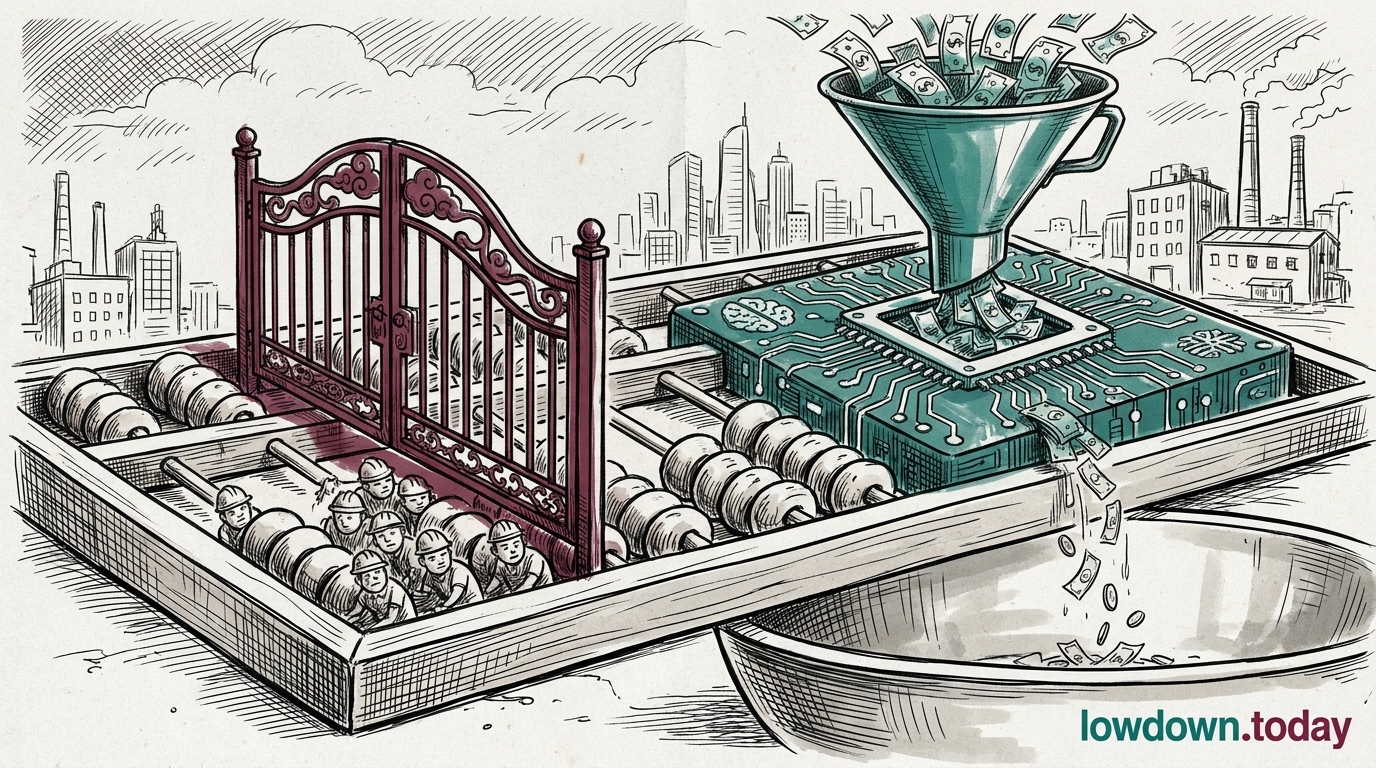
Microsoft told investors on its 29 April Q3 FY2026 earnings call that total company headcount will decline year-on-year in calendar 2027, the clearest forward signal yet of AI-driven workforce reduction at the company 1. The company also raised annual capital expenditure to $190 billion, reported annualised AI revenue of $37 billion (up 123 per cent year-on-year), and confirmed 20 million paid Microsoft 365 Copilot seats. Quarterly revenue was $82.9 billion with Azure growing 40 per cent, the same pace flagged at the prior quarter .

Investors had already modelled the capex raise from existing supply contracts. Microsoft's 2027 headcount commitment was new, and it was made on a public earnings call rather than buried in a 10-K footnote. JPMorgan's Jamie Dimon had publicly admitted AI displacement at the bank in February , with $600 million annually committed to retraining; Microsoft has now taken the same admission to a level above bank-by-bank precedent and made it a calendarised guidance item.

Microsoft has now given the rest of the enterprise software cohort permission to follow. Until 29 April, a Fortune 100 CEO who said in plain terms that AI would shrink the workforce risked being framed as anti-worker, anti-customer, or simply anti-growth. Microsoft has done it on an earnings call without share-price punishment. Salesforce, Oracle, IBM and the rest of the cohort can read off the same script, and the equity market response to date suggests they will. The labour-cost reduction baked into Microsoft's 2027 model is the operating offset that makes the $190 billion capex trajectory pencil.

Microsoft did not disclose how much headcount would decline, where geographically, or which functions take the cut. That magnitude gap is the next disclosure cycle's problem; the directional commitment is already in the public record.

Deep Analysis

In plain English

Microsoft makes software that helps businesses work more efficiently, and one of its biggest products right now is an AI assistant called Copilot that sits inside Microsoft Word, Excel, and Teams. It costs companies extra to subscribe to it. On 29 April, Microsoft told investors that by 2027 it will employ fewer people than it does today. That is unusual: most large technology companies have grown their workforces every year. Microsoft is saying directly that its own AI tools will allow it to run with fewer employees. At the same time, the company is spending $190 billion building the data centres and chips needed to power those AI tools. It earned $37 billion from AI products in the past year, up 123%. The tension is that Microsoft is both selling AI as a productivity tool to other businesses and using it to reduce its own headcount.

Deep Analysis
Root Causes

Microsoft's 2027 headcount decline has three structural drivers the earnings statement did not name explicitly.

First, Copilot's 20 million paid seats at roughly $30 per seat per month generates approximately $7.2 billion in annual recurring revenue from a product that directly substitutes for human labour in document creation, code review, and meeting summarisation. The revenue incentive to scale Copilot deployment is therefore inseparable from the headcount reduction it enables.

Second, Microsoft's $190 billion capex requires the company to find operating cost offsets. With revenue growing 18%, a headcount freeze (let alone reduction) is the most direct lever for expanding operating margins to service the capital commitment. CFO Amy Hood has guided to 'continued operating leverage' through 2027, which is financial language for the same phenomenon.

Third, Microsoft's software engineering workforce has been undergoing structural redistribution since the GitHub Copilot rollout in 2023: fewer junior developers, more senior reviewers. The 2027 headcount decline will disproportionately affect roles that AI can generate first drafts for.

What could happen next?
  • Precedent

    Microsoft's 2027 headcount guidance will be cited by other large enterprises as justification for their own AI-driven workforce reductions, normalising prospective headcount decline disclosures in investor communications.

    Short term · 0.8
  • Consequence

    The Warner-Rounds Economy of the Future Commission Act (see event 6) gains political urgency from the Microsoft signal; commission advocates will cite the 2027 forecast as evidence that the labour market impact is foreseeable and its study is overdue.

    Short term · 0.75
  • Risk

    If Microsoft's 2027 headcount decline materialises as announced while Azure growth decelerates, the company faces investor pressure to accelerate cuts further, creating a ratchet dynamic in which each productivity gain underwrites a further round of reductions.

    Medium term · 0.65
First Reported In

Update #8 · Beijing court bans AI sackings as Big Tech burns cash

Microsoft· 2 May 2026
Read original
Different Perspectives
UK financial regulators (BoE FPC / FCA)
The Bank of England's April FPC directive on agentic AI in payments was scoped around one frontier model; AISI confirmed a second model cleared the same 32-step threshold on 1 May. The supervisory architecture is one model behind the capability it was built to contain.
Indian IT sector workers (TCS, Infosys, Wipro)
TCS posted its first annual revenue decline in the modern era, Infosys shed 8,400 workers in a quarter, and Wipro hit its zero-fresher target. Western Big Tech's AI automation is cannibalising the offshored-services model that employs roughly five million Indian IT workers.
Chinese workers (Hangzhou and Beijing plaintiffs)
Workers Zhou and Liu won cases that established a two-court doctrinal chain: AI adoption is the employer's deliberate strategy, placing the cost of displacement on the employer rather than the worker. Any Chinese employee facing AI-driven dismissal now has a citable legal route that American, British, and European counterparts do not.
Chinese government, courts, and domestic employers
The Hangzhou rulings were released on Workers' Day eve alongside the Ministry of Human Resources' recognition of 42 new AI occupations. Domestic firms now face mandatory retraining obligations; the Orgvue estimate of 8-14 months added to displacement timelines will feature in employer compliance briefings throughout 2026.
EU regulators and European Parliament
The second Digital Omnibus trilogue collapsed without agreement on 28 April; the third is scheduled for 13 May with the binding employer AI-literacy obligation still contested. Brussels is arguing over a non-binding encouragement clause while Beijing's courts have already bound employers.
US legislators (Warner, Rounds, Hawley, Sanders)
Warner and Rounds produced the Economy of the Future Commission Act, the most concrete federal vehicle still moving, endorsed by the companies it would notionally regulate. The Sanders-AOC moratorium was killed by Democratic senators; the Hawley-Warner disclosure bill remains in committee with no floor date.
