Skip to content
Briefings are running a touch slower this week while we rebuild the foundations.See roadmap
AI: Jobs, Power & Money
2MAY

Amazon FCF down 95% as capex hits $200bn

4 min read
15:17UTC

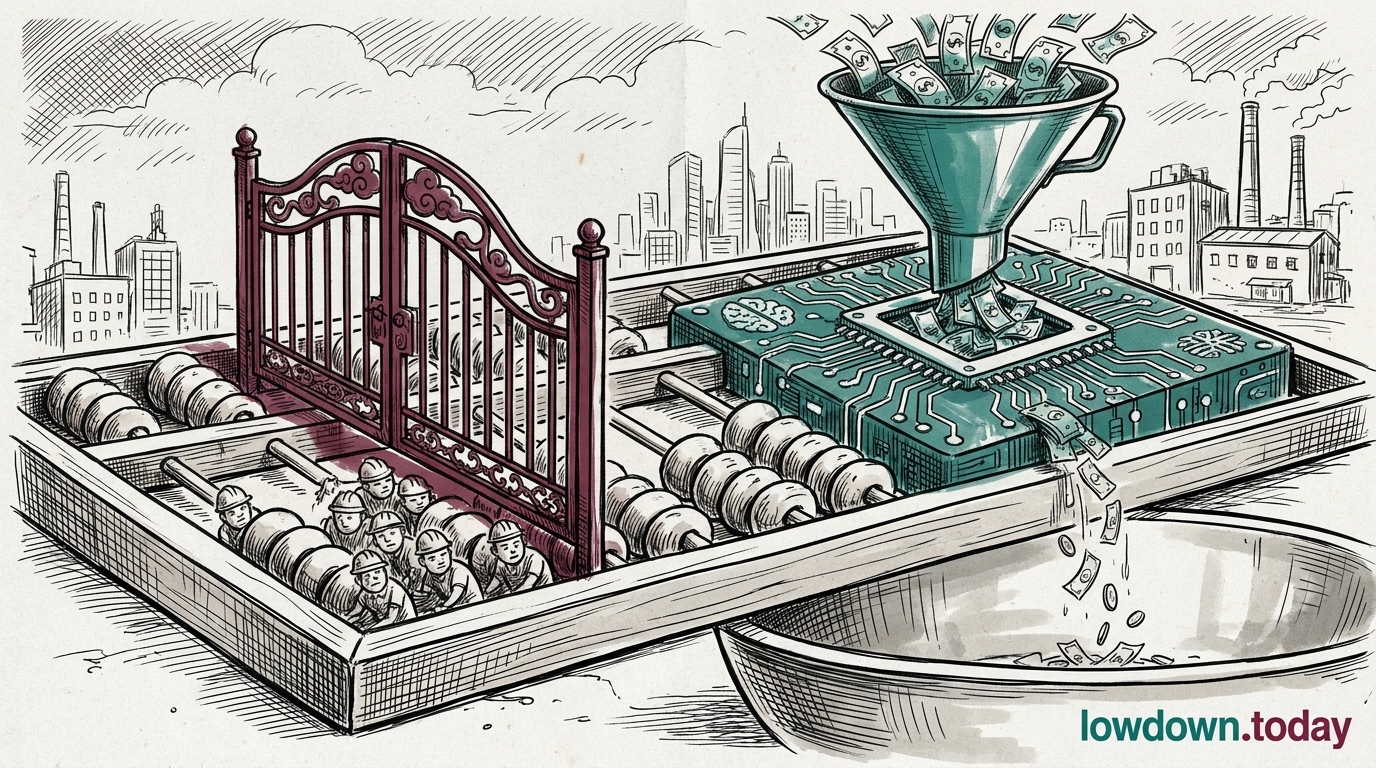
Amazon reported Q1 2026 net sales of $181.5 billion and AWS revenue of $37.59 billion, even as trailing twelve-month free cash flow collapsed 95 per cent to $1.2 billion against full-year capex projected at $200 billion.

EconomicDeveloping
Key takeaway

Amazon is spending thirteen times its AI revenue on AI infrastructure and funding the gap from free cash and headcount.

Amazon reported Q1 2026 net sales of $181.5 billion, up 17 per cent year-on-year, with AWS revenue up 28 per cent to $37.59 billion, its fastest growth in three years 1. Trailing twelve-month free cash flow fell to $1.2 billion, a 95 per cent decline year-on-year, against a full-year 2026 capital expenditure projection of $200 billion. The company also cut 16,000 corporate staff in Q1, on top of 14,000 in October 2025.

AWS is approaching a $15 billion AI revenue run rate, and Amazon is spending more than thirteen times that figure to build the infrastructure it expects will eventually carry the business. One dollar of free cash now reaches the equity holder for every $150 of revenue Amazon books. The rest is being routed into NVIDIA chips, data centre shells, power contracts, and component supply at TSMC, SK Hynix and Samsung.

Stanford's JOLTS-based analysis found AI is preventing roughly one million annual hires against the 2023 pace, an order of magnitude beyond the layoff figure US firms admit to publicly. Amazon's earnings now provide the financial picture that matches that hiring picture: a balance sheet being remade to fund infrastructure that needs the labour cost reduction to pencil. The 16,000 Q1 corporate cuts, on top of the 14,000 in October (covered in the cumulative Challenger total , are the operating offset that lets capex run at this pace without the FCF gap widening further.

For pension and ISA holders with US tech tracker exposure, this is the structural piece. The labour-cost reductions Amazon and its peers are signalling are the only realistic operating offset to the capex curve. If AI revenue does not scale into the spend by 2028, the equity drawdown belongs to the saver, not the board.

Deep Analysis

In plain English

Free cash flow is the money a company has left after it pays for everything it needs to run and grow. For most of the past decade, Amazon generated tens of billions of dollars in free cash flow each year. That money funded acquisitions, shareholder returns, and new ventures. In the twelve months to the end of Q1 2026, Amazon's free cash flow dropped from roughly $25 billion to $1.2 billion. The reason: the company committed to spending $200 billion on AI data centres and cloud infrastructure in 2026 alone. At the same time, it cut 16,000 corporate employees, roughly the equivalent of a mid-sized company's entire workforce. AWS, the cloud division that hosts AI workloads for thousands of businesses, grew 28% and is now the fastest-growing large cloud business in the world. The tension in Amazon's numbers is that record revenue and growth are being built on a spending programme that is consuming virtually all of its cash.

Deep Analysis
Root Causes

Amazon's 95% FCF collapse has three structural drivers.

First, AWS pricing is under pressure: Google Cloud's 63% growth and Azure's 40% growth have pushed Amazon to compete on price for new enterprise contracts, compressing AWS margins at exactly the moment when capex is highest. AWS operating margin fell from 37% in Q3 2025 to 32% in Q1 2026 per Amazon's SEC filing, meaning each dollar of AWS revenue generates less cash to fund the build-out.

Second, Amazon's $200 billion capex commitment was partly driven by the AWS customer demand signal from the $460 billion Alphabet backlog and Microsoft's $190 billion announcement: Amazon could not afford to fall behind in hyperscale capacity without risking enterprise contract losses to competitors with faster delivery timelines. Amazon could not afford to fall behind in hyperscale capacity without risking enterprise contract losses to Google and Microsoft, both of which are building faster.

Third, Amazon's corporate headcount reduction from 30,000 since October 2025 (ID:1116) to 16,000 more in Q1 2026 reflects AI-driven replacement of corporate and operations-support roles. Andy Jassy's internal communications have explicitly cited AI tools allowing spans of control to widen, reducing management layers.

What could happen next?
  • Consequence

    Amazon's 95% FCF collapse will be cited in Q2 earnings season as the reference case for the trade-off between AI infrastructure investment and near-term shareholder returns, pressuring other hyperscalers to justify their capex levels.

    Immediate · 0.85
  • Risk

    If AWS growth decelerates below 20% for two consecutive quarters before the $200 billion capex cycle completes, Amazon faces a period of negative FCF with limited options other than debt issuance or further headcount reduction.

    Medium term · 0.6
  • Opportunity

    AWS's 28% growth and $37.6 billion quarterly run-rate positions it ahead of Azure and Google Cloud in the enterprise AI workload capture race; if the capex builds sufficient compute capacity before competitors, the installed base moat strengthens.

    Medium term · 0.7
First Reported In

Update #8 · Beijing court bans AI sackings as Big Tech burns cash

Amazon IR· 2 May 2026
Read original
Different Perspectives
UK financial regulators (BoE FPC / FCA)
The Bank of England's April FPC directive on agentic AI in payments was scoped around one frontier model; AISI confirmed a second model cleared the same 32-step threshold on 1 May. The supervisory architecture is one model behind the capability it was built to contain.
Indian IT sector workers (TCS, Infosys, Wipro)
TCS posted its first annual revenue decline in the modern era, Infosys shed 8,400 workers in a quarter, and Wipro hit its zero-fresher target. Western Big Tech's AI automation is cannibalising the offshored-services model that employs roughly five million Indian IT workers.
Chinese workers (Hangzhou and Beijing plaintiffs)
Workers Zhou and Liu won cases that established a two-court doctrinal chain: AI adoption is the employer's deliberate strategy, placing the cost of displacement on the employer rather than the worker. Any Chinese employee facing AI-driven dismissal now has a citable legal route that American, British, and European counterparts do not.
Chinese government, courts, and domestic employers
The Hangzhou rulings were released on Workers' Day eve alongside the Ministry of Human Resources' recognition of 42 new AI occupations. Domestic firms now face mandatory retraining obligations; the Orgvue estimate of 8-14 months added to displacement timelines will feature in employer compliance briefings throughout 2026.
EU regulators and European Parliament
The second Digital Omnibus trilogue collapsed without agreement on 28 April; the third is scheduled for 13 May with the binding employer AI-literacy obligation still contested. Brussels is arguing over a non-binding encouragement clause while Beijing's courts have already bound employers.
US legislators (Warner, Rounds, Hawley, Sanders)
Warner and Rounds produced the Economy of the Future Commission Act, the most concrete federal vehicle still moving, endorsed by the companies it would notionally regulate. The Sanders-AOC moratorium was killed by Democratic senators; the Hawley-Warner disclosure bill remains in committee with no floor date.
