Skip to content
You can now search across every topic, entity and event.What's new
AI: Jobs, Power & Money
10APR

WARN Act untested: four AI cuts, zero enforcement actions

4 min read
16:54UTC

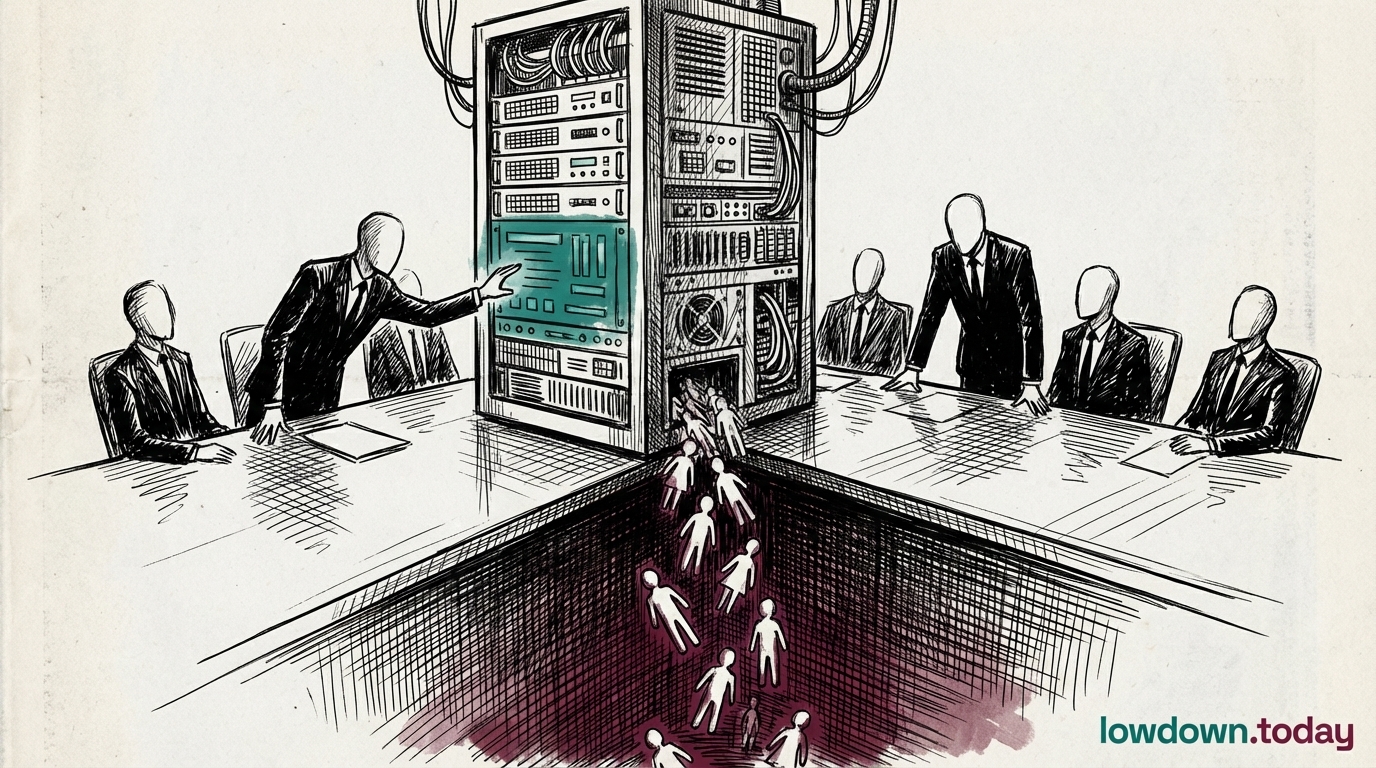
Oracle, Microsoft, PayPal, and GitLab have each navigated the 1988 WARN Act through AI-era corporate restructuring in a two-month window without producing a single enforcement action, while S.3339, the only US AI workforce bill with bipartisan Senate support, is endorsed by the companies it would notionally regulate.

EconomicDeveloping
Key takeaway

Four WARN Act navigations in two months without enforcement have made legal ambiguity into repeatable corporate template.

By 15 May 2026, four major US employers have each restructured their workforces citing AI efficiency within a two-month window without a single enforcement action under the WARN Act: Oracle, Microsoft, PayPal, and GitLab. Oracle's March 2026 cut produced WARN notices for under 4% of those affected; Massachusetts produced nothing at all . PayPal stretched its timeline to avoid the threshold. Microsoft made departures voluntary. GitLab has no qualifying single US site. Each method is different; none triggered enforcement.

The Economy of the Future Commission Act (S.3339), introduced by Senators Warner and Rounds and the most viable US AI workforce legislative vehicle as of 15 May 2026, has been publicly endorsed by Microsoft and Google . S.3339 establishes a federal commission to study AI's economic and workforce impacts; it does not create new enforcement obligations, does not extend the WARN Act to AI-driven restructuring, and does not establish individual worker rights. The companies endorsing it are the same companies whose restructuring decisions the commission would study.

The Attorney General's AI Task Force, established 9 January 2026, has produced no legal filings by 15 May. California's SB 951 (requiring 90 days' notice for AI-driven mass layoffs) and New York's WARN Act AI disclosure amendment remain on the books; the Trump administration's preemption framework positions them as targets when enforcement begins. Nothing has been filed.

The Hangzhou Intermediate People's Court ruling and the Beijing People's Court Liu case ruling represent the only binding judicial precedent in any major jurisdiction requiring employers to bear the legal consequence of deliberate AI-driven dismissal. The US and EU, which spent 2023 and 2024 building regulatory frameworks premised on the assumption that enforcement would precede significant displacement, have arrived at May 2026 with the displacement wave in progress and the enforcement mechanism unused.

Deep Analysis

In plain English

A US law from 1988 called the WARN Act requires companies to give workers 60 days' notice before large mass layoffs. Between March and May 2026, four large companies, Oracle, Microsoft, PayPal, and GitLab, made major cuts using AI as the justification. None of them received a government penalty or legal action for how they handled the notification requirement. There is also a bill in the US Senate, S.3339, that would set up a government commission to study how AI is affecting jobs. Microsoft and Google have publicly backed this bill. That is notable because these are two of the companies making AI-driven cuts. A commission that studies the problem is different from a law that prevents or compensates for it. The pattern as of 15 May 2026: companies are restructuring freely under AI framing, the existing law is not being enforced, and the proposed response is a commission to study what is already happening.

Deep Analysis
Root Causes

The WARN Act enforcement gap has a structural cause in the Act's geographic threshold design that the fact identifies but does not fully explain. The Act was modelled on plant-closure geography: a factory employs 500 workers at one address; if the factory closes, all 500 lose their jobs at one site.

The threshold triggers clearly. AI-era restructurings work differently: a company employs 500 remote engineers across 47 states, each worker legally assigned to their home address as their 'site'. Cutting all 500 produces no filing obligation because no single site has 50 departures in a 90-day window.

Oracle's 14+ former workers alleging deliberate remote-worker reclassification specifically to reduce WARN obligations describe the second mechanism: companies that might have crossed per-site thresholds reclassify affected workers as remote before the cut, distributing them into the geographic gap the Act cannot reach. The Attorney General AI Task Force has authority to litigate this. It has not done so.

What could happen next?
  • Consequence

    S.3339's commission-study model delays binding AI workforce obligations by 3-4 years from enactment, beyond the primary displacement phase of the current cycle.

    Medium term · 0.7
  • Precedent

    Four major AI-era restructurings without enforcement establishes that the WARN Act does not constrain the AI-era corporate restructuring model; the navigation template is now standard corporate practice.

    Immediate · 0.85
  • Risk

    State AI labour laws, California SB 951 and the New York WARN amendment, remain on the books as the only enforceable AI workforce obligations; their survival depends on whether the Attorney General AI Task Force litigates before the midterms.

    Short term · 0.65
First Reported In

Update #9 · GitLab signs the manifesto, Brussels backs out

Seyfarth Shaw / National Law Review· 15 May 2026
Read original
Different Perspectives
Office for National Statistics
Deferred its Transformed Labour Force Survey beyond November 2027 and disclosed a May 2026 telephone-collection failure. The ONS carries no AI-attribution layer at all, so Britain sits outside this month's cohort of measuring states by its own admission.
Uber India, Swiggy, Zomato and Urban Company
Named as respondents after the Karnataka High Court extended the interim welfare-fee deposit arrangement under the state's gig-worker welfare law to Uber India on 28 July, joining the other platforms already under the same order. The companies are contesting the underlying law while complying with the interim deposit terms.
Kenya State Department for ICT and the Digital Economy
Its draft AI policy, open for consultation to 4 August, proposes a pay floor for data-annotation work, where Kenyan annotators earn $1.46 to $3.74 an hour against $21 to $27 in the US, on figures relayed by the trade outlet WeeTracker. Kenya is legislating on AI labour even though the World Bank rates it among the least exposed economies.
ARAN and Italian public-sector unions
Signed the CCNL Funzioni Centrali 2025-2027 on 6 August, the first Italian national contract with a dedicated AI Title, barring fully automated employment decisions without meaningful human intervention and requiring advance union notice of AI deployment. The unions secured this through bargaining rather than waiting for legislation.
US employers reporting to Challenger, Gray & Christmas
Named artificial intelligence as the leading stated cause of job cuts for a fifth consecutive month in July, at 33% of that month's total, even as the overall cut count fell 27%. Employers kept citing AI as the reason even as scrutiny of the attribution rose.
Bank for International Settlements
Bulletin 130 reports a 0.75 percentage point average unemployment rise across high-AIPI countries between 2023 and 2025, while its own footnote 2 states the index is strongly correlated with employment shares in AI-exposed sectors it is used to predict. The bulletin calls the productivity payoff uncertain and uneven.