Skip to content
Briefings are running a touch slower this week while we rebuild the foundations.See roadmap
AI: Jobs, Power & Money
2MAY

Beijing's Liu ruling laid the doctrine

3 min read
15:17UTC

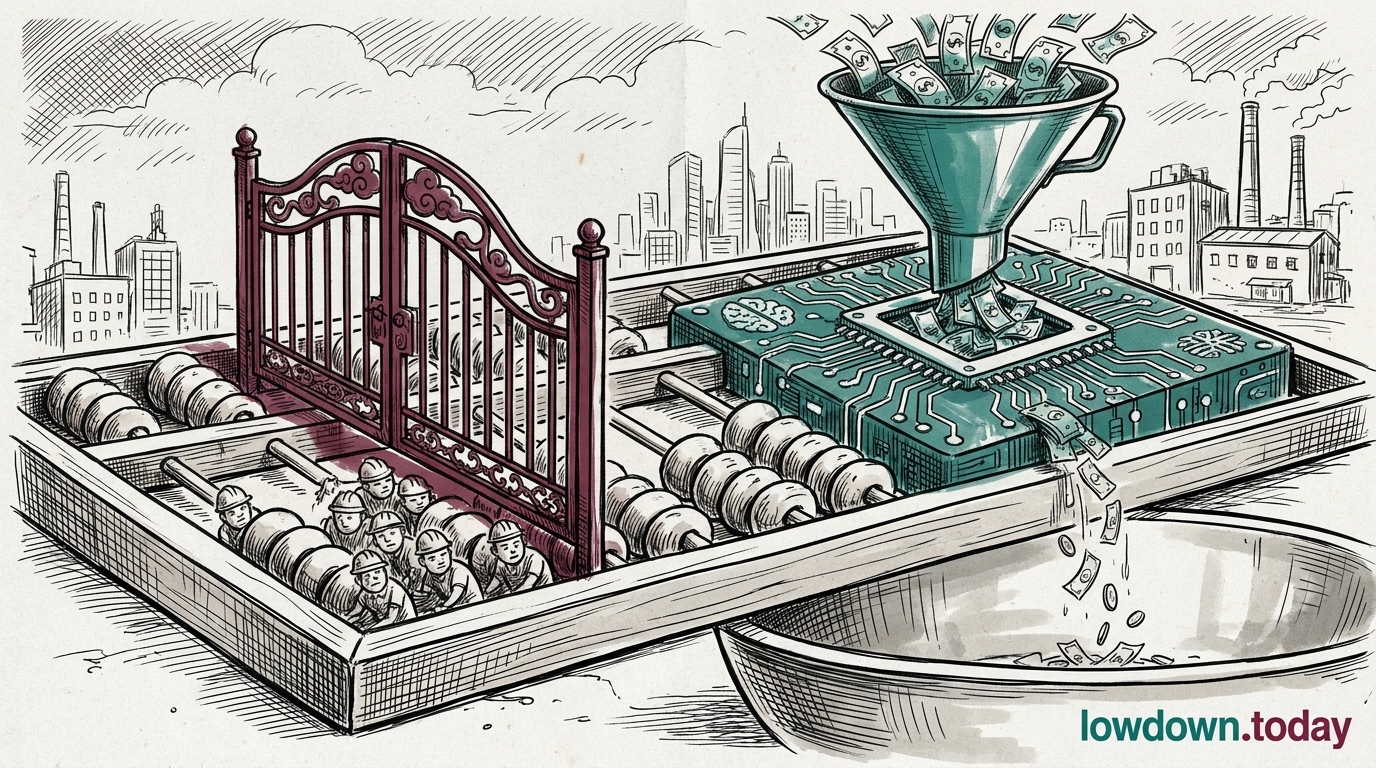
A Beijing court ruled in December 2025 that an employer's AI pivot is a deliberate, predictable strategy and not an unforeseeable circumstance, placing the legal risk of automation on the employer rather than the worker.

EconomicDeveloping
Key takeaway

December's Liu ruling did the legal heavy lifting that Hangzhou's April judgments industrialised into precedent.

A Beijing People's Court ruled in December 2025 in favour of Liu, a worker hired in 2009 for manual map data entry and dismissed when his employer switched to AI-based collection 1. The court found that the employer's AI pivot was "a deliberate, predictable strategy, not unforeseeable", and therefore did not satisfy the Labor Contract Law test for terminating an employment contract on a major change in objective circumstances 2.

The Beijing court did the doctrinal move that Hangzhou later industrialised. Chinese employment law since the 2008 Labor Contract Law tightened employer dismissal rights significantly compared with the older 1995 framework; the "objective change" clause was already narrowly construed for cyclical economic conditions like a sudden loss of contracts or a regulatory shutdown. Applying it to deliberate AI strategy is consistent with the law's text but novel as application, and Beijing's December ruling did the work of saying so. Five months later, the Hangzhou Intermediate People's Court picked up the same logic in the Zhou case and added the appellate weight that turns one judgment into guiding precedent. Beijing's MOHRSS recognised 42 new AI occupations in April , giving the state planning route a parallel to the judicial one.

For lower courts across China, the practical effect is that Liu and Zhou now read together as a doctrinal package: Liu establishes that AI redundancy is the employer's strategy, Zhou establishes the procedural remedy of mandatory retraining and reasonable reassignment before any termination. For multinationals, the practical effect is that an employer-side defence built on "AI changed our circumstances" no longer works in a Chinese labour court, regardless of which province the dispute lands in.

The Liu case did not make international headlines in December because no one had built the AI-displacement story into a frame that recognised it. The Hangzhou release was timed to that frame, on Workers' Day eve, with state media coverage attached. The Beijing court did the law; Beijing's media did the politics later.

Deep Analysis

In plain English

When your employer says business conditions changed and they no longer need your role, employment law in many countries treats that as a legitimate reason to let you go. Employment courts usually ask: did the change come from outside, or did the employer choose it? A Beijing court said in December 2025 that switching to AI is a deliberate strategic choice the employer makes and budgets for, not an outside shock. Liu had been entering map data by hand since 2009. His employer selected, funded, and deployed an AI system to replace that task, then dismissed Liu. Beijing court ruled the employer bore that cost because the employer made that choice. This ruling laid the doctrinal foundation for the stricter Hangzhou decisions that followed in April 2026.

Deep Analysis
Root Causes

Chinese civil procedure doctrine draws on a continental European model of statutory interpretation in which the purpose of the rule, including its legislative history, guides application. Article 40(3) was drafted in 2008 to protect workers from external economic shocks, with the global financial crisis as the legislature's reference point.

Beijing courts applying teleological interpretation asked whether AI adoption represents the kind of external shock that provision covers. Beijing People's Court ruled it does not: AI adoption is employer-initiated, budgeted, and scheduled, structurally unlike the crisis-driven displacement the article was written to address.

A secondary driver: China's state policy runs in two directions simultaneously. The Ministry of Human Resources published a new occupation taxonomy in April 2026 covering AI roles (ID:2188), implicitly signalling that workers can transition to AI-adjacent work. State-linked media has simultaneously run campaigns against 'arbitrary dismissal under the guise of digitisation.' Courts absorb both signals; the net reading favours retraining obligations over dismissal rights.

What could happen next?
  • Precedent

    The 'deliberate and predictable' standard from the Liu ruling, now endorsed by Hangzhou, will be cited in AI-dismissal litigation across Chinese jurisdictions through 2026, creating a de facto retraining requirement for planned AI transitions.

    Short term · 0.72
  • Risk

    Employers with documented internal AI transition plans (board papers, investor communications, capex forecasts) face higher litigation exposure because those documents prove the 'deliberate and predictable' standard is met.

    Short term · 0.8
  • Consequence

    US companies that have publicly announced headcount reductions alongside AI investment (Amazon, Microsoft, Meta) would meet the 'deliberate and predictable' test automatically if Beijing's doctrine were adopted in other jurisdictions.

    Medium term · 0.55
First Reported In

Update #8 · Beijing court bans AI sackings as Big Tech burns cash

Xinhua· 2 May 2026
Read original
Causes and effects
Different Perspectives
UK financial regulators (BoE FPC / FCA)
The Bank of England's April FPC directive on agentic AI in payments was scoped around one frontier model; AISI confirmed a second model cleared the same 32-step threshold on 1 May. The supervisory architecture is one model behind the capability it was built to contain.
Indian IT sector workers (TCS, Infosys, Wipro)
TCS posted its first annual revenue decline in the modern era, Infosys shed 8,400 workers in a quarter, and Wipro hit its zero-fresher target. Western Big Tech's AI automation is cannibalising the offshored-services model that employs roughly five million Indian IT workers.
Chinese workers (Hangzhou and Beijing plaintiffs)
Workers Zhou and Liu won cases that established a two-court doctrinal chain: AI adoption is the employer's deliberate strategy, placing the cost of displacement on the employer rather than the worker. Any Chinese employee facing AI-driven dismissal now has a citable legal route that American, British, and European counterparts do not.
Chinese government, courts, and domestic employers
The Hangzhou rulings were released on Workers' Day eve alongside the Ministry of Human Resources' recognition of 42 new AI occupations. Domestic firms now face mandatory retraining obligations; the Orgvue estimate of 8-14 months added to displacement timelines will feature in employer compliance briefings throughout 2026.
EU regulators and European Parliament
The second Digital Omnibus trilogue collapsed without agreement on 28 April; the third is scheduled for 13 May with the binding employer AI-literacy obligation still contested. Brussels is arguing over a non-binding encouragement clause while Beijing's courts have already bound employers.
US legislators (Warner, Rounds, Hawley, Sanders)
Warner and Rounds produced the Economy of the Future Commission Act, the most concrete federal vehicle still moving, endorsed by the companies it would notionally regulate. The Sanders-AOC moratorium was killed by Democratic senators; the Hawley-Warner disclosure bill remains in committee with no floor date.
