Skip to content
Welcome, thoughtbot's Giant Robots listeners!Start here
AI: Jobs, Power & Money
6NOV

RBA credits data centres for growth

3 min read
11:10UTC

The Reserve Bank of Australia raised its cash rate to 4.85% on 3 November and said data-centre investment had kept growth stronger than it expected.

EconomicAssessed
Key takeaway

Australia's central bank credits data-centre investment for stronger growth as it raises rates to 4.85%.

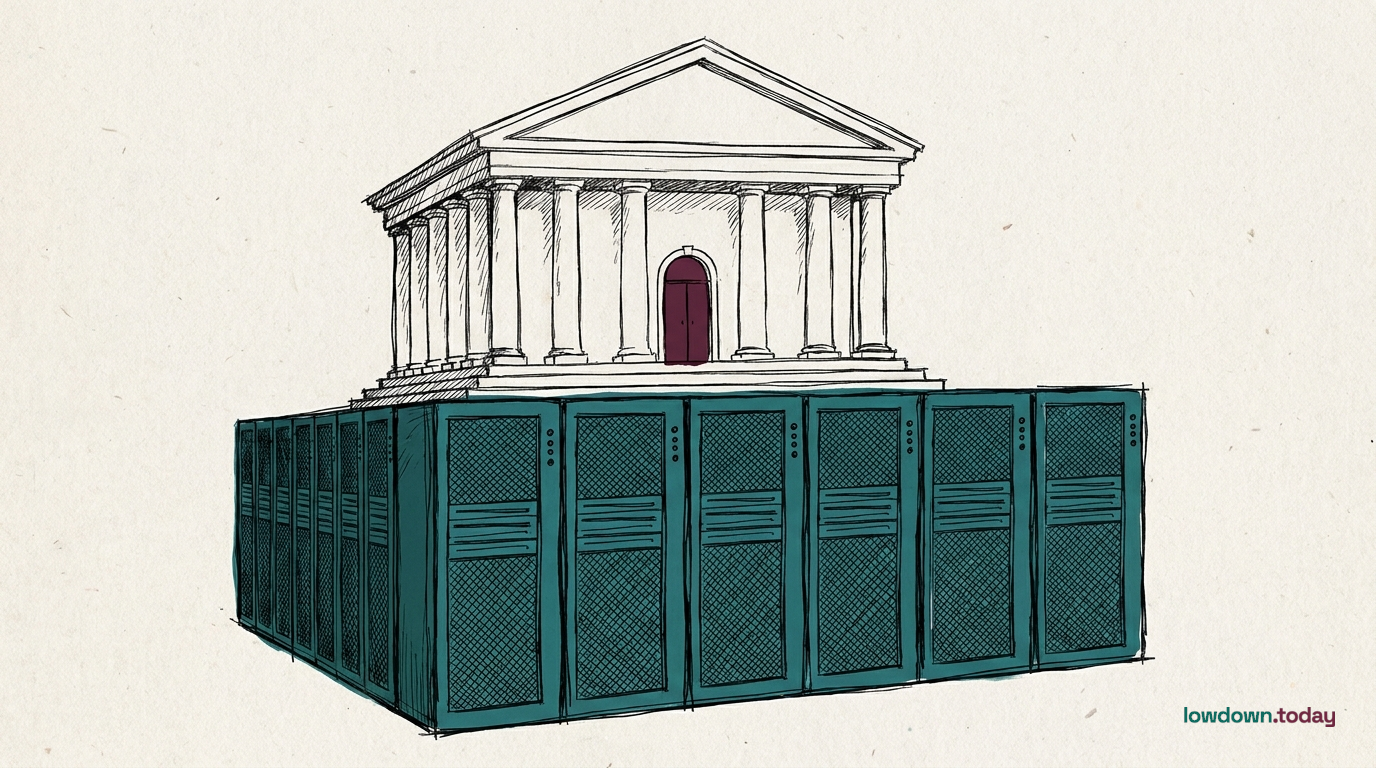
The Reserve Bank of Australia (RBA) raised its cash rate by a quarter point to 4.85% on 3 November and credited data-centre investment for growth holding up. The RBA sets the cash rate, the overnight rate that anchors Australian borrowing costs. The decision came with the RBA's Statement on Monetary Policy, the quarterly forecast it publishes with the decision.

Activity this year was "a little stronger than anticipated", the Statement says, "supported by rapid growth in data centre investment", and the RBA revised up its year-ahead growth forecast on "a stronger outlook for data centre investment"⁠1. Abroad, it cites "rapid growth in AI-related prices" as one reason inflation stays above central-bank targets into 2027. Until now, central banks mostly reached AI through labour studies, such as the Bank of Canada's work on how long AI-exposed workers take to find jobs and Banque de France research on under-30 hiring.

Domestic inflation drove the decision: headline inflation is running at 3.9% and the trimmed mean, the RBA's core gauge that drops the biggest price swings, at 3.7%. The Statement credits data-centre investment for stronger growth, not for the hike. Unemployment rose faster than the RBA expected, to an average of 4.6% in the September quarter, and the bank projects unemployment a bit over 5% by the end of 2028.

On a variable mortgage of 600,000 Australian dollars, a quarter point adds about 1,500 Australian dollars a year in interest if lenders pass it on in full. Households face that bill as joblessness climbs, while the RBA's own forecast leans on server halls for growth.


Deep Analysis

In plain English

Australia's central bank, the Reserve Bank of Australia, sets the interest rate that banks use as a base for mortgages and loans. On 3 November it raised that rate. Its main reason was that prices in Australia are still rising too fast. But in its report it also said the economy grew faster than expected partly because companies are spending heavily on data centres, the large buildings full of computers that run AI services. That building work creates demand for materials, equipment and construction workers. More demand can keep prices up, which makes the bank slower to cut rates. Meanwhile, the share of people out of work is rising.

Deep Analysis
Root Causes

A central bank sets one rate for the whole economy. When one sector's capital spending lifts total demand, every borrower pays the higher rate, whether or not they work near a data centre.

Data-centre investment adds demand now, during construction and equipment purchases. Any saving in labour that AI brings arrives later, inside the firms that rent the capacity. The timing puts AI's effect on rates years ahead of any effect on payrolls.

The Statement also imports AI through prices: it cites "upstream AI cost pressures" abroad, so chip and equipment costs set elsewhere feed into the global inflation backdrop Australia faces.

What could happen next?
  • Meaning

    AI investment now enters a G20 central bank's growth forecast as a named driver, separate from any labour-market effect.

    Immediate · Assessed
  • Risk

    If data-centre investment slows sharply, the growth the RBA credits to it would fall away while unemployment is already rising.

    Medium term · Suggested
  • Consequence

    Households outside the AI sector bear borrowing costs set partly against demand from that sector.

    Short term · Assessed
First Reported In

Update #22 · Central banks see AI before payrolls do

Reserve Bank of Australia· 6 Nov 2026
Read original →
Different Perspectives
Korea's four largest banks, as reported by News1
KB Kookmin, Shinhan, Hana and Woori rehired 1,013 retirees last year, equal to 79.1% of their graduate intake, according to News1. Graduates face a smaller entry intake while returners take fixed-term credit-screening roles at lower pay, News1 reports.
High Court of Justice of Madrid
The court's employment chamber ruled in judgment 864/2026, dated 8 October and made public in early November, that introducing AI is not on its own a ground for dismissal. Employers must prove AI's effect through the four causes the Workers' Statute already lists.
Singapore Ministry of Manpower
The Singapore Ministry of Manpower put third-quarter retrenchments at 4,800, concentrated in information and communications, financial services and manufacturing, with business reorganisation the main driver. Its release does not mention AI.
Challenger, Gray & Christmas
Challenger reported on 5 November that market and economic conditions overtook AI as the leading stated reason for 2026's US job cuts, at 130,531 against 121,401. AI was cited for 1,265 cuts in October, its lowest month of the year.
Office for Budget Responsibility
The OBR's 28 October outlook showed output per worker in information and communication growing 7.6% a year, yet kept AI's boost to UK productivity at 0.2 percentage points a year. It does not attribute the faster growth to AI.
Central Bank of Ireland
Governor Gabriel Makhlouf said on 2 November that AI investment has supported Irish activity and flagged the debt financing behind it as a financial-stability risk. On jobs, he named skills bottlenecks and mismatches, not job losses.

Written with AI from Lowdown's published reporting. Not individually reviewed by an editor. Editorial standards.

