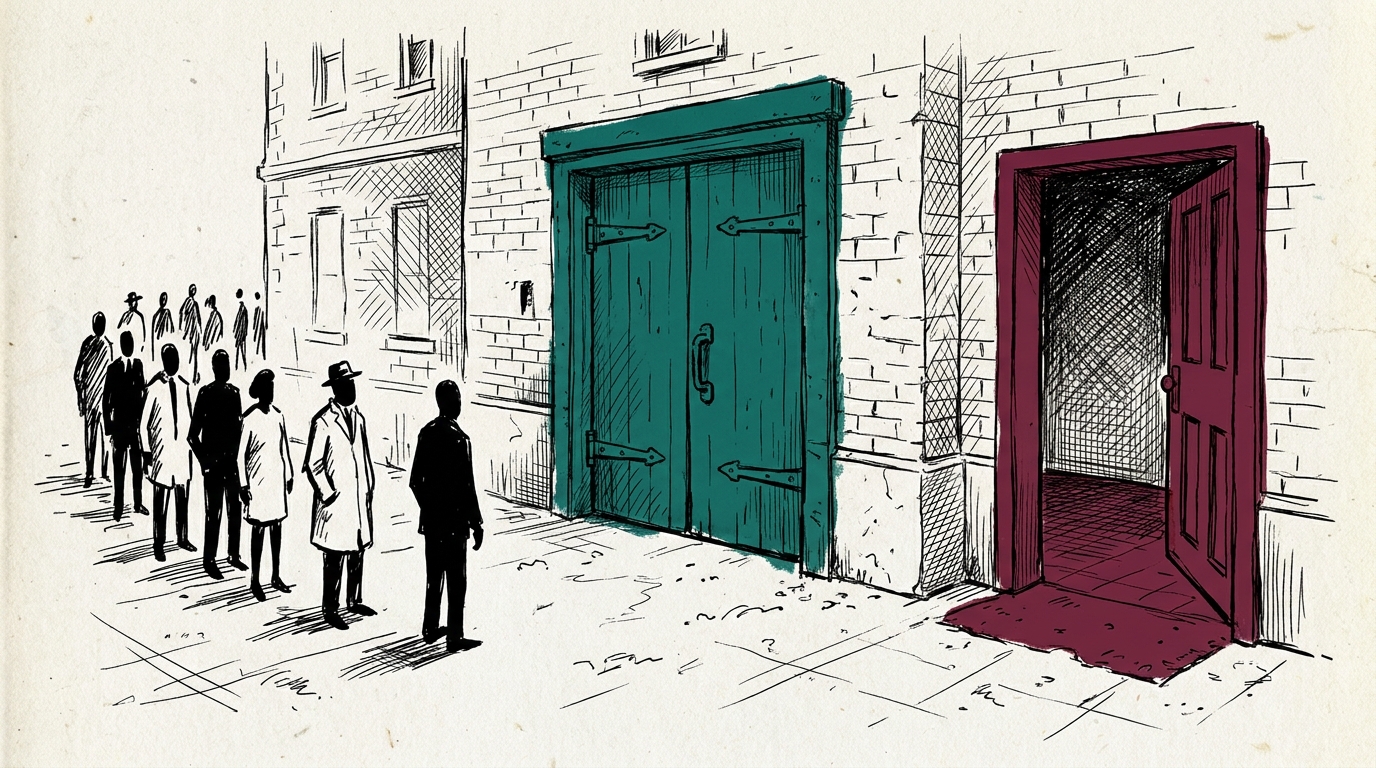
The Bank of Canada published a staff study on 24 August 2026 using Statistics Canada Labour Force Survey microdata, comparing how readily workers in fully AI-exposed occupations find jobs against workers in occupations scored at zero exposure 1. Across the 2015 to 2019 average, the gap between the two groups stood at 2.2 percentage points. In 2025 it stood at 13.9 points.
Read that number carefully, because it invites a false reading. No group's job-finding rate fell by 13.9 points. The distance between exposed and unexposed workers widened by 11.7 points, and 13.9 is where that distance now sits. The separation-rate gap, which measures the difference in how often each group loses work, moved from 0.0 points to 0.1. Dismissals did not do this. The unemployment-risk gap widened more modestly, from 1.9 to 2.8 points, which is what you would expect of workers who are not losing jobs but are queueing longer to get one.
A differential survives an objection a level cannot. A general downturn depresses hiring for exposed and unexposed workers alike and leaves the distance between them where it was. For a graduate applying into an exposed occupation this autumn, the whole effect sits in a vacancy that never opens, and no notice period, severance payment or redundancy tracker records its absence.
One institution reads the same period the other way. Pablo Hernandez de Cos, General Manager of the Bank for International Settlements, the Basel institution that acts as a bank for central banks, told the Global Fintech Fest in Mumbai on 10 September 2026 that actual displacement remains limited and that firms sit in wait-and-see mode, even while nearly 80% of firms discuss plans to automate production and substitute labour 2. Federal Reserve governor Michael Barr found little evidence of economy-wide displacement in July , and governor Lisa Cook said that month that the dire predictions had not arrived . A New York Fed survey of service firms had already sketched the Canadian shape on 5 August, with adoption climbing, AI-driven redundancies rare, and hiring suppression falling on college-educated applicants .