Skip to content
Briefings are running a touch slower this week while we rebuild the foundations.See roadmap
2026 FIFA World Cup
29MAR

Closed skies strand Iraq before playoff

4 min read
14:01UTC

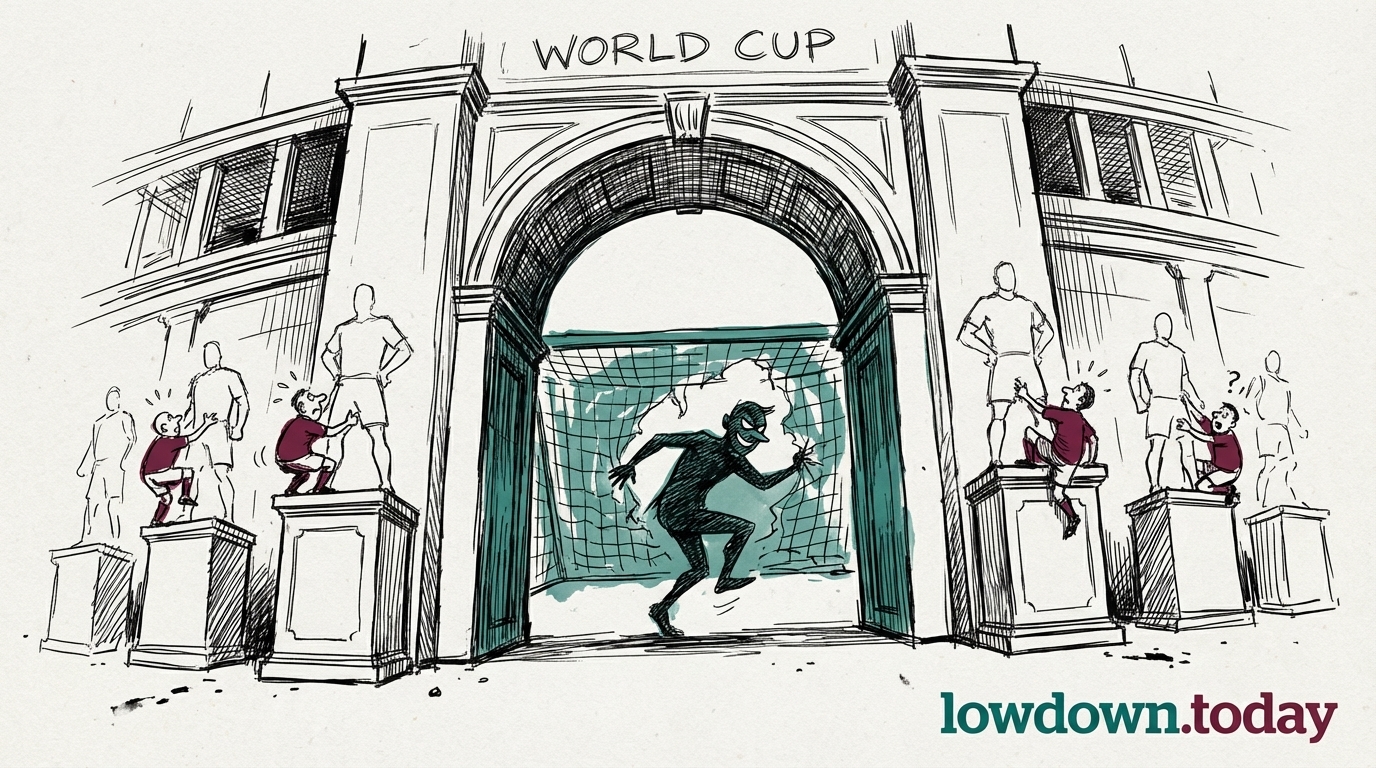
Iraqi airspace is shut, embassies are closed, and the national team's coach is stranded in the UAE. If FIFA does not postpone the 31 March playoff, Iraq will forfeit — the first World Cup qualification lost to war.

SportAssessed
Key takeaway

Iraq may forfeit World Cup qualification to a war it did not start and cannot stop.

Graham Arnold, Iraq's Australian coach, has asked FIFA to postpone his team's inter-confederation playoff final against Suriname or Bolivia, scheduled for 31 March in Monterrey 1. His case is not political but logistical: Iraqi airspace is closed until at least 1 April, domestic-league players cannot leave the country, foreign embassies in Baghdad have shut — blocking visa applications for Mexico — and Arnold himself is stranded in the UAE 2. He proposed rescheduling the match to one week before the tournament opens on 11 June.

FIFA has not publicly responded. If Iraq cannot assemble a squad and forfeits, it would be the first World Cup qualification lost directly to a concurrent armed conflict 3. Iraq last appeared at a World Cup in 1986 — in Mexico, the same country where this playoff is now scheduled.

The National team's most celebrated moment since, winning the 2007 Asian Cup while sectarian civil war tore across Iraqi cities, drew millions into the streets of Baghdad, Basra and Erbil. Football has functioned as Iraq's last shared civic space when every other institution fractured. A forfeit imposed not by defeat but by closed airspace would remove even that.

Arnold, who coached Australia at the 2022 World Cup in Qatar, took the Iraq job knowing the operating environment was difficult. His squad draws on players scattered across Gulf, European and Iraqi domestic leagues — assembling them for a single elimination match requires functioning airports, open embassies and reliable communications, none of which currently exist in Baghdad. FIFA has postponed qualifiers before: COVID-19 disrupted the entire 2022 cycle. But those decisions applied uniformly to every team. Iraq is asking for an individual exception that acknowledges a military reality FIFA has no established mechanism to grant. Refusal would mean Iraq's World Cup place was decided not on a pitch in Monterrey but by the inability to board a plane in Baghdad.


Deep Analysis

In plain English

Iraq's football coach is stranded in the UAE and cannot return. Players competing in Iraqi domestic leagues cannot obtain visas to travel because embassies in Baghdad have shut down. Iraq's airspace is closed due to the regional conflict. Iraq is scheduled to play a decisive qualification match on 31 March, but physically cannot assemble its squad to travel to Monterrey. The coach has asked FIFA to delay the match by a few weeks. FIFA has not responded publicly. If FIFA says no, Iraq may be forced to forfeit — not because they played badly, but because a war is preventing them from travelling.

Deep Analysis
Synthesis

Events 4, 5, and 7 share a single origin: the 28 February strike that killed Khamenei. FIFA is processing each case in isolation — Iran's factional dispute, Mexico's relocation offer, Iraq's postponement request — when all three are downstream consequences of the same military action. The World Cup scheduling architecture has no mechanism to process a single geopolitical event generating simultaneous participation crises across multiple nations. This is a systemic governance failure, not a series of unrelated administrative problems.

Root Causes

FIFA's qualification framework contains no explicit force majeure provision for armed conflict affecting a member association's ability to travel and assemble. The framework was designed to address natural disasters affecting stadium infrastructure — not active conflict zones simultaneously closing airspace, shutting diplomatic infrastructure, and stranding coaching staff across international borders. This is a structural gap in FIFA's rulebook, not a discretionary judgement call within existing provisions.

Escalation

FIFA's continued public silence on Arnold's postponement request is itself a de facto signal: institutional precedent strongly suggests FIFA defaults to proceeding with scheduled fixtures unless formally compelled otherwise. Each passing day without a response reduces the time available for Iraq to assemble even a partial squad of foreign-based players, making the forfeit outcome progressively more likely regardless of FIFA's eventual ruling.

What could happen next?
  • Precedent

    FIFA's response — or continued silence — establishes the institutional precedent for how concurrent armed conflicts affecting national team logistics are handled in future tournaments.

    Immediate · Assessed
  • Consequence

    If Iraq forfeits, Suriname or Bolivia qualifies without playing a match — a sporting anomaly with no legitimate on-field resolution and significant implications for qualification process credibility.

    Short term · Assessed
  • Risk

    Iraq's government could frame a FIFA refusal internationally as institutional complicity in the sporting consequences of Western military action — a narrative with significant resonance across the Global South.

    Short term · Suggested
  • Meaning

    A forfeit would establish by institutional inaction that concurrent armed conflict can strip a nation of its earned qualification rights — a principle FIFA has never formally codified but would implicitly endorse.

    Long term · Assessed
First Reported In

Update #1 · Iran splits on World Cup boycott

Al Jazeera· 22 Mar 2026
Read original
Causes and effects
This Event
Closed skies strand Iraq before playoff
FIFA's competition regulations contain force majeure provisions but have never been applied to a scenario where a qualifying nation's entire civilian infrastructure — airspace, embassies, domestic transport — is disabled by international military action. The closest precedent, Yugoslavia's exclusion from Euro 1992, was a political decision by UEFA under UN sanctions, not a logistical impossibility imposed by bombardment.
Different Perspectives
Brazilian Football Confederation
Carlo Ancelotti's CBF named a 55-man preliminary squad on 9 May including Neymar, absent since October 2023, with the final 26 announced 18 May. Rodrygo and Militão were ruled out; the inclusion of Neymar serves both the coaching staff's tactical options and CBF's commercial interests in the home-continent cycle.
Confederation of African Football
CAF issued no public statement on the $15,000 visa bond affecting five qualified African nations, named by Al Jazeera on 5 May. Per BBC Africa Sport, CAF privately encouraged federations to use bilateral diplomatic channels rather than issue a collective protest, reflecting the body's institutional dependency on FIFA's commercial framework.
Giovanni Malagò / Serie A
Malagò reached 48% confirmed FIGC assembly bloc on 10 May after Lega B and Lega Pro signalled support, driven by Serie A clubs' need for parliamentary access to three debt-reduction reforms. A pre-vote majority before the 13 May declaration deadline would make the 22 June election ceremonial.
Football Supporters Europe / Euroconsumers
The Article 102 TFEU complaint filed on 24 March remains unacknowledged by DG COMP 18 days past the procedural deadline; MEP Brando Benifei and 24 colleagues filed a parliamentary question E-001336/2026 demanding an explanation from the Commission.
Human Rights Watch
Human Rights Watch
HRW's 11 May deadline for host cities to publish rights action plans passed with 12 of 16 cities non-compliant. HRW disputes FIFA's position that internal submission satisfies the transparency requirement, arguing fans cannot read what protections their city have committed to.
UNITE HERE Local 11
UNITE HERE Local 11
Filed NLRB and California AG complaints naming FIFA on 8 May, describing a SoFi Stadium strike as 'pretty realistic'. The filings follow five weeks of FIFA non-response to its April letter and test whether a Swiss event organiser can be bound by US employment and privacy law through its licensee chain.


