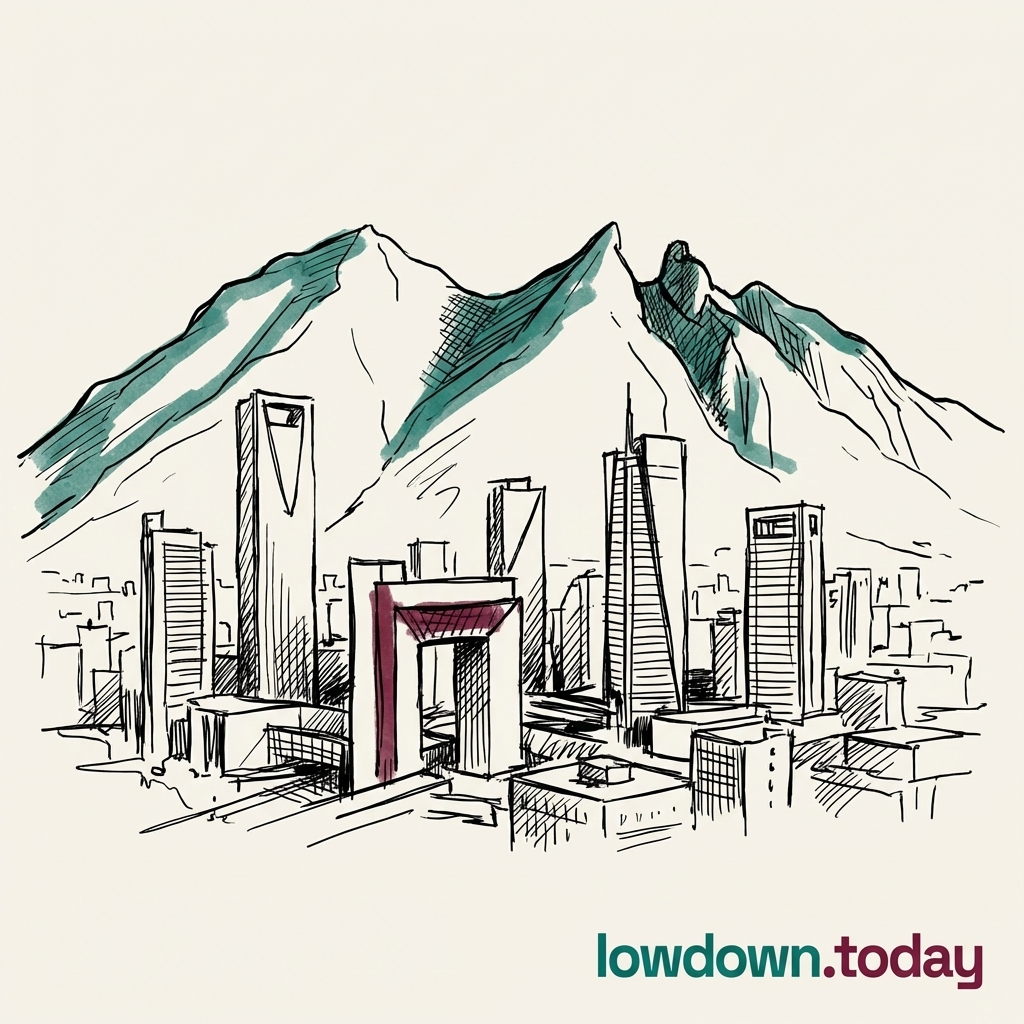
Monterrey
Mexican city hosting 2026 FIFA World Cup matches and the inter-confederation playoff final.
Security analysts linked a cartel drone-bombing of the Guerrero village of Guajes de Ayala on 8 July to Mexico's decision to concentrate roughly 100,000 personnel in Monterrey and its two fellow World Cup host cities, after residents said they had warned state police for weeks.
Last refreshed: 25 July 2026 · Appears in 2 active topics
Did Monterrey's World Cup security deployment leave rural Guerrero exposed to cartel attacks?
Timeline for Monterrey
FIFPRO says one match in five was too hot
2026 FIFA World CupRecorded a hotel occupancy decline alongside other host cities
2026 FIFA World Cup: Host cities got emptier hotel roomsReceived a share of the security deployment
2026 FIFA World Cup: Mentioned in: Cartel drones bomb a Guerrero villageMentioned in: Japan score four in the 1,000th match
2026 FIFA World CupMentioned in: Svanberg scores 18 seconds off bench
2026 FIFA World CupBackground
Monterrey is a city of 5.3 million people in the state of Nuevo Leon, northern Mexico, and the country's third largest metropolitan area. Estadio BBVA (capacity 53,500), home to CF Monterrey, is one of three Mexican venues for the 2026 World Cup alongside Estadio Azteca in Mexico City and Estadio Akron in Guadalajara.
Monterrey hosted the 2026 FIFA World Cup inter-confederation playoff final, where Iraq's squad assembled via chartered private jets after the Iran conflict closed Iraqi airspace. Coach Graham Arnold had asked FIFA to delay the fixture; FIFA declined but assisted with Visa logistics. Dallas Police sent a senior delegation to Monterrey on 8 April 2026 for joint security training, the first cross-border policing arrangement in World Cup history, reflecting the expected cross-border fan movement between the two cities during group matches.
On the nomads-and-communities track, the World Cup window has driven a sharp STR supply expansion. Monterrey's short-let count doubled to 7,274 units as of May 2026, the largest proportional increase of any Mexican host city. Unlike Mexico City, Monterrey has no active STR CAP or registration deadline, leaving the supply surge unregulated. Human Rights Watch noted on 11 May 2026 that Monterrey was one of twelve host cities yet to publish a Human Rights Action Plan.
Monterrey was one of three World Cup host cities, alongside Mexico City and Guadalajara, where Mexico concentrated roughly 100,000 security personnel for the tournament. On 8 July a cartel, La Nueva Familia Michoacana, bombed the rural community of Guajes de Ayala in Guerrero state with drones at dawn, forcing around 70 women, children and elderly residents to shelter in an abandoned clinic. Security analyst David Saucedo linked the village's exposure to that host-city deployment; residents said they had warned Guerrero state police for weeks and were ignored.
FIFPRO rated Monterrey among six World Cup venues at 'extremely high risk' for heat, alongside Atlanta, Dallas, Houston, Kansas City and Miami; the players' union recorded 19% of the tournament's 104 matches played at a wet bulb globe temperature of 28C or above, its own postponement threshold, while FIFA does not mandate cooling breaks until 32C.
Guerrero pays for Monterrey's security shift
A cartel, La Nueva Familia Michoacana, drone-bombed the rural village of Guajes de Ayala in Guerrero state at dawn on 8 July, forcing around 70 women, children and elderly residents to shelter in an abandoned clinic; resident Marilu Solorio said they had warned state police for weeks and were ignored.
Security analyst David Saucedo linked the village's exposure directly to Mexico's tournament security posture, which concentrated roughly 100,000 personnel across Monterrey, Mexico City and Guadalajara rather than rural Guerrero, leaving World Cup host cities better protected than the villages the deployment was drawn from.
Monterrey hosts a wartime qualifier
Monterrey hosted the FIFA inter-confederation playoff final on 31 March, after coach Graham Arnold's request to postpone was declined and his squad arrived on individually chartered flights once their home airspace closed, each player greeted separately outside the hotel because no group flight could get them out together.
The match went ahead as scheduled, and the visiting side won 2-1 to reach a first World Cup in 40 years, a qualification FIFA's 96-year history had never before produced through a fully closed national airspace.
Recently resolved
How did Iraq's football team reach Monterrey for the World Cup playoff final?
Did the World Cup security deployment leave other parts of Mexico exposed?
When did hotel occupancy fall in Monterrey during the World Cup?
How many Airbnb listings does Monterrey have for the 2026 World Cup?
Where is the World Cup playoff final being played?
Why is short-term rental supply unregulated in Monterrey?
What was the first cross-border policing arrangement in World Cup history?
Has Monterrey published a Human Rights Action Plan for the World Cup?
Is Monterrey hosting the 2026 World Cup?
Why was Monterrey rated an extremely high heat risk for the World Cup?
How much did short-term rentals grow in Monterrey during the World Cup?
What is Monterrey's World Cup stadium called?
Why did Dallas Police train with Monterrey ahead of the World Cup?
