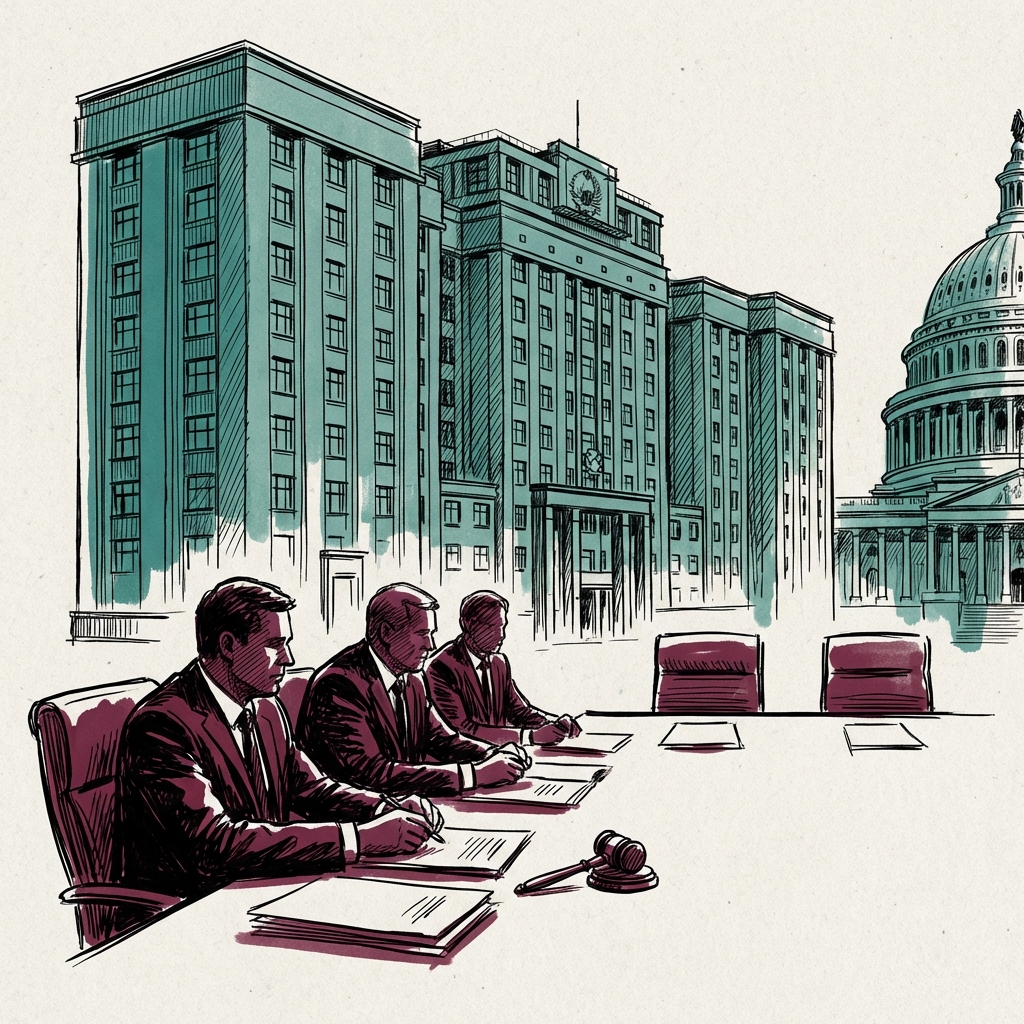
State Duma
Lower house of Russian Parliament; delegation visited US Congress under sanctions.
From 18 to 20 September, ten parties contested Russia's State Duma election after courts excluded Yabloko's federal list and cut its district candidates.
Last refreshed: 22 October 2026 · Appears in 1 active topic
Why are Russian officials discussing a new mobilisation wave right after the September Duma vote?
Timeline for State Duma
Mentioned in: Putin offers November talks, aide says
Russia-Ukraine War 2026Mentioned in: EU ministers add nearly 1,600 Russia sanctions listings
Russia-Ukraine War 2026Received the 2027-29 draft budget
Russia-Ukraine War 2026: Russia plans record 17.1tn for defenceMentioned in: Putin lifts army ceiling to 1,550,500
Russia-Ukraine War 2026Mentioned in: Ten parties on the Duma ballot, Yabloko excluded
Russia-Ukraine War 2026Background
The State Duma is the lower house of Russia's Federal Assembly. It has 450 deputies elected through party lists and single-member districts. Federal bills pass through the Duma before review by the Federation Council and signature by the president.
The chamber provides the formal legislative route for budgets, military measures and changes to domestic law. Its committees examine bills and Conduct foreign contacts, while plenary votes create the lower-house mandate needed for federal legislation. The Foreign Affairs Committee gives deputies an institutional role in parliamentary diplomacy.
Under wartime conditions, large majorities often support measures backed by the presidential executive. The Duma remains constitutionally separate from the Kremlin even when its votes align with presidential policy.
The election shaped mobilisation timing
On 24 June, Meduza reported that Russian officials were discussing a fresh mobilisation wave after the State Duma elections, citing eight government sources. Falling contract recruitment and regional budget pressure formed the report's context, but no mobilisation order had been issued.
The election ran from 18 to 20 September with ten parties on the federal ballot. Courts had cancelled Yabloko's federal list and reduced its registered district candidates, leaving the anti-war liberal party outside The National contest. For the Duma, the sequence tied parliamentary legitimacy to the timing of an unconfirmed military policy discussion.
A record defence bill awaits the chamber
Why did a Russian MP mention 1917 in the Duma in 2026?
Reference
What is Russia's State Duma?
Did the Duma authorise Putin to deploy troops abroad?
How did sanctioned Russian lawmakers get into the United States?
Who leads the State Duma Foreign Affairs Committee?
Did Russian MPs visit the US Congress in 2026?
What laws has the State Duma passed during the Ukraine war?
Written with AI from Lowdown's published reporting. Not individually reviewed by an editor. Updated 22 October 2026. Editorial standards.