Can one Marine unit really tip the balance between war and deterrence across two oceans?
Timeline for 31st Marine Expeditionary Unit
Mentioned in: Second Marine unit reaches the Gulf
Iran Conflict 2026Mine crisis blocks the path to Kharg
Iran Conflict 2026Embarked force deploying to Gulf
Iran Conflict 2026: USS Boxer sails with second MEURevealed as part of 5,000-strong force, correcting earlier 2,200 figure
Iran Conflict 2026: Pacific force is 5,000, not 2,200Redeployed 2,200 Marines from Pacific toward Middle East with F-35s
Iran Conflict 2026: 2,200 Marines pulled from PacificBackground
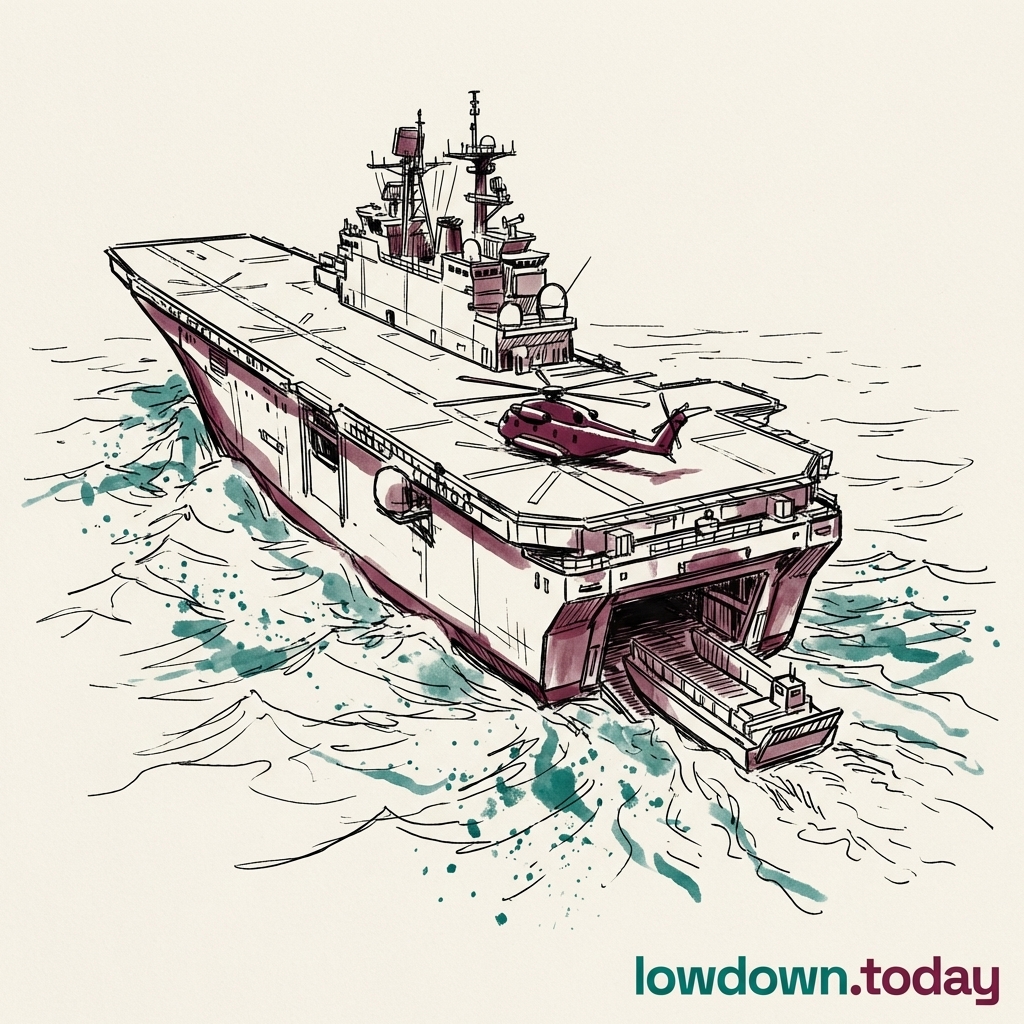
The 31st MEU is the US military's only continuously forward-deployed Marine expeditionary unit, stationed at Camp Hansen and Camp Courtney, Okinawa since the 1990s as the primary rapid-response force for INDOPACOM. Built around an Amphibious Ready Group, it integrates ground assault, F-35B aviation, MV-22 Ospreys and logistics into a self-contained force deployable within 24 hours. It reports to III Marine Expeditionary Force.
In March 2026 the 31st Marine Expeditionary Unit was ordered from its permanent station in Okinawa to the Middle East, 2,500 Marines and 2,500 sailors aboard the Tripoli Amphibious Ready Group (USS Tripoli, USS San Diego, USS New Orleans). A second deployment, the 11th MEU aboard USS Boxer from San Diego, followed, alongside CBS reporting of Pentagon preparations for potential ground operations against Iran, including options to seize Kharg Island. As of 3 July the Tripoli ARG remains in theatre alongside the newly arrived Boxer ARG, part of a build-up that reached roughly 24 warships and 50,000 personnel by 30 June, running in parallel with a Doha diplomatic track now paused until Supreme Leader Ali Khamenei's 4-9 July state funeral concludes.
The redeployment represents the first time the unit has been stripped from the Pacific theatre for a combat-zone deployment in over a decade, creating a gap in INDOPACOM coverage that Pentagon planners acknowledge cannot be quickly filled, at a moment when China has deployed its own naval assets to The Gulf and PLA activity in the South China Sea remains elevated. Four months on, that gap shows no sign of closing.
What is the 31st MEU?
Why was the 31st MEU sent to the Middle East?
Does the 31st MEU deployment mean the US will invade Iran?
What gap does the 31st MEU departure create in the Pacific?
What ships make up the 31st MEU's Amphibious Ready Group?


