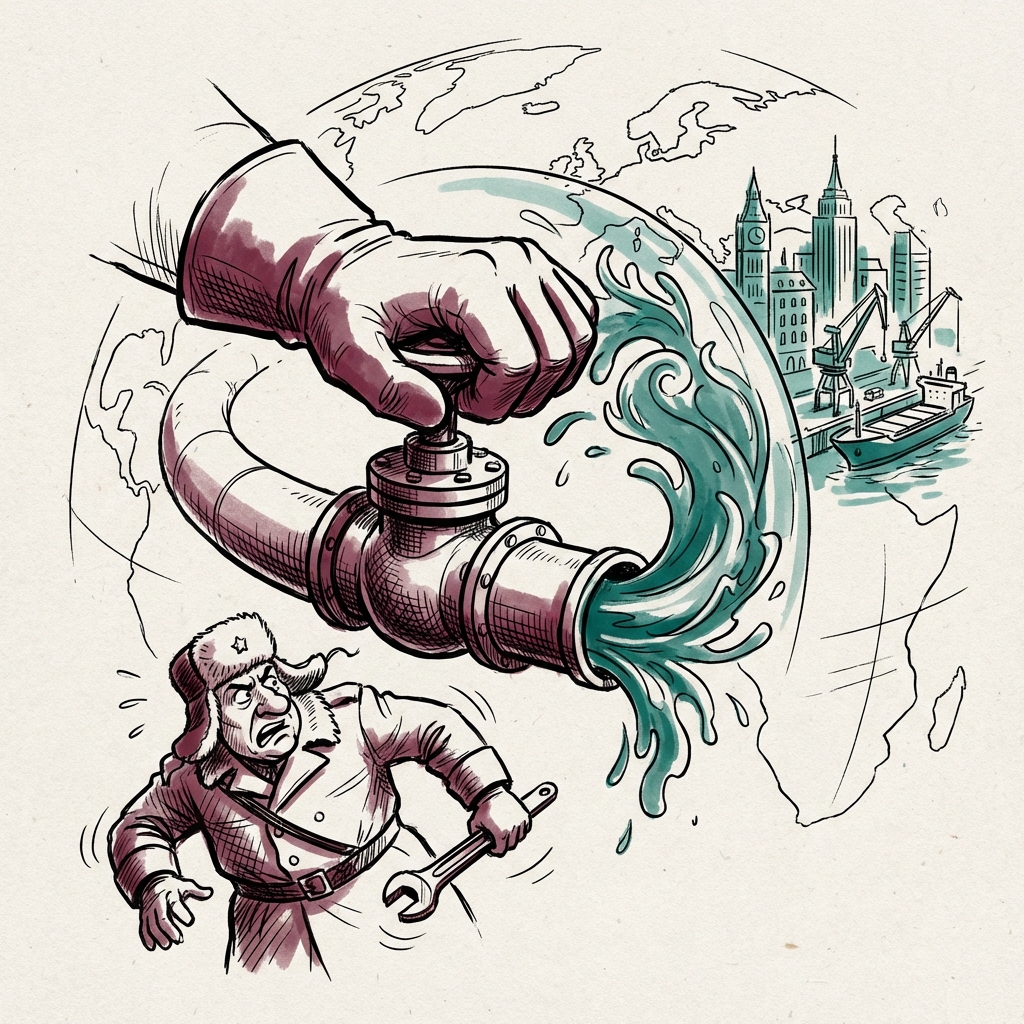
Russian LNG short-term contract ban
EU law banning new short-term Russian LNG import contracts, entering force 25 April 2026; removes 17 bcm/yr.
Last refreshed: 28 July 2026
Where does Europe find 17 bcm of replacement LNG when no country has named a source?
Timeline for Russian LNG short-term contract ban
Mentioned in: 20th sanctions: Arc7 ban live, maritime ban blocked
European Energy MarketsMentioned in: Russian LNG short-term ban lands without grace period
European Energy MarketsBackground
The EU Council short-term contract ban on Russian LNG enters force on 25 April 2026, removing roughly 17 billion cubic metres per year (about 13% of EU LNG imports in the first eleven months of 2025). From that date, importers must operate under a prior-authorisation system proving non-Russian origin on every cargo, and member states have one month to notify the Commission of any remaining Russian gas contracts. Long-term contracts follow on 1 January 2027. No member state has publicly named a committed replacement supply, and March 2026 saw record EU LNG imports driven by high Russian and US volumes, consistent with front-loading ahead of the Deadline rather than a durable supply bridge.
The measure is the first EU instrument that actually blocks Russian LNG at the European border. The earlier transshipment ban of 27 March 2026 covered re-export to non-EU destinations; it did not reduce inbound Russian volumes at EU terminals. Bruegel data confirms March imports as a record high, including record US and elevated Russian deliveries, evidence that the commercial incentive to front-load was stronger than any signal from the 27 March measure. The ban passed through a qualified majority mechanism; Hungary could not veto it despite opposing further energy-sanctions tightening.
At March 2026 import levels, the ban displaces roughly 1.3-1.6 bcm per month of LNG. Replacing that volume from US flexible supply requires winning cargoes on the JKM-TTF spread, which had compressed to near parity for weeks before 15 April. QatarEnergy's Ras Laffan Force majeure remains in place and close to a dozen Atlantic cargoes diverted to Asia in the same period. The combined effect is a supply gap landing on day one of the ban rather than gradually, against an EU storage level of only 29.55% on 13 April.
When does the EU ban on Russian LNG take effect?
How much Russian LNG does the EU import?
What replaces Russian LNG after the EU ban?
Does the EU LNG ban affect long-term contracts?
