Drone Dominance
Pentagon programme mass-producing attack drones; 300K+ drones by 2027 at $1.1B budget
Last refreshed: 7 June 2026 · Appears in 1 active topic
Which Gauntlet II vendors survive JIATF-401's live electronic warfare red team in August 2026?
Timeline for Drone Dominance
Progressed into its production-test phase with a 120-drone, five-week build requirement.
Drones: Industry & Defence: Pentagon orders 120 drones in five weeksCompleted Stage 1 testing 49 companies and 79 drones at Camp Grayling
Drones: Industry & Defence: Drone Gauntlet now judges the partsDrone Dominance Gauntlet opens 8 June
Drones: Industry & DefenceMentioned in: Pentagon's drone buy lands a third short
Drones: Industry & DefenceTwo Ukrainian firms enter Pentagon gauntlet
Drones: Industry & DefenceBackground
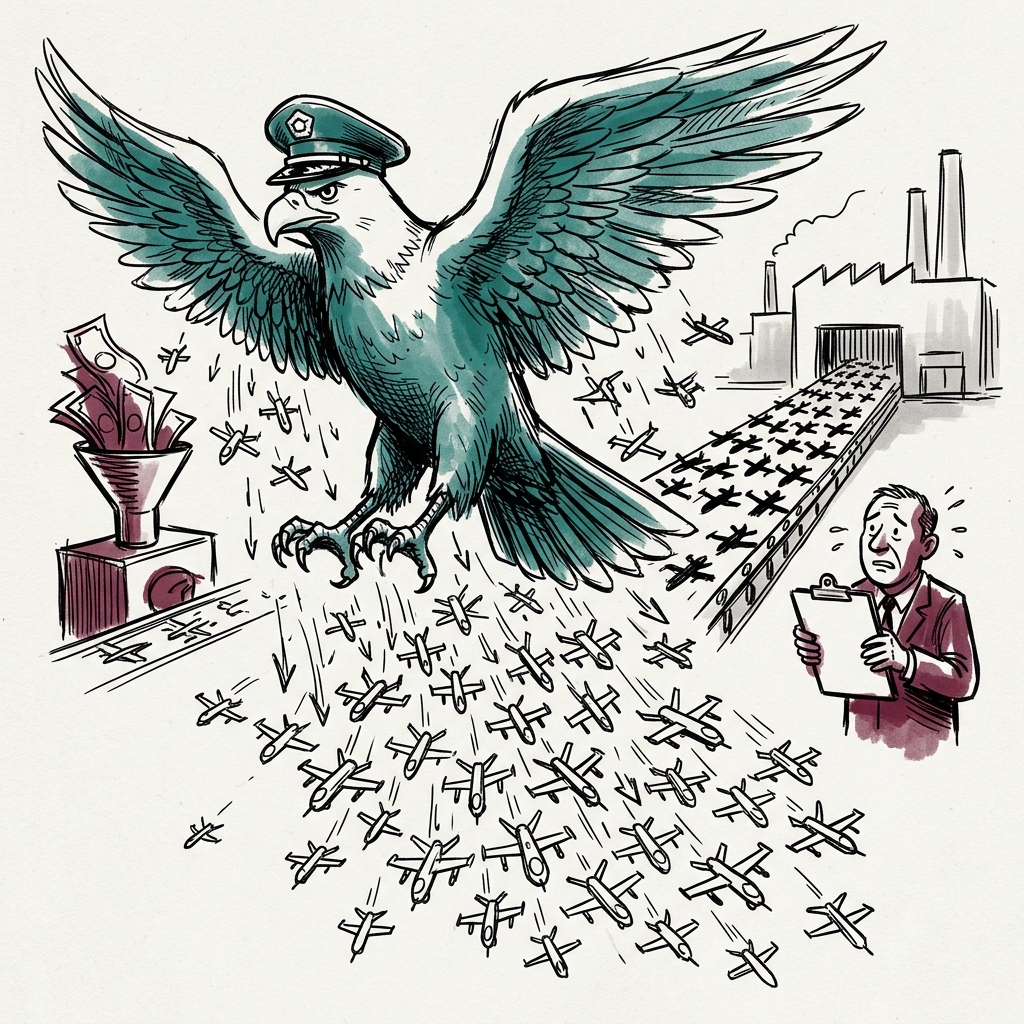
Drone Dominance is the Pentagon's strategic programme to procure attack drones at industrial scale, drawing explicit lessons from Ukrainian drone warfare. The programme runs competitive Gauntlet trials to assess vendor systems under increasingly demanding conditions before placing large production orders. Gauntlet I, held at Fort Moore, Georgia, involved eleven companies and delivered 30,000 one-way attack drones at approximately $5,000 per unit, with a five-month delivery timeline and a total Phase 1 allocation of $150 million . London-based Skycutter, partnered with Ukrainian firm SkyFall, topped the scoring at 99.3 out of 100 .
Phase 2 Gauntlet Stage 1 opened 8 June 2026 at Camp Grayling, Michigan, running until 20 June. The field includes two Ukrainian drone manufacturers, FPV racing veterans, and Phase 1 performers Skycutter and Neros. Separately, Northrop Grumman was named as one of five preferred payload providers for the programme's Common UAS Payload initiative, supplying standardised fuze, warhead and interface modules to the 30,000-unit initial tranche of the 200,000-by-2027 Group 1 FPV programme. Gauntlet II is confirmed for August 2026 at an undisclosed desert location, targeting 50,000 to 60,000 additional drones, with a live Counter-UAS red team operated by JIATF-401.
The programme represents a doctrinal shift: the US military is treating attack drones as attritable mass-production munitions rather than precision systems, mirroring the Ukrainian model where volume and cost are primary capability metrics. The revised programme target has expanded to over 200,000 drones, reflecting the scale of consumption observed in the Iran-Gulf conflict where Iran alone launched 4,446 drones in a five-week campaign.
What is the Pentagon Drone Dominance programme?
What is the Lethality Prize Challenge for Gauntlet II?
Drone Dominance Gauntlet I results winner?
When is Gauntlet II and what will be tested?
US military attack drone mass production Ukraine lessons?

