Barnett formula
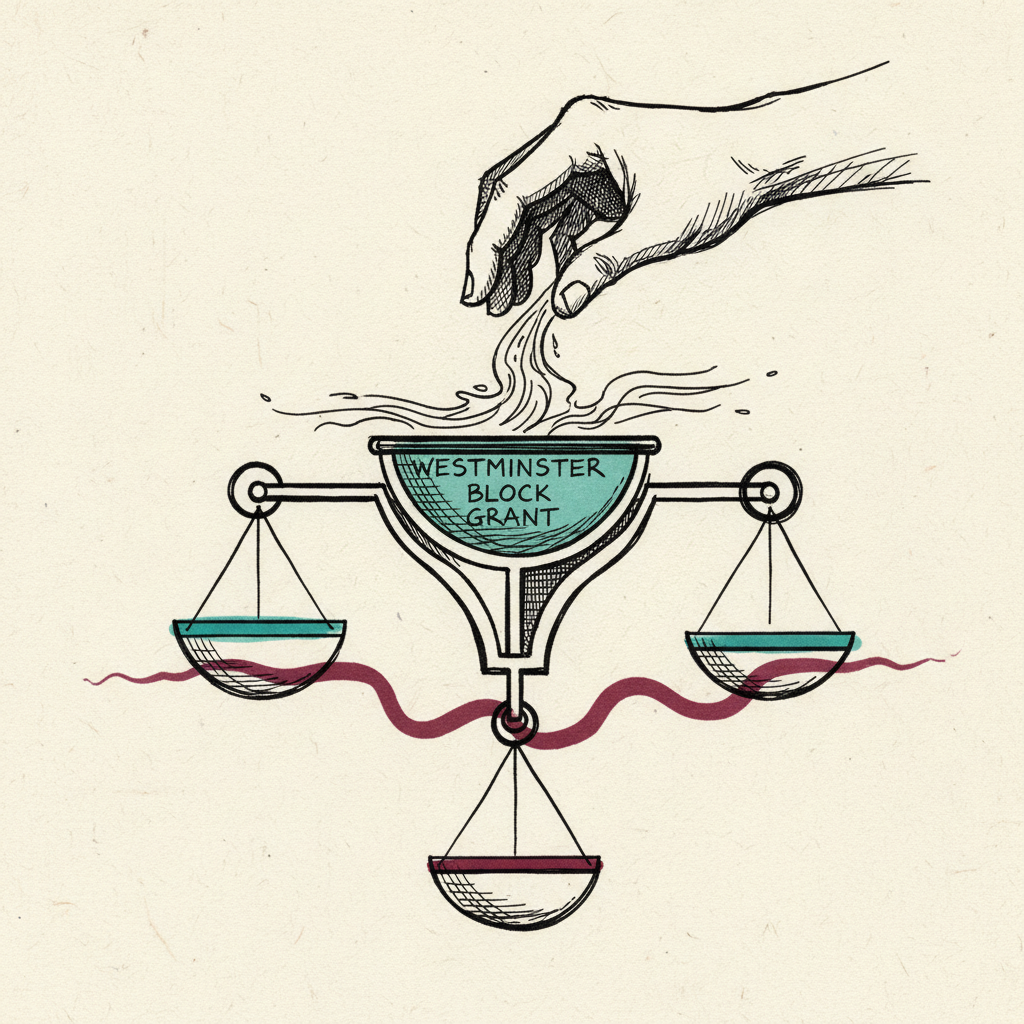
UK formula determining Scotland, Wales and Northern Ireland block grants from Westminster.
Last refreshed: 22 May 2026 · Appears in 1 active topic
Why does the Barnett formula undermine Scottish Conservative manifesto tax pledges?
Timeline for Barnett formula
ap Iorwerth's six-power Wales Bill ask
UK Local Elections 2026Mentioned in: IFS sweep: five of five Holyrood parties
UK Local Elections 2026Mentioned in: IFS rejects every Scottish party's fiscal plan
UK Local Elections 2026Mentioned in: IFS Demolishes Both Scottish Opposition Manifestos
UK Local Elections 2026- What is the Barnett formula and how does it work?
- The Barnett formula adjusts Scotland, Wales and Northern Ireland's block grants from Westminster based on per-Capita changes in comparable English spending. Devised in 1978, it operates by Treasury convention rather than statute.Source: Standard UK constitutional reference
- Why does the Barnett formula affect Scottish income tax cuts?
- When Scotland changes income tax rates, the Treasury applies a block grant adjustment to avoid double-counting the fiscal effect. This means a Scottish income tax cut reduces the block grant, eating into the savings the cut was meant to deliver.Source: IFS manifesto analysis 2026
- Is Wales underfunded under the Barnett formula?
- The Welsh Government argues yes: the formula allocates funding based on English spending changes rather than assessed need, which Welsh ministers say leaves Wales behind. No UK Government has yet replaced it.Source: Wales Governance Centre and Welsh Government positions
- What is the Barnett formula and why is it controversial?
- The Barnett formula distributes block grants to Scotland, Wales, and Northern Ireland based on per-Capita changes in comparable English spending, regardless of local need. Critics argue it over-funds Scotland relative to Wales and ignores relative deprivation.
- What is the Welsh Government asking instead of the Barnett formula?
- First Minister Rhun ap Iorwerth's May 2026 priorities statement called for a needs-based fair funding formula to replace Barnett, arguing Wales is systematically underfunded relative to public service demand and deprivation levels.Source: event
- Will the Barnett formula change in 2026?
- No change is imminent. The UK Treasury has no active plans to replace the formula, but Welsh pressure has increased since Plaid Cymru took the Welsh Government in May 2026, and Reform UK is attacking it from an English-subsidy angle, leaving the Treasury defending the status quo on two fronts.
- How does the Barnett formula affect Scottish tax policy?
- Scottish income tax changes trigger a block grant adjustment: if Scotland raises taxes, the Treasury reduces the block grant by a corresponding amount to avoid double-counting the revenue. The IFS used this mechanism in 2026 to show the Scottish Conservative pensioner tax cut would yield less than its headline cost implied.
Background
The Barnett formula is the mechanism by which the UK Treasury calculates the block grants paid to Scotland, Wales, and Northern Ireland. Devised by Chief Secretary to the Treasury Joel Barnett in 1978, it adjusts devolved budgets based on per-Capita changes in comparable English public spending. If England increases NHS spending by £1 billion, Scotland receives a population-proportionate share automatically, regardless of local need. The formula has never been enshrined in statute and operates by Treasury convention.
In the 2026 Holyrood election, the formula became politically salient because Scottish income tax changes interact with it via the block grant adjustment: if Scotland raises or cuts income tax, the Treasury offsets the block grant by a corresponding amount to avoid double-counting. This mechanism is the basis for the IFS critique of the Scottish Conservative manifesto, whose pensioner tax cut yielded less fiscal space than the headline cost implied. More broadly, all five Scottish Holyrood parties received IFS verdicts of fiscal incredibility in 2026, a devolution-era first.
The Wales angle has sharpened in May 2026. Rhun ap Iorwerth's six-demand priorities statement explicitly included a fair funding formula, framing Barnett as needs-blind and calling for a replacement based on relative deprivation and public service demand . The Welsh Government has made similar arguments since the 2010s, but a Plaid First Minister with a confidence-and-supply arrangement that required no Labour votes makes the ask harder for Westminster to dismiss as routine Welsh Labour positioning. Reform UK has separately attacked the formula from an English-taxpayer framing, arguing it represents unfair subsidy of devolved nations, pressure from a different direction that leaves the Treasury defending the status quo on two flanks simultaneously.