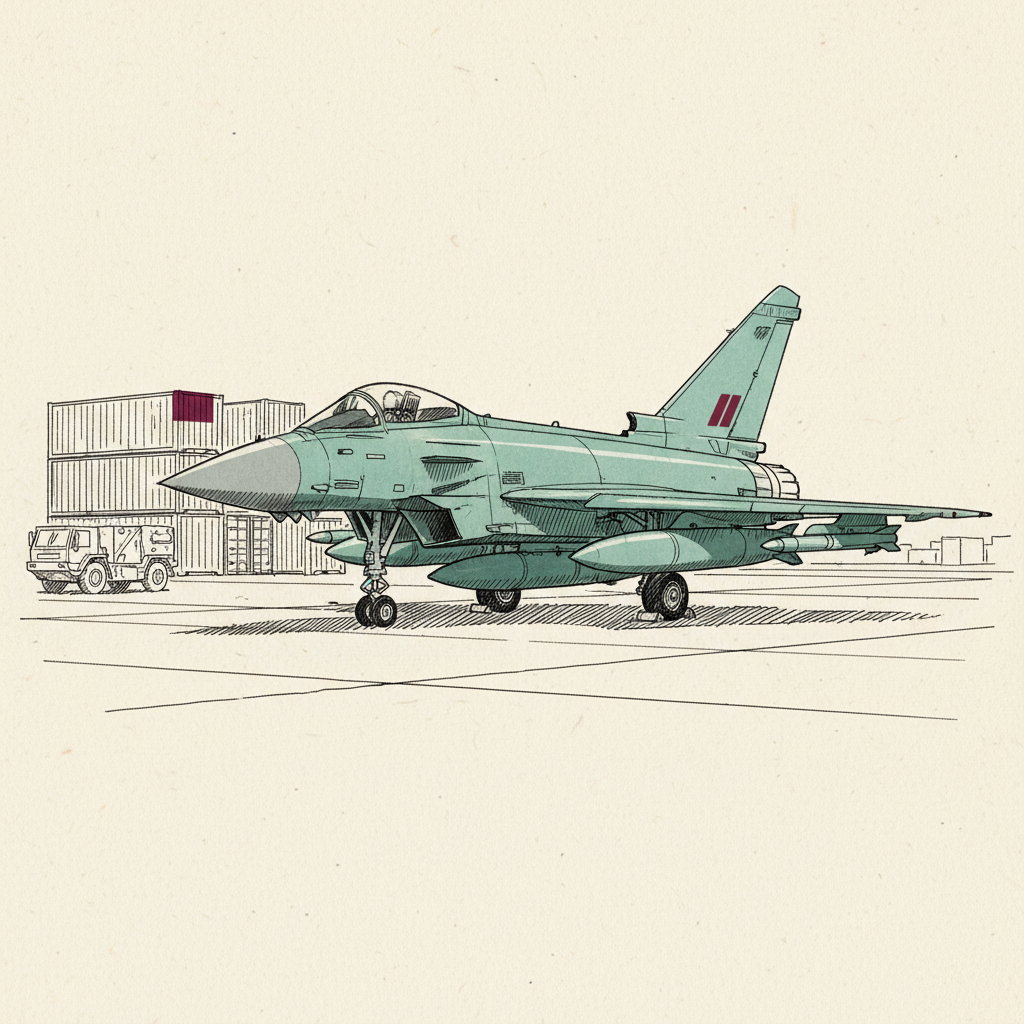
APKWS
Advanced Precision Kill Weapon System, a laser-guidance conversion kit for unguided rockets, deployed by RAF Typhoons for counter-drone operations at approximately £20,000 per shot.
Last refreshed: 29 May 2026 · Appears in 1 active topic
Timeline for APKWS
Mentioned in: UK sends £115M to Hormuz drones
Drones: Industry & Defencedeployed operationally by RAF Typhoons for counter-drone missions in the Middle East
Drones: Industry & Defence: RAF Typhoons fire APKWS in Gulf combatMentioned in: UK tenders £130M Watchkeeper swap
Drones: Industry & DefenceBackground
The Advanced Precision Kill Weapon System (APKWS) is a semi-active laser-guided kit produced by BAE Systems that converts standard unguided 70mm (2.75-inch) Hydra folding-fin rockets into precision-guided munitions. Developed for US military helicopters and strike aircraft, APKWS adds a mid-body guidance section with four laser-detecting wings, transforming a cheap unguided rocket into a weapon with roughly 5-metre circular error probable at ranges up to 5 km. In May 2026, RAF Typhoons of 9 Squadron operationally deployed APKWS for counter-drone missions in the Middle East from RAF Akrotiri and Al Udeid, at approximately £20,000 per shot — a significant cost reduction against drone targets compared with Brimstone (circa £100,000) or Meteor (over £1 million).
APKWS entered US service around 2012 and has since been integrated onto AH-64 Apaches, UH-60 Black Hawks, AV-8B Harriers, A-10 Warthogs, and fixed-wing fast jets across several allied air forces. The UK's integration onto the Typhoon required a specific BAE Systems programme to adapt the munition for the Typhoon's weapon management system. The use case against Group 3 and Group 4 drones — medium-altitude systems such as Shahed-class loitering munitions — represents a new operational role not envisaged in the original APKWS design, though its terminal seeker is well-suited to track slow-moving, low-signature targets.
At £20,000 per engagement, APKWS sits between the expensive missile stack and the emerging directed-energy alternatives such as AeroVironment's LOCUST X3 at roughly $5 per shot. For NATO air forces burning through high-value interceptors at Gulf attrition rates, the rocket-guided approach offers an intermediate cost tier. The RAF's combat experience will feed the UK's C-UAS doctrine review and may accelerate APKWS integration requests from other Typhoon operators including Germany, Spain, and Saudi Arabia.
What is APKWS and how does it work against drones?
How much does it cost to shoot down a drone with a rocket?
Which aircraft can fire APKWS rockets?

