Skip to content
You can now search across every topic, entity and event.What's new
US Midterms 2026
7SEP

Tennessee map survives its first test

3 min read
13:32UTC

A three-judge panel let Tennessee's redrawn congressional map stand on 23 July, accepting that splitting Memphis three ways was about party advantage rather than race.

PoliticsDeveloping
Key takeaway

Admitting a partisan motive now defeats a claim that Section 2 would once have carried.

A three-judge federal panel refused on 23 July to block Tennessee's redrawn congressional map, finding that the redraw "was driven by politics, not race" 1. Panels of this kind hear constitutional redistricting challenges and their refusals at the preliminary stage are slow to unpick. The lines will govern the 6 August primary and the November general election.

The plaintiffs are three Memphis voters, the Black Clergy Collaborative of Memphis, the Memphis A. Philip Randolph Institute and The Equity Alliance. Their complaint is that the map carved the state's only Black-majority district across three seats. Lucas Cameron-Vaughn, legal director of the American Civil Liberties Union (ACLU) of Tennessee, said lawmakers "deliberately divided Black neighborhoods across multiple districts, minimizing their voting strength" 2. The vote-dilution case continues to trial, so any remedy arrives after the seats have been filled.

Two prior rulings built the defence that worked here. The Supreme Court narrowed Voting Rights Act (VRA) Section 2 protection in Louisiana v. Callais, striking Louisiana’s second majority-Black district as unconstitutional on 29 April , and Governor Bill Lee signed the new Tennessee lines on 7 May, a week and a day later . Rucho v. Common Cause, decided in 2019, had already put partisan gerrymandering beyond the reach of federal courts while leaving racial gerrymandering actionable.

Read together, the two doctrines reward candour about party motive. A legislature that says on the record it was chasing Republican seats stands in better shape than one that says nothing at all, because the admission answers the only claim left. Plaintiffs must now prove racial intent rather than racial effect, and legislatures redrawing elsewhere after Callais have their first district-court data point saying the shield holds.

Deep Analysis

In plain English

Tennessee redrew its congressional map so that Memphis, a majority-Black city, no longer has a district where Black voters can elect their own preferred representative. Federal courts will strike down a map if it was drawn mainly to hurt voters because of their race, but the Supreme Court has ruled that courts cannot second-guess a map drawn mainly to hurt voters because of their political party, even when the two overlap heavily. Tennessee's lawmakers said this was about party, so the map stands for the August primary while the underlying racial-discrimination case continues at trial.

Deep Analysis
Root Causes

Tennessee's map survives because two separate doctrines closed off both routes a challenger could otherwise take. Rucho forecloses the partisan-gerrymandering claim outright, regardless of evidence.

Callais narrowed the Section 2 results test that had let plaintiffs prove vote dilution from a map's effect on Black voters without proving the legislature's intent . With the effects test gone, a challenger must prove the legislature's predominant purpose was race, not party, which is far harder when the legislature's own floor debate can be read either way.

What could happen next?
  • Precedent

    Other legislatures that redrew maps after Callais now have a district-court data point suggesting the political-gerrymandering defence holds at the preliminary stage.

  • Consequence

    The 6 August primary and the November general election both run on the new map regardless of the ongoing trial, so any eventual remedy would arrive after the seats are already filled.

First Reported In

Update #14 · 0-for-17 in court, and the map that held

WSMV Nashville· 26 Jul 2026
Read original
Different Perspectives
New Hampshire student voters
Students who hold no accepted photo ID under HB 323 cannot vote in the 8 September primary after Judge Laplante declined to block the law on timing grounds. Whether the same rule applies on 3 November is still open.
Alaska Democratic Party
The Alaska Democratic Party moved $884,835 in coordinated spending to Mary Peltola between 17 and 30 July, more than the DCCC spent nationally in the same fortnight.
National Republican Senatorial Committee
The NRSC, which sued to remove coordinated-spending caps in NRSC v. FEC, put $2,230,472 behind candidates in the first complete month after winning that case, more than double the total for the prior six months combined.
Supreme Court of Missouri
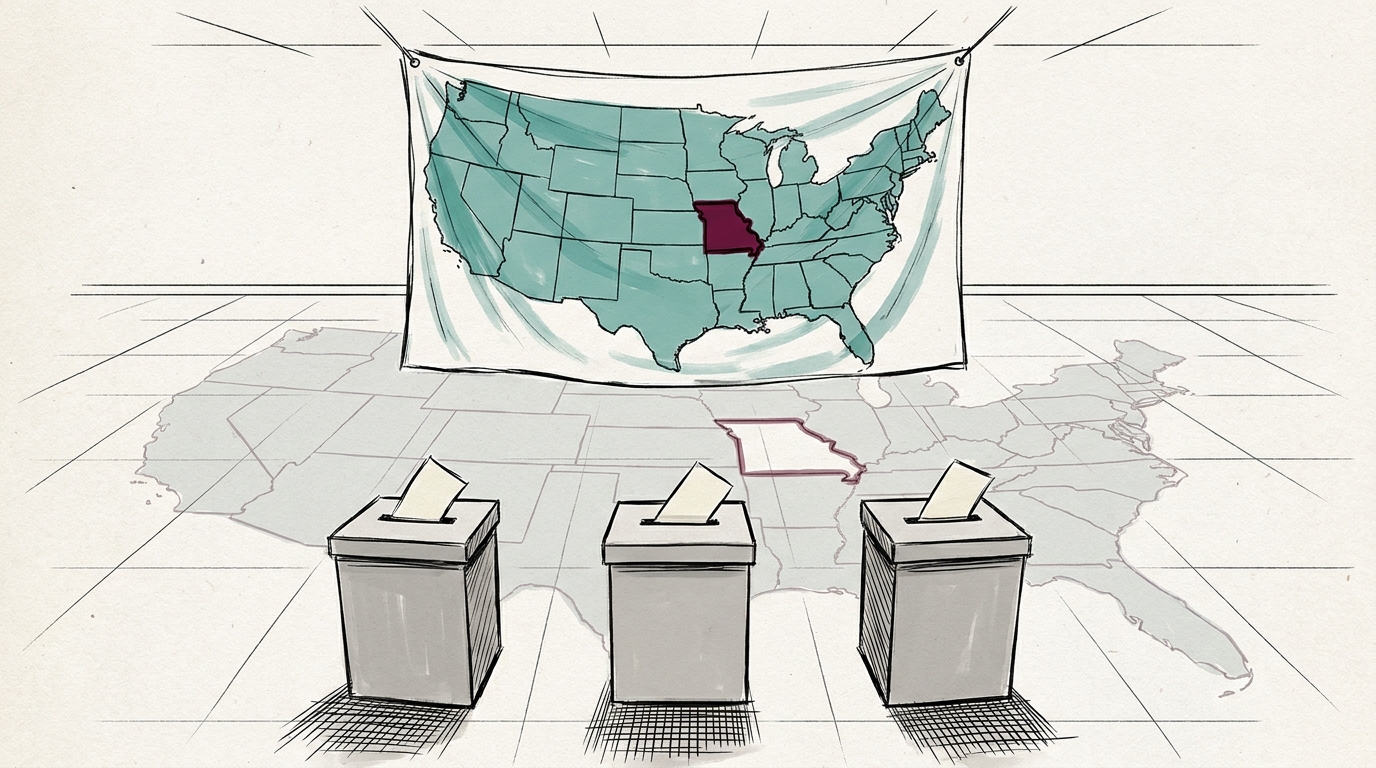
The unanimous court held that Article III, section 49 carries no redistricting exception, so a referendum petition against a congressional map is as valid as against any other law. It ordered the 2022 map to govern unless voters approve HB 1 on 3 November.
Denny Hoskins, Missouri Secretary of State
Hoskins told the Supreme Court that changing the congressional map after 1.2 million primary votes and ahead of the 19 September overseas-ballot deadline violates Purcell and the Elections Clause. He wants HB 1 reinstated before ballots print for November.
Senate Republican leadership
Floor time is finite at 51-47 with a bipartisan funding negotiation running, and a contested procedural fight over grant conditions is not the best use of it this month. Nothing has been abandoned; the resolution keeps its place on the calendar.
