Skip to content
You can now search across every topic, entity and event.What's new
US Midterms 2026
7SEP

NRCC opens $8.3M cash gap over DCCC

3 min read
13:32UTC

The National Republican Congressional Committee held $78.2M against the DCCC's $69.9M at the close of Q1, an $8.3M advantage; the DCCC raised $522,000 in the forty-eight hours after Callais.

PoliticsDeveloping
Key takeaway

NRCC's Q1 lead reverses February parity; the cash gap is real but smaller than the redistricting one.

The National Republican Congressional Committee (NRCC) ended Q1 2026 with $78.2M cash on hand against the Democratic Congressional Campaign Committee (DCCC) $69.9M, an $8.3M advantage. 1 Both committees are the formal fundraising arms for House caucus candidates. The NRCC's Q1 raise of $47.1M is the highest first-quarter figure on its books.

Late-February parity has reversed. DCCC had reached effective parity at $57.4M against NRCC's $57.6M through 28 February ; two months later NRCC pulled ahead by an amount that funds roughly forty competitive-district independent-expenditure buys at current market rates.

The Louisiana v. Callais ruling produced a forty-eight-hour DCCC fundraising surge of $522,000, modest against the gap but directionally on. The donor read on the redistricting harvest is therefore engagement-positive for Democrats; the structural read on cash supply is not. House race independent-expenditure buys typically run $1M-$3M per district at the high end; an $8.3M committee gap maps to roughly three to eight competitive-seat buys before any outside-money matching. The bigger constraint on the Democratic flip path remains the new map , not the bank balance.

Deep Analysis

In plain English

Both parties have congressional campaign committees that raise money to spend on House races. Republicans have the National Republican Congressional Committee (NRCC); Democrats have the Democratic Congressional Campaign Committee (DCCC). These committees run advertisements, do opposition research, and buy airtime in competitive districts. At the end of the first quarter of 2026, the NRCC had $78M in the bank and the DCCC had $70M, an $8.3M gap. The Republicans also raised a record $47.1M in the quarter alone. Through late February, the two committees were separated by just $172,000; two months of fundraising reversed that parity. The Democrats' fundraising surged after the Callais ruling, raising $522,000 in two days. At that rate, closing an $8.3M gap would take roughly six more weeks, and the Q2 totals are already locking in. The more fundamental problem for Democrats is that the redistricting wave means they are now defending seats they expected to hold safely.

Deep Analysis
Root Causes

The NRCC's record Q1 raise reflects two structural inputs. First, the redistricting calendar created an urgency signal for Republican donors: contributions to the NRCC in Q1 directly funded the committee's legal and opposition-research work on the Florida and Texas maps, creating a tangible return on investment that motivates further giving.

Second, the DCCC's donor base responded to the wrong calendar event. The $522,000 surge after Callais came too late to change Q1 totals and was too small to close the gap. Democratic small-dollar donors are highly responsive to outrage events such as the Callais ruling and the Florida map signing; the committee's institutional donor relationships, which drive the large cheques that build a Q1 cash position, had already been set weeks earlier.

What could happen next?
  • Consequence

    The NRCC's Q2 cash advantage allows it to run defensive IE buys in seats like FL-07 and FL-12 that moved from Safe Republican to Likely Republican, preventing Democratic pickup opportunities from opening.

  • Risk

    The DCCC must now spend defensively in Florida districts that were previously off the board, reducing the resources available for its offensive map in Republican-held competitive seats.

First Reported In

Update #5 · Callais lands; maps move

Roll Call· 7 May 2026
Read original
Different Perspectives
New Hampshire student voters
Students who hold no accepted photo ID under HB 323 cannot vote in the 8 September primary after Judge Laplante declined to block the law on timing grounds. Whether the same rule applies on 3 November is still open.
Alaska Democratic Party
The Alaska Democratic Party moved $884,835 in coordinated spending to Mary Peltola between 17 and 30 July, more than the DCCC spent nationally in the same fortnight.
National Republican Senatorial Committee
The NRSC, which sued to remove coordinated-spending caps in NRSC v. FEC, put $2,230,472 behind candidates in the first complete month after winning that case, more than double the total for the prior six months combined.
Supreme Court of Missouri
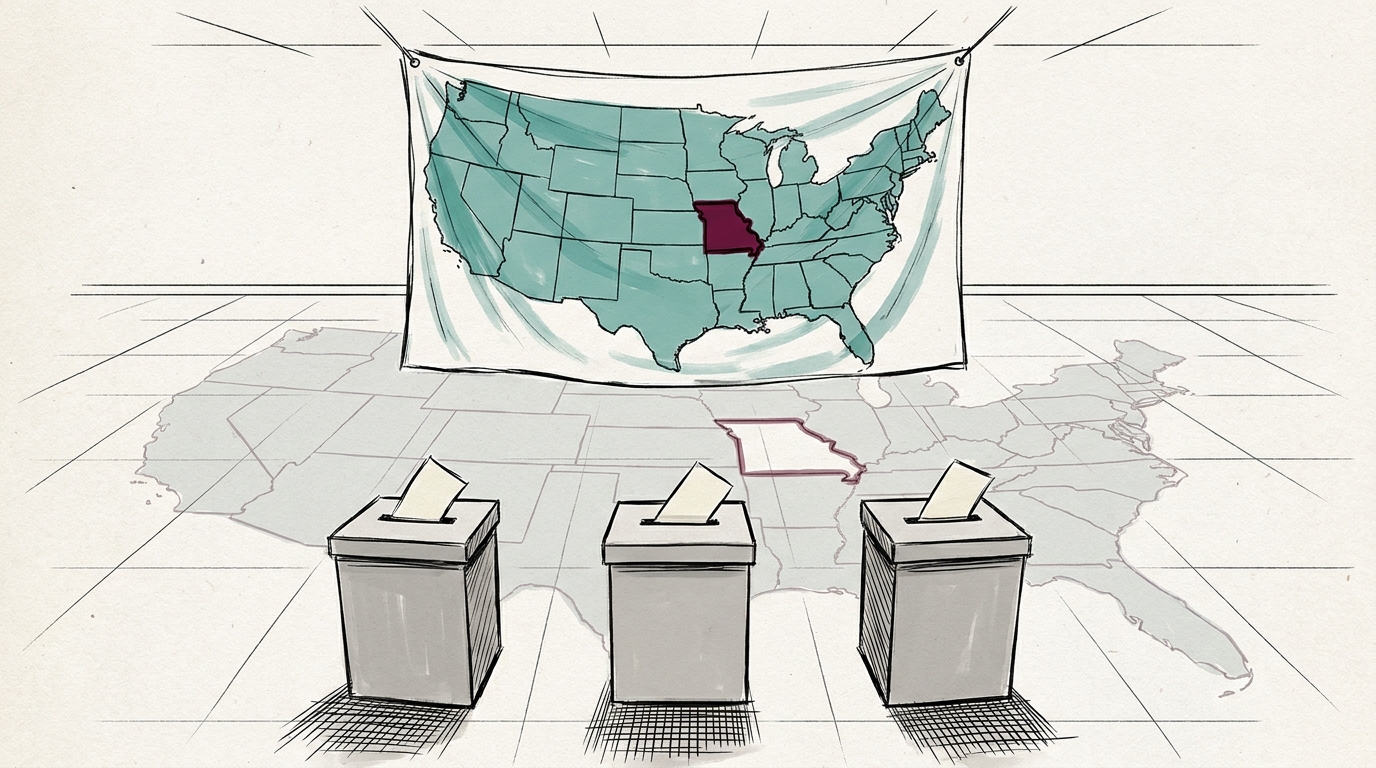
The unanimous court held that Article III, section 49 carries no redistricting exception, so a referendum petition against a congressional map is as valid as against any other law. It ordered the 2022 map to govern unless voters approve HB 1 on 3 November.
Denny Hoskins, Missouri Secretary of State
Hoskins told the Supreme Court that changing the congressional map after 1.2 million primary votes and ahead of the 19 September overseas-ballot deadline violates Purcell and the Elections Clause. He wants HB 1 reinstated before ballots print for November.
Senate Republican leadership
Floor time is finite at 51-47 with a bipartisan funding negotiation running, and a contested procedural fight over grant conditions is not the best use of it this month. Nothing has been abandoned; the resolution keeps its place on the calendar.
