Skip to content
You can now search across every topic, entity and event.What's new
US Midterms 2026
7SEP

DCCC closes cash gap with NRCC

3 min read
13:32UTC

The Democratic Congressional Campaign Committee reported $57.4 million in cash on hand against $139.1 million in cycle receipts through 28 February, reaching effective parity with the NRCC's $57.6 million and closing the Republican committee's end-2025 lead.

PoliticsDeveloping
Key takeaway

Democrats have closed the committee fundraising gap on the ground-game side of the ledger super PACs cannot replicate.

The Democratic Congressional Campaign Committee (DCCC), the Democratic Party's official committee for electing Democrats to the US House of Representatives, reported $57.4 million in cash on hand through 28 February 2026 against cycle-to-date receipts of $139.1 million, per its Federal Election Commission monthly filing 1. The National Republican Congressional Committee (NRCC), its Republican counterpart, reported $57.6 million in cash against $136.3 million in receipts across the same window 2. The two committees are within $172,000 of each other, and the DCCC has the stronger Q1 receipts pace.

The parity reads against a Republican super-PAC layer that still dominates in absolute dollars. MAGA Inc, the principal Trump-aligned super PAC, entered the cycle with approximately $304 million in cash on hand. Senate Leadership Fund announced a $342 million battle plan targeting eight Senate seats on 6 April. What party committees do that super PACs cannot is the ground-game infrastructure: voter registration drives, field offices, coordinated expenditures with named candidates, the machinery of turnout. By statute, super PACs are barred from coordinating with campaigns and must run parallel operations.

The DCCC message set leans on the tariff-economy attack line that the Q1 GDP print now backs with national-accounts data rather than polling alone. Closing a multi-million-dollar committee gap in a single quarter is not a base-fundraising story; it tracks a small-donor surge that the contraction is likely to accelerate rather than interrupt. Senate Leadership Fund's war chest is deployable across eight states; Cook moved four of those states toward Democrats the same week. The ground war is where the 2026 turnout fight will be contested, and the two parties enter that fight on equal committee footing for the first time this cycle.

Deep Analysis

In plain English

In US elections, there are two main types of political spending organisations. Party committees, the DCCC for House Democrats and the NRCC for House Republicans, raise and spend money in coordination with candidates within legal limits. Super-PACs raise unlimited money but must spend it independently, without coordinating with candidates. As of February, the Democratic committee (DCCC) had $57.4 million in the bank versus the Republican committee's (NRCC) $57.6 million, effectively level. This matters because party committee money pays for the door-knocking, phone banking, and voter data operations that advertising cannot replicate. However, Republican-aligned super-PACs have far more money overall. MAGA Inc alone entered 2026 with $304 million. Democrats are competitive at the committee level but outmatched in the broader advertising war.

Deep Analysis
Root Causes

The DCCC-NRCC parity reflects two converging trends: Democrats benefiting from small-dollar fundraising acceleration following the Georgia-14 result and Cook's April ratings shift, and Republican party committees facing a small-dollar deficit because MAGA Inc and the Senate Leadership Fund have become the preferred destination for large Republican donors who want to place money outside coordinated-expenditure limits.

The super-PAC dominance on the Republican side is a structural consequence of the Citizens United regime: once the super-PAC channel opened, major Republican donors shifted from party committees (which have contribution limits) to super-PACs (which do not), transferring both money and strategic control to organisations that have their own presidential-aligned priorities rather than purely congressional ones.

What could happen next?
  • Opportunity

    DCCC parity with NRCC enables Democrats to invest equally in ground-game infrastructure in competitive districts, offsetting some of the Republican super-PAC advertising advantage through higher base turnout.

    Medium term · 0.74
  • Risk

    MAGA Inc's $304 million and the Senate Leadership Fund's $342 million create a Republican advertising advantage of roughly 4:1 over Democratic equivalents in the final eight weeks, a differential that party committee parity cannot offset.

    Medium term · 0.8
  • Consequence

    April Cook rating shifts trigger in-cycle fundraising acceleration that closes the DCCC-NRCC gap further; if Georgia and North Carolina hold as Lean Democrat, the DCCC will likely hold a cash advantage by July.

    Short term · 0.68
First Reported In

Update #3 · Tariff shock reads in GDP. Senate map moves.

FEC· 16 Apr 2026
Read original
Different Perspectives
New Hampshire student voters
Students who hold no accepted photo ID under HB 323 cannot vote in the 8 September primary after Judge Laplante declined to block the law on timing grounds. Whether the same rule applies on 3 November is still open.
Alaska Democratic Party
The Alaska Democratic Party moved $884,835 in coordinated spending to Mary Peltola between 17 and 30 July, more than the DCCC spent nationally in the same fortnight.
National Republican Senatorial Committee
The NRSC, which sued to remove coordinated-spending caps in NRSC v. FEC, put $2,230,472 behind candidates in the first complete month after winning that case, more than double the total for the prior six months combined.
Supreme Court of Missouri
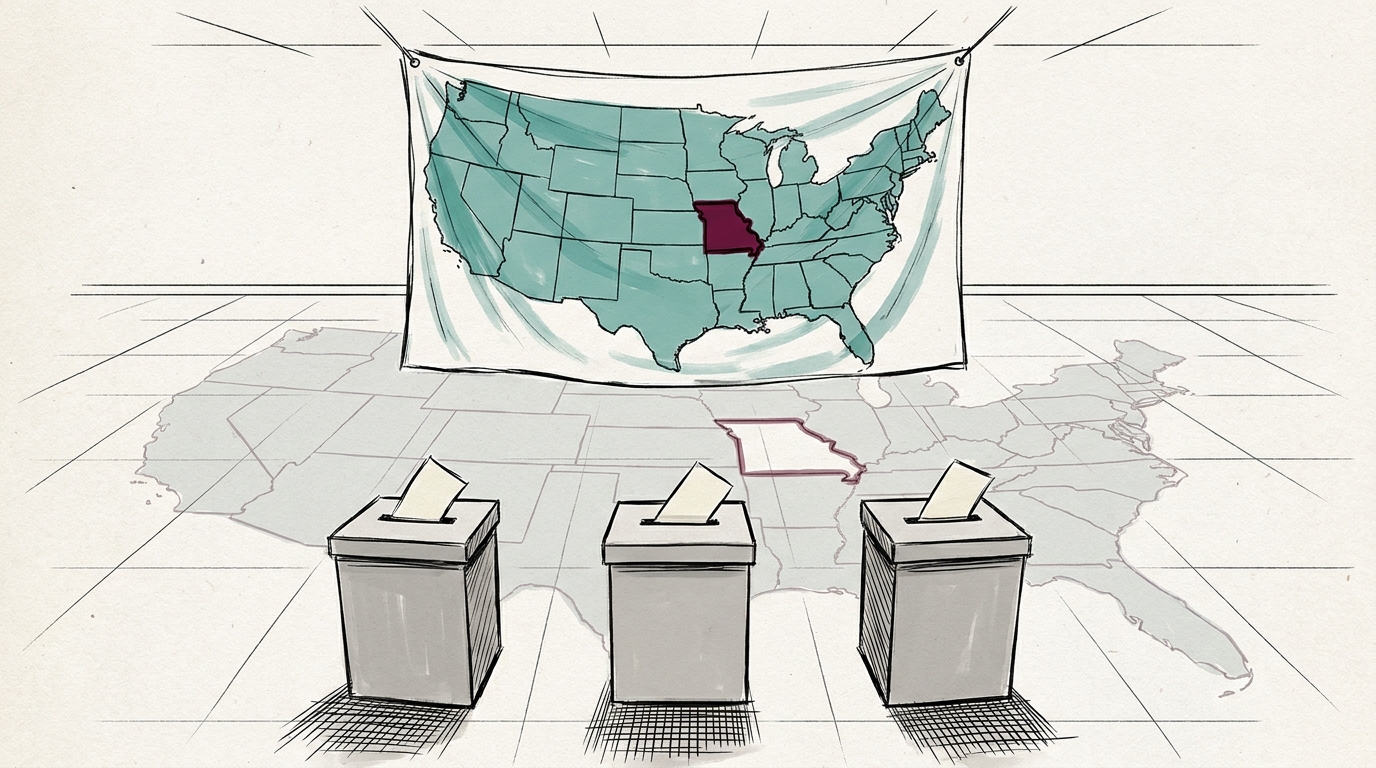
The unanimous court held that Article III, section 49 carries no redistricting exception, so a referendum petition against a congressional map is as valid as against any other law. It ordered the 2022 map to govern unless voters approve HB 1 on 3 November.
Denny Hoskins, Missouri Secretary of State
Hoskins told the Supreme Court that changing the congressional map after 1.2 million primary votes and ahead of the 19 September overseas-ballot deadline violates Purcell and the Elections Clause. He wants HB 1 reinstated before ballots print for November.
Senate Republican leadership
Floor time is finite at 51-47 with a bipartisan funding negotiation running, and a contested procedural fight over grant conditions is not the best use of it this month. Nothing has been abandoned; the resolution keeps its place on the calendar.
