Skip to content
You can now search across every topic, entity and event.What's new
US Midterms 2026
7SEP

Florida session slips to 28 April

3 min read
13:32UTC

Governor Ron DeSantis delayed Florida's redistricting special session by proclamation on 15 April, pushing it four days past the state's own candidate filing deadline with no map drafted.

PoliticsDeveloping
Key takeaway

Florida's redistricting session now opens four days after the candidate filing deadline with no map drafted.

Governor Ron DeSantis issued a proclamation on 15 April 2026 delaying Florida's redistricting special session from 20-24 April to 28 April through 1 May, expanding the agenda to include vaccine-exemption and artificial intelligence consumer-protection bills 1. DeSantis had originally timed the session to await the Supreme Court's ruling in Louisiana v. Callais , the pending case on whether Voting Rights Act (VRA) Section 2 still requires states to create majority-minority congressional districts. That ruling has not arrived; supplemental briefing was ordered in October 2025 and remains pending.

The delay produces a scheduling conflict Florida has not yet reconciled. The state's congressional candidate filing deadline is 24 April, four days before the new session opens. In practice, candidates would be required to file before knowing the district boundaries they are filing to represent. No congressional map exists; Senate President Ben Albritton has confirmed the Senate will not draft one, leaving the governor's office to present a proposal on 28 April. The Callais ruling remains the variable that determines whether any map produced survives federal review on the majority-minority district question.

The expanded agenda matters operationally. Adding AI consumer-protection and vaccine-exemption legislation to a session originally framed as redistricting-only dilutes the legislative time available for the map and provides cover for an outcome in which the session closes without one. If the Callais ruling does not land before 1 May, Florida enters the summer with no map, a filed candidate slate tied to 2022 boundaries, and the same underlying constitutional question unresolved.

Deep Analysis

In plain English

Florida is one of the most politically contested large states in the US. Its Republican governor, Ron DeSantis, wants to redraw the state's congressional districts to benefit Republicans. He had originally called a special legislative session for 20-24 April to do this. On 15 April he pushed that session back to 28 April through 1 May. The problem is that 24 April is the deadline for candidates to officially file to run for Congress. If the district boundaries are not set before that deadline, candidates do not know which district they are running in. The delay also creates a legal question: can a map drawn after the filing deadline apply to the 2026 election at all? The governor is apparently willing to test that question.

Deep Analysis
Root Causes

DeSantis's delay has a structural cause: the administration is awaiting the Supreme Court's ruling in Louisiana v. Callais, which tests whether the Voting Rights Act Section 2 still requires majority-minority congressional districts. A ruling against the VRA requirement would give Florida cover to draw a map that eliminates majority-minority districts without triggering Section 2 litigation.

The Senate's refusal to draft a map creates a second structural constraint: the session will produce either a House-drafted map (with Senate amendments possible under time pressure) or no map at all. DeSantis's expansion of the session agenda to include vaccine-exemption and AI bills gives the legislature deniability if no map passes, the session will have had a stated purpose other than redistricting.

What could happen next?
  • Risk

    If the 28 April session produces a map after the 24 April filing deadline, candidates who filed under existing boundaries will face immediate legal challenges over which map governs their race.

    Short term · 0.78
  • Opportunity

    A favourable Callais ruling arriving before 28 April would give DeSantis a map that eliminates majority-minority VRA constraints, producing a cleaner legal path through both state and federal courts.

    Short term · 0.6
  • Precedent

    If a post-filing-deadline map survives legal challenge, it sets a template for other Republican-controlled states to delay redistricting sessions until after filing deadlines, stripping the constraint from the process entirely.

    Medium term · 0.65
First Reported In

Update #3 · Tariff shock reads in GDP. Senate map moves.

MyNews13· 16 Apr 2026
Read original
Different Perspectives
New Hampshire student voters
Students who hold no accepted photo ID under HB 323 cannot vote in the 8 September primary after Judge Laplante declined to block the law on timing grounds. Whether the same rule applies on 3 November is still open.
Alaska Democratic Party
The Alaska Democratic Party moved $884,835 in coordinated spending to Mary Peltola between 17 and 30 July, more than the DCCC spent nationally in the same fortnight.
National Republican Senatorial Committee
The NRSC, which sued to remove coordinated-spending caps in NRSC v. FEC, put $2,230,472 behind candidates in the first complete month after winning that case, more than double the total for the prior six months combined.
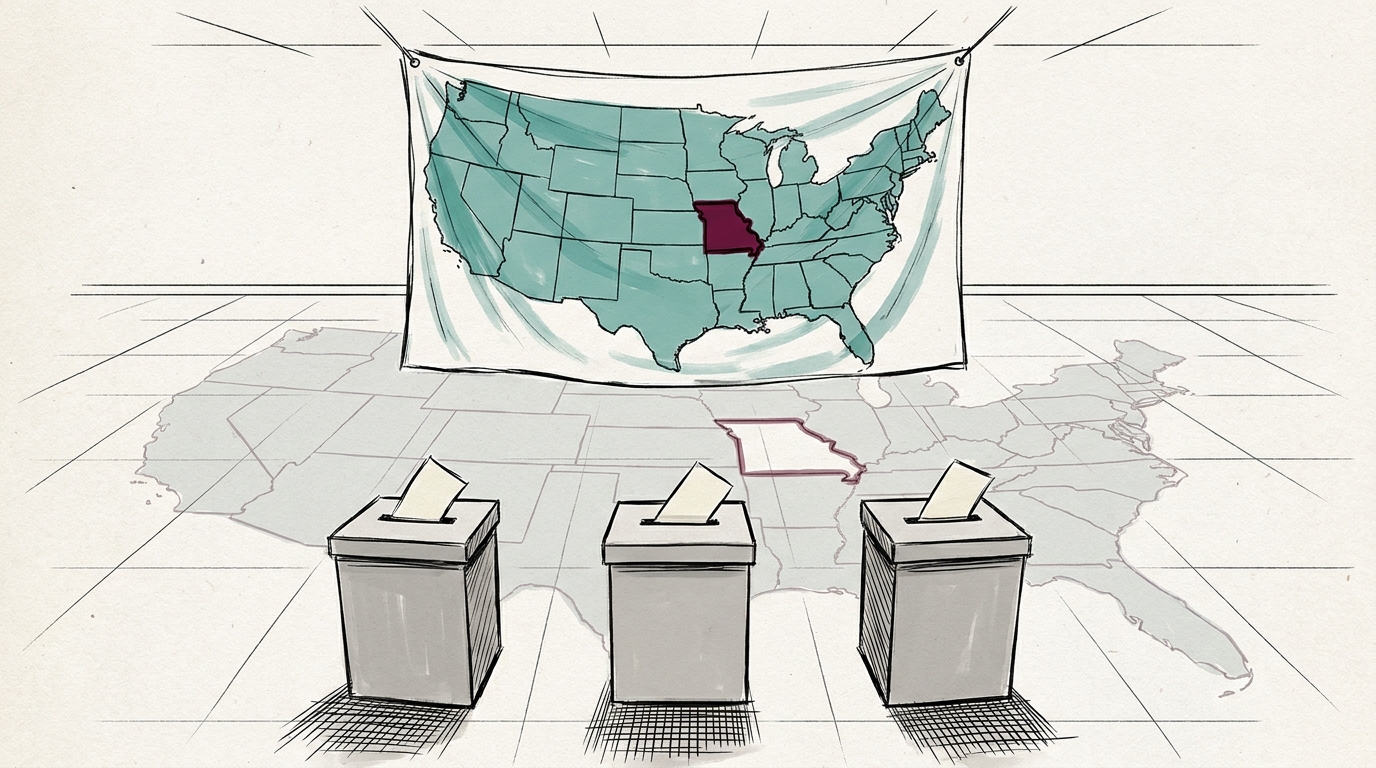
Supreme Court of Missouri
The unanimous court held that Article III, section 49 carries no redistricting exception, so a referendum petition against a congressional map is as valid as against any other law. It ordered the 2022 map to govern unless voters approve HB 1 on 3 November.
Denny Hoskins, Missouri Secretary of State
Hoskins told the Supreme Court that changing the congressional map after 1.2 million primary votes and ahead of the 19 September overseas-ballot deadline violates Purcell and the Elections Clause. He wants HB 1 reinstated before ballots print for November.
Senate Republican leadership
Floor time is finite at 51-47 with a bipartisan funding negotiation running, and a contested procedural fight over grant conditions is not the best use of it this month. Nothing has been abandoned; the resolution keeps its place on the calendar.
